
What Is the Agent-to-Agent Protocol (A2A)? A Guide to Multi-Agent Collaboration in Ecommerce
The Agent-to-Agent Protocol (A2A) is an open standard that lets independent AI agents discover each other, exchange messages, and collaborate securely across platforms.
Where MCP connects agents to tools, A2A connects agents to other agents. Announced in 2025 by Google and industry partners, A2A is designed to solve a basic problem: most agents are still trapped inside vendor silos, unable to coordinate workflows that span multiple systems, clouds, or organizations.
In the context of agentic commerce, A2A sits in the "coordination" layer, orchestrating how shopping agents, fulfillment agents, support agents, and analytics agents cooperate around a shopper or business workflow.
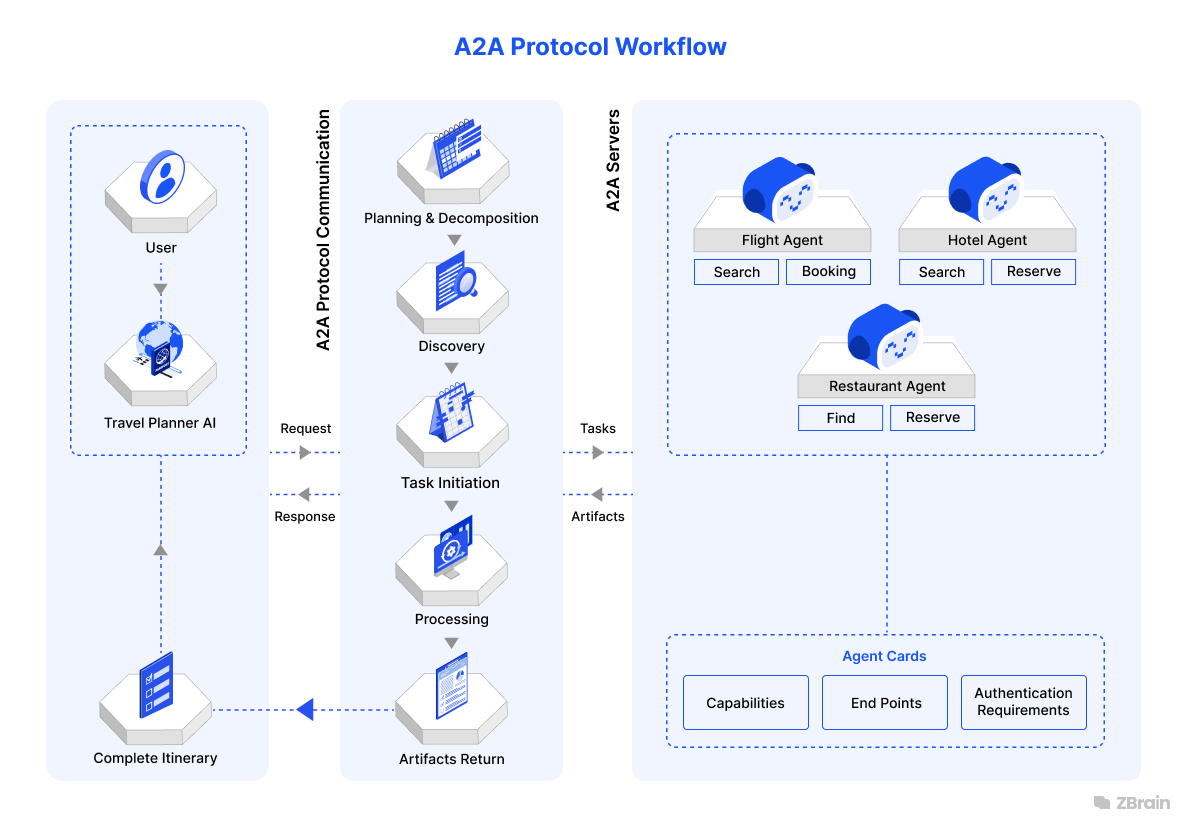
What Is the Agent-to-Agent (A2A) Protocol?
A2A is an open, vendor-neutral protocol for secure, structured communication between AI agents. It defines shared concepts—agent cards, tasks, messages, authentication—so agents built by different teams can still work together.
The protocol defines standard JSON-based message formats, HTTP(S)-based transport, and a three-role model: users who initiate tasks, client agents that act on behalf of users, and remote agents that perform specialized work. It also includes security primitives like authentication declarations and role-based access, aligning with zero-trust practices.
A2A emerged because ad hoc webhooks and proprietary APIs do not scale to a world where many autonomous agents from different vendors must coordinate without human micromanagement. By 2026, it is referenced in enterprise AI and agentic commerce roadmaps as a core interoperability layer.
How A2A Works (Simple Walkthrough)
Step-by-step example: Multi-agent returns workflow
Consider a retailer that uses different agents for customer chat, returns authorization, and warehouse coordination.
User asks: A shopper messages a chat agent: "I want to return the running shoes I bought last week; they’re too small."
Client agent creates a task: The chat agent becomes an A2A client agent and creates a "ReturnRequest" task.
Agent discovery: Via A2A agent discovery, it finds a "Returns Agent" whose agent card advertises capabilities for eligibility checks.
Task delegation: The chat agent sends a structured JSON task message over HTTPS to the Returns Agent.
Remote agent executes: The Returns Agent checks policy and decides whether to approve, exchange, or deny.
Status updates: Using A2A’s task primitives, the Returns Agent emits progress and completion messages back to the client agent.
Practical Use Cases (2026+)
Cross-vendor shopping journeys: A personal shopping agent can use A2A to delegate price comparison to a deals agent and inventory checks to retailer-specific agents.
Post-purchase orchestration: Customer-service agents coordinate with logistics and billing agents to handle returns and refunds without fragile point-to-point integrations.
Marketplace operations: Marketplaces use A2A so seller, buyer, and platform agents can exchange structured tasks about listings and disputes.
Enterprise workflows: Internal finance, procurement, and IT agents use A2A to coordinate approvals while respecting security boundaries.
How to Prepare for A2A Collaboration
From a technical standpoint, teams should start thinking in terms of smaller, specialized agents rather than one monolithic assistant. Each agent can then advertise its capabilities via an A2A agent card and accept defined task types.
Security and governance are critical: treat each agent like a microservice with clear scopes, authentication requirements, and audit logging. Define which decisions can be fully delegated versus which require human-in-the-loop approvals.
It is also useful to align A2A adoption with MCP, ACP, UCP, and AP2 efforts so that the same agents can both coordinate among themselves and connect to tools and payment rails using complementary protocols.
Frequently Asked Questions
What is the Agent-to-Agent Protocol (A2A)?
A2A is an open standard from Google and partners that lets AI agents discover each other, authenticate, and exchange structured tasks and messages securely.
How does A2A work?
Agents publish "agent cards" describing their capabilities, then use HTTP/JSON-based messages and task IDs to delegate work and share artifacts.
Is A2A widely adopted?
A2A is still emerging but has notable industry backing and is featured in enterprise reference architectures as of early 2026.
How does A2A affect e-commerce and retail?
A2A enables shopping, support, logistics, and payments agents from different vendors to collaborate on end-to-end customer journeys.
A2A vs MCP — what’s the difference?
MCP standardizes how agents connect to tools and data; A2A standardizes how agents talk to each other and coordinate tasks.