
The Protocol Revolution: How Agentic Commerce Is Reshaping Retail
For two decades, the internet assumed a human sits at the keyboard. That assumption is breaking down. Here's what brands and retailers need to know about the protocols enabling autonomous AI agent commerce.
The Setup: Where We Are and Why This Matters
Within the next few years, the majority of purchasing decisions in digital commerce won't be made by people. They'll be made by AI agents acting on people's behalf. This isn't speculation. Salesforce research shows that 48% of AI-using consumers are already open to letting an agent complete a purchase for them. McKinsey estimates that by 2030, agentic commerce could generate between $1 trillion and $5 trillion in global revenue.
But here's the critical part: for this shift to actually happen at scale, we need something we've never really had in commerce before. Not better algorithms. Not faster processors. We need protocols - open, standardized agreements about how AI agents talk to merchants, authorize payments, and complete transactions.
Why does this matter to executives and marketing teams? Because we're at the moment where early infrastructure choices determine who survives and who gets bypassed. This is the equivalent of 1994, when companies had to decide whether to build a web presence. Except this time, the decisions are more technical, the window is shorter, and the cost of waiting is higher.
The Four Protocols: A New Foundation for Commerce
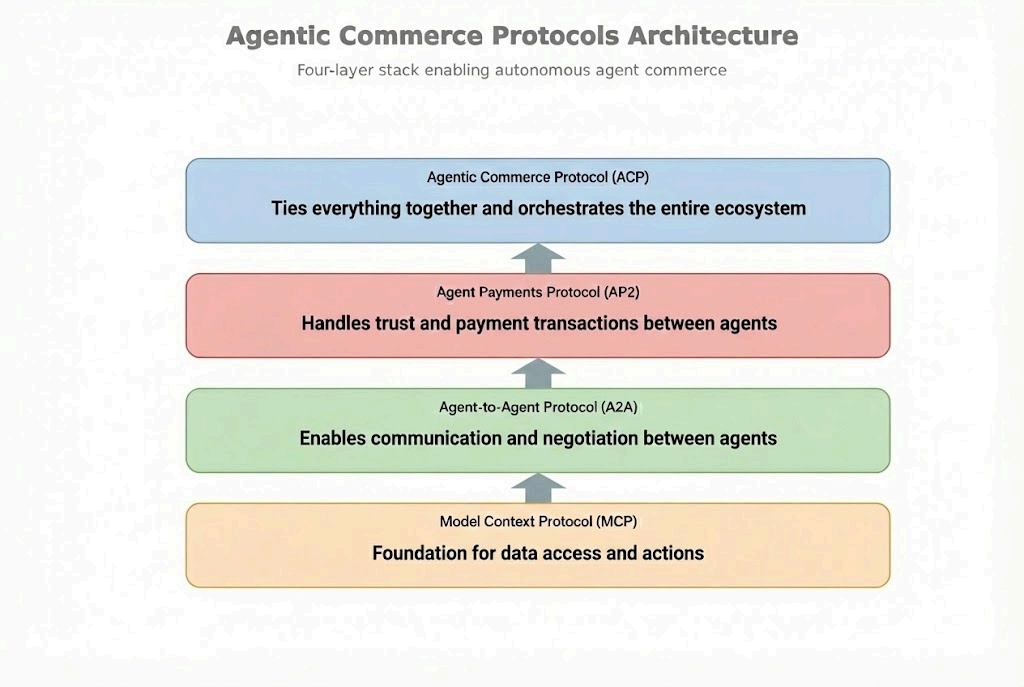
The four-layer protocol stack enabling autonomous agent commerce (Source: ZeroClickProject)
1. The Model Context Protocol (MCP): The Data Layer
Think of MCP as USB-C for AI. Released by Anthropic in late 2024, it's a standardized way for AI agents to connect to data sources and execute actions. Instead of building custom integrations for every combination of agent and merchant, MCP creates a single interface that works everywhere.
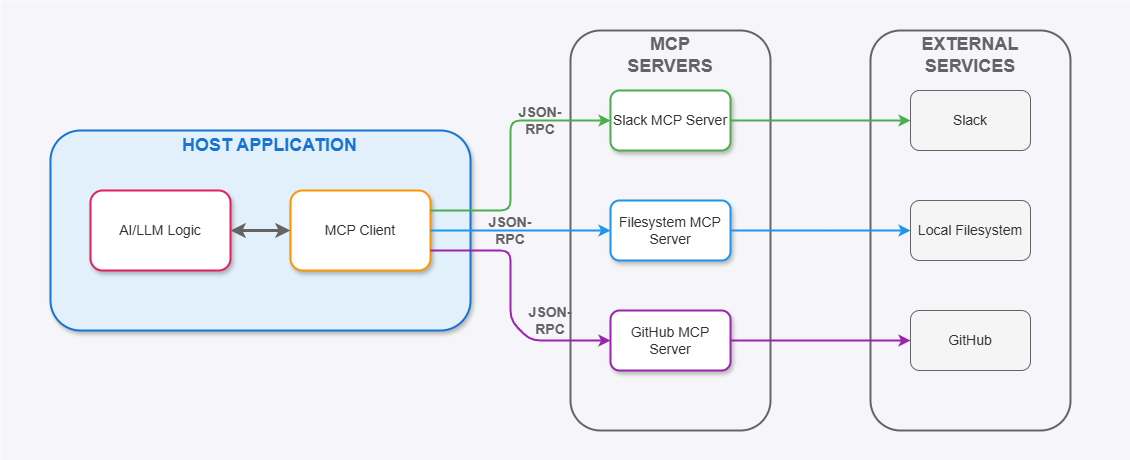
MCP architecture: AI applications connect to servers via JSON-RPC (Source: TheMLArchitect)
For retailers, this means structuring your product catalog, inventory, customer service tools, and checkout systems in ways that any compliant AI agent can understand and interact with. MCP isn't about selling - it's about being readable. If your data isn't MCP-ready, no agent can reliably recommend your products, answer customer questions, or manage returns. Shopify understood this early and has built MCP servers that let any AI agent query live product data, manage carts, and pull customer account information.
2. The Agent-to-Agent Protocol (A2A): The Communication Layer
Once your data is accessible, agents need to talk to each other. A2A defines the secure language for this conversation.
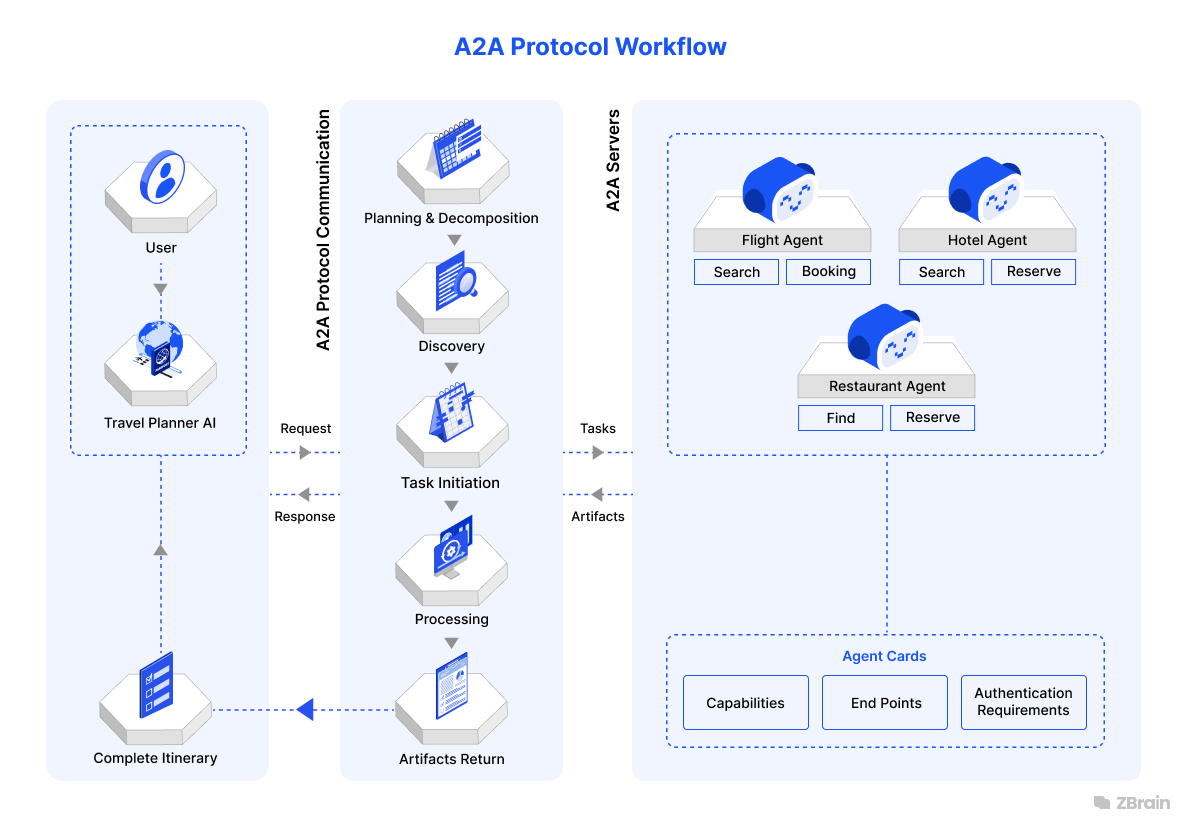
A2A protocol workflow: Agents discover, negotiate, and coordinate tasks (Source: ZBrain)
Picture this: A customer's personal AI agent is shopping for them. It needs to negotiate with a retailer's commerce agent about pricing, inventory, delivery options, and returns policy. Without a standard protocol, the retailer would have to build custom logic for every agent in existence. With A2A, they speak the same language. In the future, agents will bundle purchases across multiple retailers, negotiate volume discounts, and handle back-orders automatically - all at machine speed.
3. The Agent Payments Protocol (AP2): The Trust Layer
Here's where it gets genuinely innovative. Google's AP2 solves a problem that traditional payment infrastructure wasn't designed for: How do you authorize an agent to spend money on your behalf?
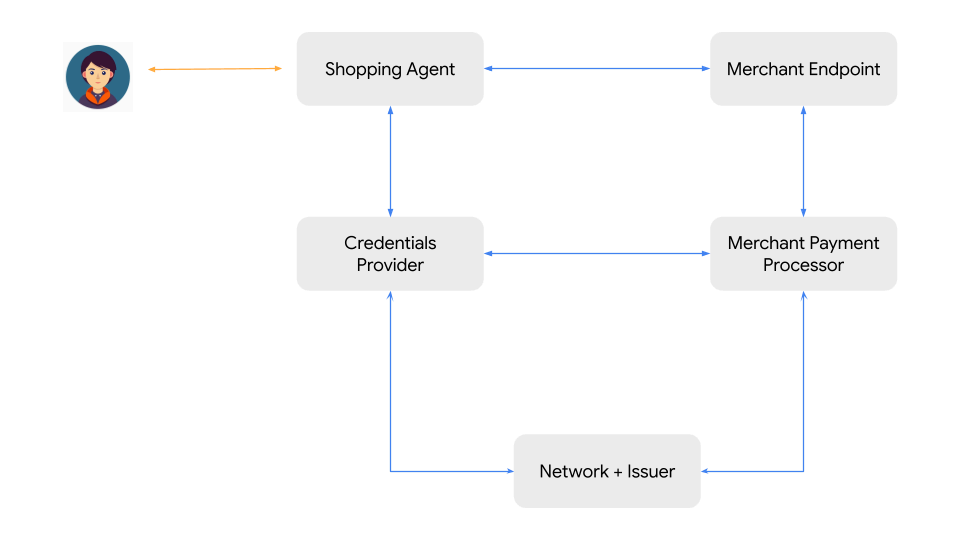
AP2 payment flow: Cryptographic authorization between agents and merchants (Source: AP2 specification)
AP2 introduces the concept of "mandates" - tamper-proof, digitally signed contracts that prove authorization:
Cart Mandate: Works like traditional checkout - you see what you're buying, you approve it, both you and the merchant sign.
Intent Mandate: More powerful - you tell your agent "I'm willing to spend up to $500 on winter gear within these constraints." Your agent then monitors the market and executes purchases when opportunities align.
For retailers, AP2 means fewer disputes - every transaction has cryptographic proof of authorization. For payment processors, fraud detection becomes certainty-based rather than probability-based.
4. The Agentic Commerce Protocol (ACP): The Orchestration Layer
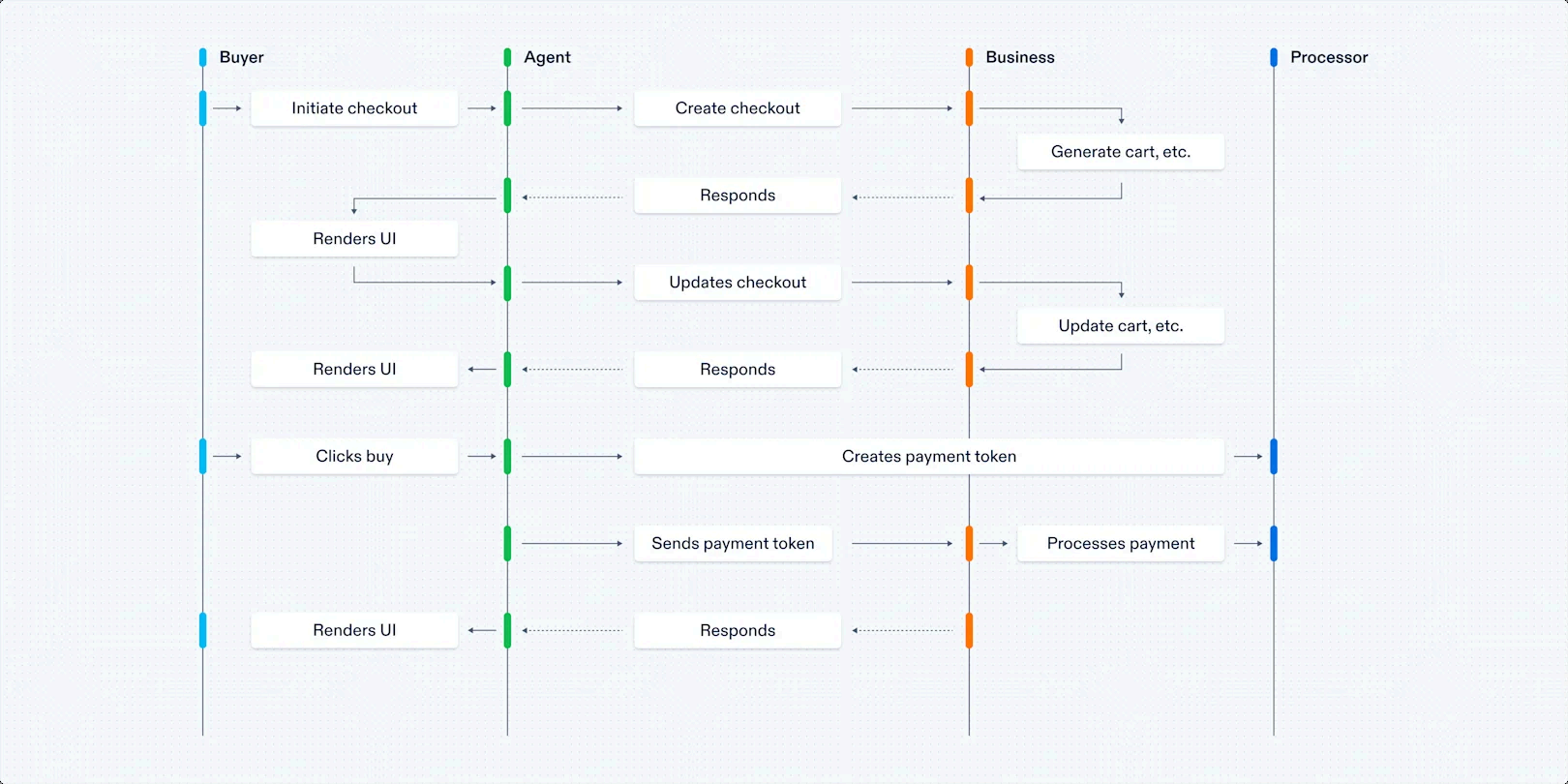
ACP transaction flow from initiation to payment processing (Source: Stripe)
ACP, co-developed by OpenAI and Stripe, sits above everything else. It defines how agents discover merchants, exchange structured product data, verify terms, and initiate purchases. Without ACP, every agent would need custom integration with every merchant. With it, any agent can find any merchant, understand their product catalog, assess their policies, and initiate checkout in a standardized way. This is the protocol that makes you discoverable in an agent-driven world.
How This Actually Works: A Practical Future Scenario
April 2027. Sarah runs a small business. She tells her agent: "Keep my team stocked with the supplies we actually use. Stay within our $800/month budget."
Her agent uses MCP to connect to:
Her accounting system (sees what they've purchased historically)
Her team's Slack (notices people asking "anyone have a USB-C cable?")
Her calendar (spots upcoming client presentations → need poster boards)
Her expense policy docs (understands approval limits and preferred vendors)
Every Monday, her agent analyzes usage patterns and projects needs. This week it detects: "You're low on sticky notes based on past consumption rates, you have a client pitch Thursday, and your team mentioned needing HDMI adapters twice."
Her agent uses ACP (structured communication standard) to broadcast an RFQ to merchant agents at Staples, Amazon Business, Office Depot, and Uline: "I need: 12 pads sticky notes, 3 HDMI adapters, 2 foam poster boards. Delivery by Wednesday. Prefer consolidated shipping. What's your bundled offer?"
The agents respond. Her agent uses A2A to negotiate directly with Amazon Business's agent:
"Can you beat Staples on the adapters?"
"Yes, if you commit to monthly office supply orders."
"Deal. Send Cart Mandate."
Amazon's agent generates a Cart Mandate (locks price, items, delivery). Sarah's agent countersigns with an Intent Mandate - basically: "I authorize up to $180 for this specific cart."
Payment settles via AP2: Sarah's agent transmits a single-use delegated payment token (not her actual card number) to Stripe. The token is restricted: "$180 max, Amazon Business only, expires in 24hrs."
Transaction completes. Supplies arrive Wednesday. Sarah never opened a browser, never compared prices, never entered payment info.
This scenario isn't hypothetical. Every protocol mentioned exists today. Some pieces are production-ready. Some are still rolling out. But the architecture is real, and versions of this flow are operational right now through ChatGPT, Shopify, Etsy, and Walmart.
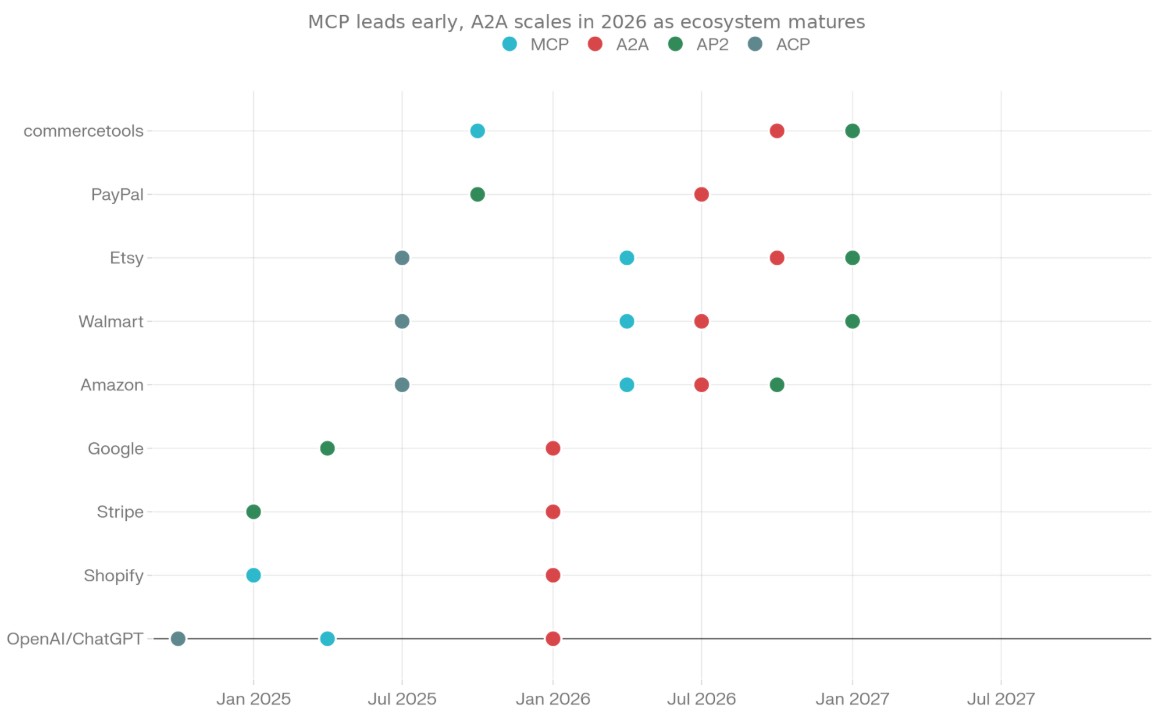
Protocol adoption acceleration across platforms 2024-2027 (Source: ZeroClickProject)
The Promise and the Pitfalls
The Promise
For brands done right, agentic commerce is existentially positive. You remove friction. A customer with a specific need finds your product immediately. Conversion rates rise. Customer acquisition becomes cheaper because agents do the legwork humans used to do. According to Shopify data, merchants using accelerated checkout see 12-18% higher conversion rates. Now imagine that acceleration applied across all agents.
The Pitfalls
Fragmentation: We have four major protocols plus emerging alternatives like Visa's Trusted Agent Protocol, Mastercard's Agent Pay, and blockchain-native standards. There's no guarantee these interoperate.
Control: Historically, merchants controlled the customer relationship. In agentic commerce, the agent stands between you and the customer. You see an order, not a person.
Power dynamics: Whoever controls the protocol controls the economics. If agentic commerce follows the same consolidation path as HTTP, merchants won't be in charge.
Data visibility: When agents do the shopping, merchants lose observability into customer intent. You get an order, but you don't get the thinking behind it.
Cryptocurrency pressure: Stablecoin payments settle in milliseconds; card networks take days. If agentic commerce scales, there will be pressure to move substantial transaction volume onto blockchain rails.
Three Possible Futures
Future One: Retailers Maintain Control (40% likelihood)
Walmart, Amazon, and Shopify syndicate their product feeds and advertising inventory into AI assistants. They expand ACP support and push their own agents as primary shopping channels. Merchants integrate with one or two dominant agent platforms, and that becomes sufficient.
Future Two: AI Platforms Build Independent Ad Networks (35% likelihood)
OpenAI, Google, and Perplexity realize they control discovery. They stop just syndicating retailer inventory and start building independent recommendation layers. Brands can bid directly into these platforms, bypassing retailers. It becomes Google and Facebook in 2008 again.
Future Three: A Hybrid Mess (25% likelihood)
Multiple protocols coexist. Some merchants implement ACP, some use AP2, some use blockchain rails. Merchant adoption is patchy. Large brands build proprietary agent experiences. Medium-sized brands integrate with one or two dominant platforms. Small brands get left behind.
What Brands Should Actually Focus On (Next 6-12 Months)
1. Audit Your Data Foundation
Your product feeds are probably a mess. Product titles are inconsistent. Descriptions are written for humans, not machines. Structured data is incomplete. A clean, machine-readable product feed is the table stakes for the agentic era. This takes time. Begin now.
2. Make a Protocol Bet
You can't support all protocols immediately. Pick which ones you'll integrate with first. ACP is the obvious choice because OpenAI and Shopify are pushing it hard. But don't ignore AP2 if you sell internationally.
3. Build Your Own Agent or Don't - But Decide Now
You need to decide whether you want your own branded agent as a shopping interface or whether you're delegating that to third-party platforms. Walmart decided to build an agent called "Sparky." Others are piggybacking on ChatGPT. Both are viable. But the infrastructure investments are different.
4. Get Serious About Conversion Rate Optimization
Instant Checkout on ChatGPT and similar agent-native experiences are seeing higher conversion rates. Start running small pilots with one or two AI platforms right now. Learn what works.
5. Rethink Loyalty
Your loyalty program is built around repeat humans. In an agentic era, agents will manage repeat purchases. You need loyalty mechanics that work when the customer isn't a person: subscription discounts, guaranteed pricing for multi-unit purchases, exclusive agent-only terms.
6. Plan for Reduced Direct Traffic
Your website traffic will decline as agents become primary shopping interfaces. Plan for it. Stop building your business around web traffic. Start building around transactions and customer outcomes. The psychological shift is as important as the technical one.
The Honest Assessment
Agentic commerce is real, it's coming, and it will be significant. But it's not happening as fast as the hype suggests. Right now, most shoppers still use websites and apps. That won't change overnight.
What will change is optionality. A customer with a specific need will increasingly ask an agent to handle it. A brand that's agent-ready captures that transaction. A brand that's not gets skipped.
The protocols matter because they determine who gets to be agent-ready without massive engineering work. ACP and AP2 are honest efforts to create open standards. They're not perfect. Protocol wars are still possible. But they're an improvement over the alternative.
The brands that thrive won't be the ones that guessed right about which future materialized. They'll be the ones that stayed flexible, kept their data clean, and made small bets on multiple pathways. The ones that will struggle are the ones that do nothing.