
How ChatGPT Shopping Is Changing Ecommerce Discovery: Traffic, Conversion, and Merchant Visibility Data
ChatGPT shopping is emerging as a measurable ecommerce discovery channel. Independent studies now show higher conversion rates, explosive traffic growth, and serious attribution gaps that most merchants are not yet accounting for.
Thesis: ChatGPT shopping matters less as a checkout replacement than as a pre-purchase discovery layer that compresses comparison behavior, raises conversion quality, and creates an attribution blind spot most analytics stacks cannot see. The data from multiple independent studies now makes this measurable, not speculative.
ChatGPT shopping research compresses the comparison journey into a conversational layer before the merchant site visit.
Methodology and data sources
This analysis synthesizes findings from three independent research efforts published between May 2025 and March 2026:
Visibility Labs (February 2026): 12-month GA4 analysis across 94 ecommerce stores, covering 9.46 million organic sessions and 135,000 ChatGPT sessions generating $474K in tracked revenue.
Adobe Digital Insights (May 2025): Analysis of trillions of retail data points and two consumer surveys of 5,000 US respondents each (September 2024 and February 2025), tracking AI referral traffic growth, engagement quality, and conversion trends.
The Digital Bloom (February 2026): Platform share and referral attribution analysis benchmarking generative AI traffic distribution across ChatGPT, Gemini, Perplexity, DeepSeek, and Grok, anchored to January 2026 data.
Where possible, we cross-reference findings across sources. Where data conflicts or carries caveats, we note the limitations explicitly.
Key findings
Finding 1: ChatGPT traffic converts 31% higher than non-branded organic search
Visibility Labs analyzed 94 ecommerce stores over 12 months and found that ChatGPT referral traffic converted at 1.81% compared to 1.39% for non-branded organic search — a 31% improvement. ChatGPT outperformed organic in 10 of 12 months measured.
The conversion advantage reflects a compressed buyer journey. By the time a shopper clicks through from ChatGPT, they have already compared options, narrowed preferences, and built confidence conversationally. They arrive with higher purchase intent than a typical search visitor still evaluating multiple results.
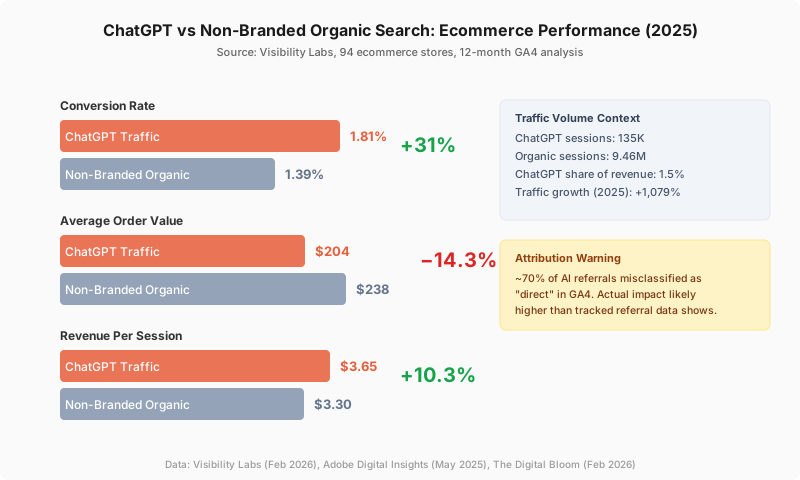
ChatGPT traffic converts 31% higher but carries 14.3% lower average order values — the net revenue per session advantage is 10.3%.
Finding 2: Average order value is 14.3% lower, but revenue per session is 10.3% higher
ChatGPT shoppers spent less per order ($204 vs $238 for organic), but the higher conversion rate more than compensated: revenue per session was $3.65 for ChatGPT versus $3.30 for organic search, a 10.3% net lift. The lower AOV may reflect ChatGPT's current strength in mid-market product categories rather than luxury or high-ticket items.
Finding 3: Traffic growth exceeded 1,000% in 2025, then decelerated
ChatGPT ecommerce referral traffic grew 1,079% over the 12-month period measured by Visibility Labs — from 1,544 sessions in January 2025 to 18,202 in December 2025. The inflection point was April 2025, when OpenAI launched shopping carousels inside ChatGPT.
Adobe Digital Insights reported an even more dramatic trajectory at the aggregate level: AI-driven traffic to retail websites jumped 12× between July 2024 and February 2025. By October 2025, Adobe measured a 1,200% year-over-year traffic increase with a 16% conversion lift compared to other traffic sources.
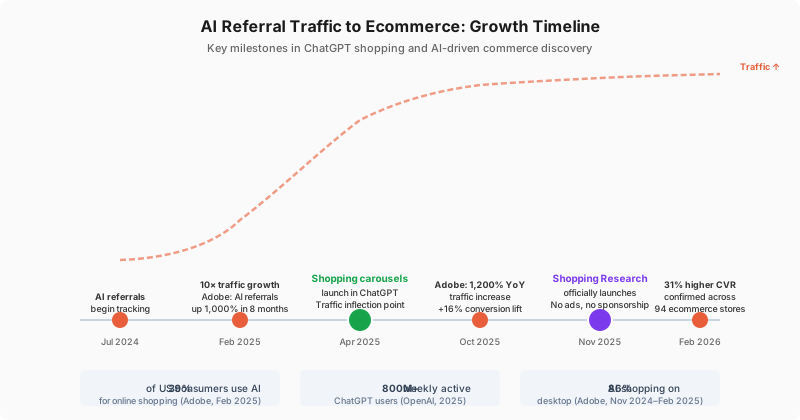
ChatGPT shopping evolved from informal product queries to a structured discovery layer in under 18 months.
Finding 4: The attribution gap is massive — 70% of AI referrals are invisible in GA4
The Digital Bloom's February 2026 analysis found that approximately 70.6% of AI referral traffic arriving on websites was misclassified as "direct" in Google Analytics 4 and never attributed to the AI channel that generated it. This means the conversion and traffic numbers reported above likely undercount ChatGPT's actual influence significantly.
The attribution problem has a behavioral component as well. Visibility Labs noted that many ChatGPT users do not click through directly. Instead, they search the recommended brand or product in Google, arrive via branded organic search, and the sale is attributed to search — not to the AI discovery session that created the intent.
Finding 5: AI shopping adoption is broad and accelerating
Adobe's February 2025 consumer survey found that 39% of US consumers were already using AI for online shopping. Millennials led adoption at 46%, with higher-income millennials (earning $70,000+) exceeding 50% engagement. Even Baby Boomers showed 63% growth in AI shopping adoption between September 2024 and February 2025.
Among active AI shoppers, 72% reported using AI as their primary tool for researching products and brands. The most common use cases were product recommendations (47%), deal finding (43%), gift ideation (35%), and shopping list generation (33%).
Metric | ChatGPT Traffic | Non-Branded Organic | Difference |
|---|---|---|---|
Conversion rate | 1.81% | 1.39% | +31% |
Average order value | $204 | $238 | −14.3% |
Revenue per session | $3.65 | $3.30 | +10.3% |
Share of organic revenue | 1.5% (rising to 2.2% in H2 2025) | — | |
Traffic growth (2025) | +1,079% YoY | — | |
How ChatGPT shopping works as a discovery layer
OpenAI launched shopping research as a formal feature in November 2025, building on the shopping carousels introduced in April 2025. The system is optimized for multi-constraint queries — questions that involve trade-offs, comparisons, or use-case matching rather than simple product lookups.
Three structural differences separate it from traditional search and marketplace discovery:
Discovery channel | What the shopper does | What the merchant gains or loses |
|---|---|---|
Classic search | Clicks through multiple results pages | More direct traffic, but more friction and lower intent per click |
Marketplace search | Browses inside a closed commercial shelf | High intent, but marketplace dependency and fee exposure |
ChatGPT shopping | States needs conversationally and receives synthesized, compared options | Fewer early clicks, but higher-intent visits and stronger conversion from merchants selected |
OpenAI has explicitly separated advertising from shopping research. Product recommendations are not paid placements. That matters strategically because it positions recommendation integrity as a product feature — even as commercial models may evolve later.
Merchant signals that appear to influence visibility
Cross-referencing merchant inclusion patterns with the conversion data, four signal groups appear to drive ChatGPT shopping visibility:
Structured product data: Clear titles, complete attributes, variant logic, pricing, and availability in machine-readable formats. Merchants with schema.org Product markup and clean GTINs appear more consistently.
Trust signals: Return policy clarity, shipping expectations, aggregate review depth, and merchant reputation. Adobe found that AI traffic to categories with strong trust infrastructure (electronics, jewelry) converted at higher rates than categories with weaker signals (apparel, grocery).
Authority and citation presence: Third-party mentions, expert reviews, and publisher coverage across the web. Similarweb's 2026 Brand Visibility Index found that brand size alone does not predict AI visibility — smaller merchants with strong citation footprints can overperform larger competitors.
Comparison readiness: Content structured around use cases, constraints, and direct trade-offs rather than marketing copy alone.
Discovery-to-checkout separation
One of the most operationally important findings is that ChatGPT influences discovery but does not control checkout. Merchants still own fulfillment, conversion, and post-purchase experience on their own properties. The new risk is not disintermediation at checkout — it is invisibility during evaluation.
This should reshape how teams measure AI impact. If ChatGPT moves shoppers into a narrower, higher-confidence intent state before they visit a merchant site, the visit may come later but convert faster. Teams tracking only direct referral attribution will miss most of that influence.
Competitive implications
For Google: ChatGPT shopping increases pressure on AI-driven shopping experiences (AI Mode, Shopping Graph) and on merchant data quality standards within Google Merchant Center.
For Amazon and marketplaces: ChatGPT creates an upstream comparison layer that can redirect demand before a shopper reaches a marketplace shelf. Marketplace-dependent brands face a new channel risk.
For Shopify and DTC merchants: The data reinforces the importance of machine-readable catalog quality, strong merchant policies, and direct citation-building. Shopify's integration with ChatGPT through product feeds gives its merchants an early structural advantage.
For analytics teams: The 70% attribution gap means most organizations are significantly undercounting AI-influenced revenue. Post-purchase surveys and multi-touch attribution models become essential, not optional.
What brands should monitor next
Prompt coverage: Which commercial queries include your brand, and in what position? Test systematically across product categories.
Attribution accuracy: Implement post-purchase surveys asking "how did you first discover this product?" to capture AI-influenced conversions that GA4 misattributes.
Traffic quality segmentation: Track AI-referred sessions separately for conversion rate, AOV, bounce rate, and pages per session. Compare against organic and paid baselines.
Category timing: Adobe data shows AI referrals convert best in research-intensive categories (electronics, jewelry) and underperform in low-consideration categories (grocery, basic apparel). Know where your category sits.
Competitive visibility: Monitor whether competitors appear in ChatGPT recommendations for your target queries. Similarweb's Brand Visibility Index suggests market share in AI recommendations does not mirror traditional search rankings.
Open questions
Several important dynamics remain unresolved and warrant ongoing monitoring:
Will ChatGPT introduce commercial models (sponsored recommendations, paid participation tiers) that change merchant inclusion patterns?
How will mobile AI shopping adoption change traffic quality as the channel shifts from 86% desktop toward mobile?
Will the attribution gap narrow as analytics platforms improve AI referral detection, or will it widen as AI agents increasingly trigger branded search rather than direct clicks?
How quickly will competing AI shopping surfaces (Google AI Mode, Perplexity shopping, Amazon Rufus) fragment the discovery layer?
Frequently Asked Questions
How much ecommerce revenue does ChatGPT actually drive?
In tracked referral data, ChatGPT generated approximately 1.5% of non-branded organic revenue across 94 ecommerce stores in 2025, rising to 2.2% in the second half. However, with roughly 70% of AI referrals misclassified in analytics, the actual influenced revenue is likely significantly higher.
Does ChatGPT shopping traffic convert better than Google organic search?
Yes. Visibility Labs found a 31% higher conversion rate (1.81% vs 1.39%) compared to non-branded organic search across 94 ecommerce stores over 12 months. The advantage reflects a compressed buyer journey where shoppers arrive with higher purchase intent.
Why is the average order value lower for ChatGPT traffic?
ChatGPT shoppers spent 14.3% less per order ($204 vs $238). This may reflect the channel's current strength in mid-market product research rather than luxury or high-ticket purchases. The lower AOV is more than offset by the higher conversion rate, resulting in 10.3% more revenue per session overall.
Are ChatGPT shopping recommendations influenced by advertising?
No. OpenAI has explicitly separated advertising from shopping research. Product recommendations are not paid placements. Recommendation integrity is positioned as a product feature, though commercial models may evolve as the platform scales.
What should merchants do first to improve ChatGPT shopping visibility?
Start with structured product data: clean titles, complete attributes, schema.org markup, and clear merchant policies. Then address trust signals — return clarity, shipping expectations, and review depth. These are the signal groups that appear to influence inclusion most consistently.
How do I track ChatGPT's actual impact if GA4 misattributes most of it?
Add a post-purchase survey question asking how the customer first discovered the product. This captures AI-influenced conversions that analytics tools attribute to branded search or direct visits. Also configure GA4 to properly identify AI referral domains in your channel groupings.
Which product categories benefit most from ChatGPT shopping?
Adobe's data shows AI referral traffic converts best in research-intensive categories like consumer electronics and jewelry, where comparison behavior is complex. Categories with simpler purchase decisions (grocery, basic apparel) show weaker AI conversion lifts.