
What Is the Agent Payments Protocol (AP2)? A Practical Guide for Ecommerce & Retail
The Agent Payments Protocol (AP2) is an open standard that defines how AI agents can make payments on behalf of users in a secure, auditable, and payment-agnostic way.
As shopping shifts from human "click to buy" to delegated, agent-driven transactions, the Agent Payments Protocol (AP2) aims to preserve trust. Led by Google and industry partners, AP2 introduces cryptographically signed "mandates" that capture user intent at each stage of a transaction.
For brands and retailers, AP2 matters because it offers a path to accept agent-initiated payments without rewriting checkout from scratch or taking on opaque new fraud risks.
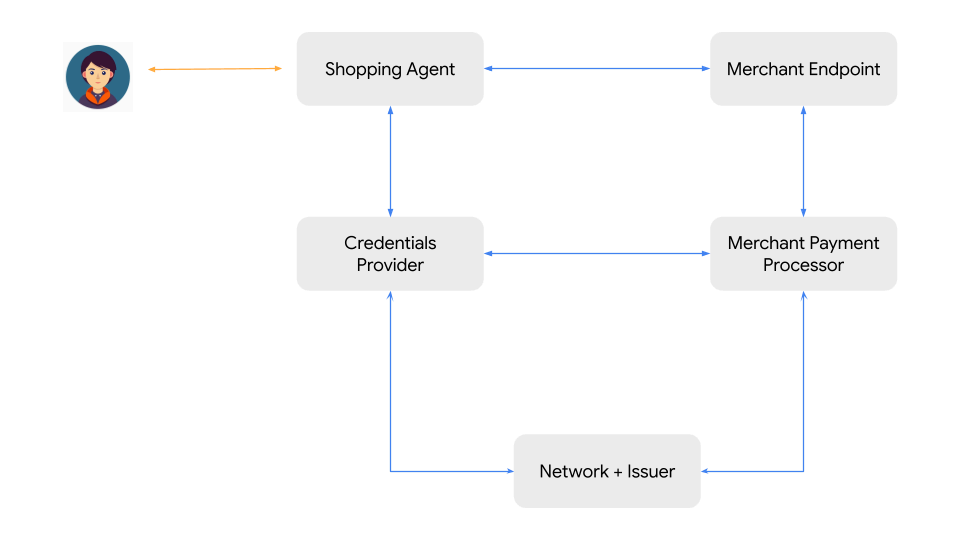
What Is the Agent Payments Protocol (AP2)?
AP2 is a specification that defines how autonomous AI agents can be authorized to make payments while preserving clear accountability. The protocol centers on three verifiable digital credentials (VDCs), often referred to as mandates:
Intent Mandate: Captures the user's high-level instructions and budget constraints.
Cart Mandate: Captures the exact items and price authorized by the user.
Payment Mandate: Shared with issuers and networks to signal that an agent is acting under a specific user-approved mandate.
Together, these constructs provide deterministic, non-repudiable proof of what the user authorized, under which conditions, and through which payment method. AP2 is designed to be payment-agnostic, working across cards, bank transfers, and even stablecoins.
How AP2 Works (Simple Walkthrough)
Step-by-step example: Agent booking a trip
User defines intent: A traveler tells an AI agent, "Book me a flight from New York to Mexico City under $400 next month."
Intent Mandate is created: The agent generates a signed digital credential specifying the budget and route constraints.
Agent shops: The agent uses commerce protocols (ACP/UCP) to search offers that meet the constraints.
User approves a cart: When the user selects an option, a Cart Mandate is created capturing exact details ("AA flight, $395").
Payment Mandate is sent: A Payment Mandate is shared with issuers, signaling agent action under a user-approved mandate.
Transaction is authorized: The issuer authorizes the transaction using normal risk models plus AP2 context.
Practical Use Cases (2026+)
Price-watch purchases: Shoppers authorize an agent to buy a product once it drops below a target price, with AP2 mandates constraining spend.
Hands-free travel booking: Agents can assemble flights and hotels within a defined budget and execute purchases under signed mandates.
Subscription management: Agents can safely adjust or cancel subscriptions with clear records of user intent and timing.
Merchant analytics on agent traffic: Payment providers expose analytics distinguishing agentic from non-agentic traffic to help merchants understand behavior shifts.
How to Prepare for Agentic Payments
Merchants do not need to implement AP2 directly in most cases; instead, they should work with payment providers, wallets, and processors that add AP2 support. Engineering teams should verify that their systems can store and reference mandate identifiers for disputes and analytics.
From a data and UX perspective, brands should clarify policies around agent-driven orders—refunds, chargebacks, and dispute handling. Marketing and product teams should also be ready to explain to customers how agentic payments work and what protections are in place.
Developers building agents should design flows that clearly separate "intent setting" from final approval, aligning their interfaces to AP2’s mandate model to ensure compatibility with compliant wallets.
Frequently Asked Questions
What is the Agent Payments Protocol (AP2)?
AP2 is an open standard that defines how AI agents can make verifiable, accountable payments on behalf of users using cryptographically signed mandates.
How does AP2 work?
AP2 uses Intent, Cart, and Payment Mandates—digital credentials that capture user instructions and authorization—to link agent actions to user-approved transactions.
Is AP2 widely adopted?
AP2 is still emerging but has backing from major tech and payments companies, with pilots and documentation available by early 2026.
How does AP2 affect e-commerce?
AP2 lets merchants accept agent-driven orders with clearer proof of consent and better dispute evidence, reducing the risk of fraud.
AP2 vs ACP — what’s the difference?
AP2 focuses on how agents pay (authorization, consent, accountability), while ACP focuses on how agents and merchants handle checkout sessions and orders.