
The AI Shopping Approval Ladder: What Consumers Will Delegate—and What They Still Want to Control
Consumers do not make one decision about whether to trust an AI shopper. They delegate one action at a time. Product teams should design a visible ladder from advice to transaction, with stronger evidence, narrower limits, and better recovery as the agent gains power.
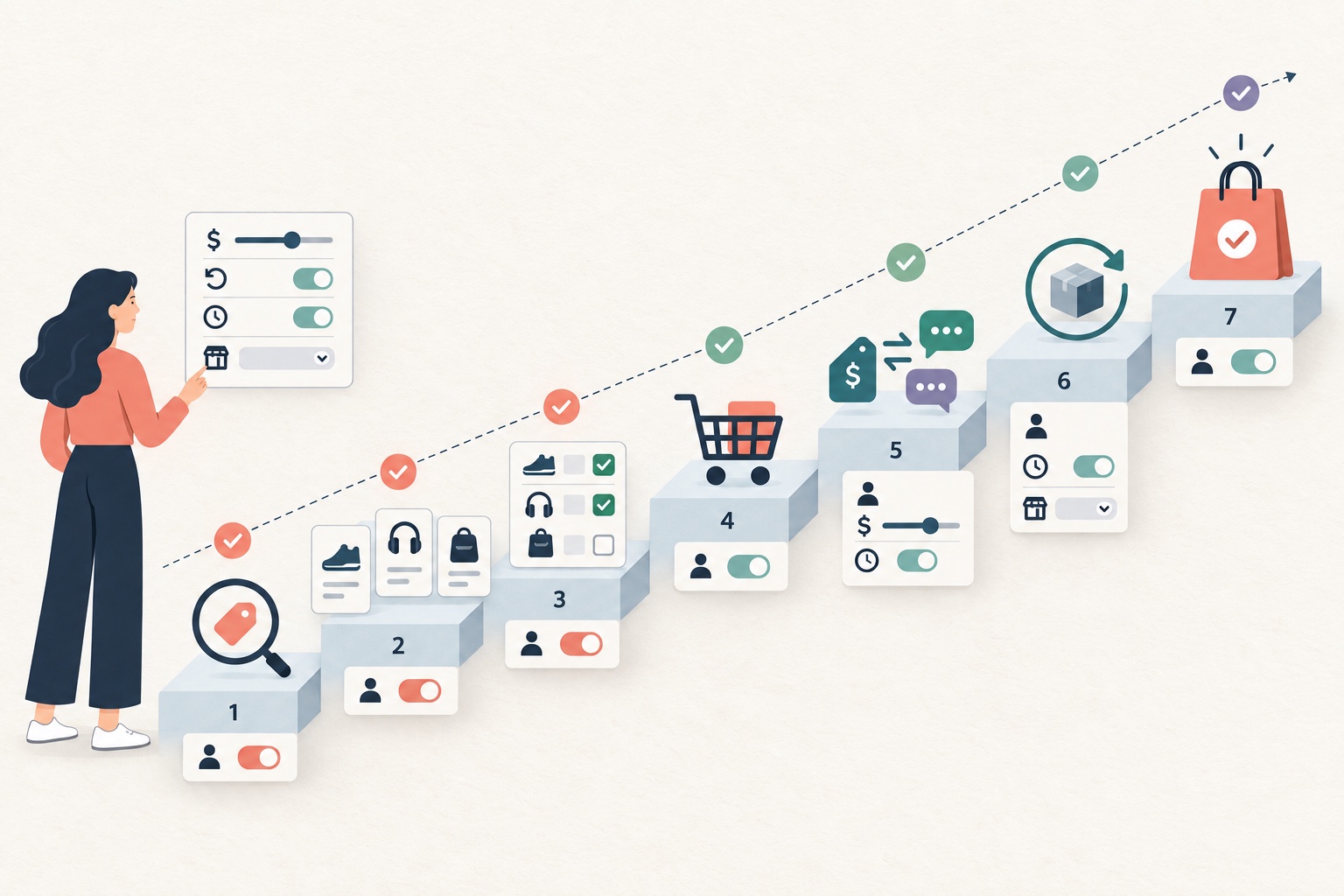
Short answer: Do not ask customers to choose between “assistant” and “autopilot.” Offer seven progressively more powerful capabilities—suggest, compare, shortlist, add to cart, negotiate, reorder, and purchase. At each step, match the approval requirement to financial exposure, reversibility, product risk, uncertainty, and novelty. Let customers move up or down the ladder by category and task.
The fully autonomous buyer is a poor starting point for product design.
It bundles several different acts into one frightening permission: deciding what the customer needs, choosing the product, selecting the seller, committing money, and managing the result. A customer who would happily let an agent compare laptops may refuse to let it select one. The same customer may allow automatic detergent replenishment but require explicit approval for a new skincare formula.
Consumer research reflects this gradient. Gartner reported that willingness to let AI narrow choices was materially higher than willingness to let it make purchase decisions. Visa's cross-market research found strong interest in convenience alongside high demand for transparency and control over data. The practical conclusion is not merely “keep a human in the loop.” It is to define which loop, at which moment, for which risk.
The five variables that should determine approval
| Variable | Low-risk example | High-risk example |
|---|---|---|
| Financial exposure | $12 household item | $1,800 laptop or recurring contract |
| Reversibility | Cancelable reservation | Final sale, custom item, perishable delivery |
| Product harm | Notebook | Health, child-safety, compatibility-critical product |
| Uncertainty | Exact SKU reorder | New category with conflicting specifications |
| Novelty | Known merchant and address | New seller, payment method, destination, or subscription |
Price alone is not enough. A low-cost allergen mistake can matter more than an expensive but fully refundable reservation. Calculate approval policy from the combination.
The seven-level approval ladder
Level 1: Suggest
Agent authority: surface ideas, categories, or products.
User control: no state change. The user can inspect sources and sponsorship.
Design requirement: show why each suggestion fits, disclose commercial influence, and distinguish known facts from inference. Do not personalize from sensitive data unless the customer knowingly enabled it.
Failure to avoid: a recommendation that feels neutral but is actually driven by payment or unavailable inventory.
Level 2: Compare
Agent authority: assemble products into a comparable structure and evaluate explicit criteria.
User control: choose or edit criteria, inspect evidence, and correct assumptions.
Design requirement: preserve missing values and uncertainty. Never convert “not disclosed” into a negative or positive fact. Let the shopper see which tradeoff caused the ranking.
Failure to avoid: a polished score that hides incomparable data or weights the agent invented.
Level 3: Shortlist
Agent authority: narrow the consideration set to a manageable number.
User control: approve constraints and restore excluded options.
Design requirement: summarize why each product survived, why major alternatives were excluded, and whether the shortlist is complete or sampled. A shortlist is a consequential act because products outside it may become effectively invisible.
Failure to avoid: silent exclusion based on a preference the shopper never made hard.
Level 4: Add to cart
Agent authority: create a cart or reservation without committing payment.
User control: review exact variant, seller, quantity, add-ons, delivery estimate, and return terms.
Design requirement: adding to cart must not imply approval to buy. Avoid preselected warranties, subscriptions, tips, and upgrades. Preserve a clean undo.
Failure to avoid: cart mutation that becomes harder to notice because the agent summarizes rather than shows line items.
Level 5: Negotiate
Agent authority: seek a better price, delivery date, bundle, or term within declared boundaries.
User control: define what may be traded and approve any change that affects product quality, privacy, recurrence, or cancellation.
Design requirement: express floors and ceilings: maximum total, minimum warranty, latest delivery, prohibited substitutions, and information the agent may disclose. Negotiation authority is not purchase authority.
Failure to avoid: saving money by accepting a worse seller, refurbished condition, longer commitment, or weaker return right.
Level 6: Reorder
Agent authority: repeat a known purchase under stable conditions.
User control: set product, variant, quantity, frequency, price ceiling, merchant scope, notification, pause, and stop rules.
Design requirement: compare the new order with the last approved order. Escalate formula, seller, pack-size, price, delivery, or subscription changes. Show cumulative spend.
Failure to avoid: treating a familiar product name as proof that the offer is materially unchanged.
Level 7: Purchase
Agent authority: commit funds and submit the order, either after transaction-specific approval or under a narrow standing mandate.
User control: see the authorization scope, final transaction, status, receipt, cancellation window, and a prominent stop control.
Design requirement: bind approval to merchant, seller, exact items, quantity, total, currency, delivery terms, and recurring status. A material change invalidates the approval.
Failure to avoid: a broad “shop for me” permission that becomes a reusable payment power.
The approval matrix
| Action | Default approval | May be pre-authorized when | Always escalate when |
|---|---|---|---|
| Suggest | None | Sources and sponsorship are visible | Sensitive data or regulated claim affects ranking |
| Compare | Confirm criteria | Criteria are saved and editable | Evidence conflicts or key facts are missing |
| Shortlist | Review exclusions | Low-stakes category and stable preferences | Safety, health, compatibility, or high value |
| Add to cart | Review cart | Exact SKU and no side effects | Seller, variant, add-on, or recurring term changes |
| Negotiate | Approve boundaries | Tradeable terms are explicit | Agent proposes a prohibited tradeoff |
| Reorder | Notice plus undo | Known item within price and frequency limits | Material offer or product change |
| Purchase | Transaction confirmation | Narrow valid mandate covers exact transaction | Any bound transaction field changes |
Approval is a product surface, not a legal checkbox
A weak confirmation asks, “Continue?” A strong confirmation answers:
- What exactly will happen?
- What will it cost now and later?
- Which seller and payment method are involved?
- Which assumptions did the agent make?
- What changed since the last review?
- Can the action be canceled or reversed?
- What future authority remains after approval?
Put material facts in the decision view, not behind a disclosure link. Use plain verbs—reserve, subscribe, renew, purchase—not generic terms such as continue or confirm.
Make standing mandates legible
A customer who delegates recurring authority needs a control center. Show every active mandate as a card with agent, purpose, categories or products, merchant scope, maximum amount, cumulative spend, frequency, expiry, last action, next possible action, and revoke button.
Use one-off, session, time-bound, and standing permissions as visibly different objects. Do not make revocation harder than delegation. Pausing should take effect before the next tool call, not after the next billing cycle.
Design for reversibility
Trust grows when mistakes are containable. Before increasing autonomy, ensure the system can cancel pending actions, stop repeated orders, identify what changed, contact the responsible merchant or provider, and preserve the evidence needed for a dispute.
Reversibility also determines interaction design. A hotel reservation with free cancellation until tomorrow may need less friction than a cheaper nonrefundable ticket. Show the deadline and let the agent remind the customer before the option disappears.
Explain without overwhelming
Every decision does not need a technical transcript. Use progressive disclosure:
- Decision summary: product, seller, total, delivery, recurrence.
- Why this choice: the two or three criteria that determined the result.
- What is uncertain: missing or conflicting evidence.
- Authority: which mandate or approval permits the action.
- Full evidence: sources, policy result, and audit details for those who need them.
The explanation should help the shopper catch the likely mistake. A generic paragraph about AI is not an explanation.
Measure ladder performance
| Metric | What it reveals |
|---|---|
| Approval completion by level | Where friction or distrust appears |
| Edit-before-approval rate | How often the agent's proposed action is wrong |
| Post-approval mutation rate | Whether the transaction remains bound |
| Cancellation and reversal rate | Whether the system creates buyer regret |
| Mandate revocation rate | Whether standing authority feels unsafe or unclear |
| Escalation precision | Whether high-risk cases receive review without interrupting everything |
| Unauthorized-action rate | The non-negotiable safety outcome |
| Customer comprehension | Whether people understand what they approved |
Do not optimize approval completion alone. Dark patterns can raise completion while destroying informed consent.
A 30-day implementation plan
Week 1: inventory every agent action and assign it to a ladder level. Identify hidden side effects such as account changes, coupon application, or subscription creation.
Week 2: score actions for exposure, reversibility, product harm, uncertainty, and novelty. Define default approval and mandatory escalation rules.
Week 3: design transaction summaries, saved-mandate controls, change detection, undo, and denial flows. Test comprehension with realistic carts.
Week 4: run adversarial cases: seller swap, price increase, recurring add-on, expired mandate, conflicting compatibility, and repeated use. Instrument edits, approvals, reversals, and unauthorized attempts.
Frequently asked questions
Should every purchase require a final confirmation?
Use final confirmation by default. It may be skipped only when a narrow, current mandate clearly covers the exact product or category, merchant, amount, frequency, and transaction conditions.
Can customers set different approval levels by category?
They should. A customer may allow automatic household replenishment while requiring comparison-only behavior for electronics and no recommendations based on health data.
What is the difference between reorder and purchase authority?
Reorder authority is constrained by a previously approved item and stable conditions. General purchase authority selects a new transaction and therefore requires broader reasoning and stronger controls.
How should the agent handle an unavailable approved product?
Follow the customer's substitution policy. If no policy exists, return to shortlist or approval. Similarity is not authorization, especially when formula, compatibility, seller, or recurring terms differ.
References & Further Reading
Continue Exploring
Verifiable Intent in Agentic Commerce
Define how agents prove bounded purchase authority to merchants and payment providers.
How to Red-Team an AI Shopping Assistant
Test approval, tool, privacy, and checkout boundaries before launch.
When an AI Shopping Agent Makes a Bad Purchase
Explore responsibility when automation exceeds intent or produces the wrong outcome.