
Conversational AI in Ecommerce: A Complete Guide to Implementation and Best Practices
A practical guide to understanding and implementing conversational AI in ecommerce, from basic chatbots to sophisticated shopping assistants that drive real business results.
The gap between browsing and buying has never been smaller, yet friction still exists at critical moments. A shopper finds the perfect product but hesitates about sizing. Another customer reaches checkout but gets confused about shipping options. These micro-moments of uncertainty can derail purchases that seemed certain.
Conversational AI in ecommerce addresses this friction by providing immediate, contextual assistance exactly when shoppers need it most. Rather than forcing customers to hunt through FAQ pages or wait for email responses, conversational interfaces deliver answers within the shopping flow itself.
As we move through 2026, conversational commerce has evolved from basic chatbots to sophisticated systems that understand context, maintain conversation history, and integrate deeply with ecommerce platforms. The technology now handles complex queries while knowing when to gracefully hand off to human agents.

Understanding Conversational AI in Modern Ecommerce
Conversational AI encompasses any system that can engage in natural language dialogue with customers. In ecommerce contexts, this typically means chat interfaces on websites, voice assistants for shopping, and messaging integrations across platforms like WhatsApp or Facebook Messenger.
The key difference between early chatbots and today's conversational AI lies in contextual understanding. Modern systems can track conversation history, understand implicit references ("that blue one" referring to a previously mentioned product), and maintain context across multiple interactions.
How Conversational AI Actually Works
Behind every smooth conversational experience are three core components working together:
Natural Language Processing (NLP): Interprets customer intent from their messages, handling variations in phrasing and context.
Knowledge Base Integration: Connects to product catalogs, inventory systems, order databases, and policy documents to provide accurate, real-time information.
Response Generation: Crafts appropriate replies that feel natural while maintaining brand voice and providing actionable next steps.
The most effective implementations also include confidence scoring - the system knows when it's uncertain and can escalate to human agents rather than providing potentially incorrect information.
Where Conversational AI Delivers Maximum Impact
Not every customer interaction benefits equally from conversational AI. The highest-impact applications focus on moments where immediate answers directly influence purchase decisions or customer satisfaction.
Product Discovery and Recommendations
Traditional search works well when customers know exactly what they want. Conversational AI excels when intent is fuzzy. A customer might say "I need something warm for my morning commute" rather than searching for "wool coat size medium." The AI can ask clarifying questions about style preferences, budget, and specific needs to narrow down options effectively.
This guided discovery often leads to higher-value purchases because the AI can surface products customers might not have found through traditional browsing or search.
Sizing and Compatibility Guidance
Sizing remains one of the biggest barriers to online apparel purchases. Conversational AI can gather information about fit preferences, previous purchases, and specific concerns to provide personalized sizing recommendations. For electronics and technical products, it can verify compatibility requirements and suggest necessary accessories.
Checkout and Payment Support
Cart abandonment often happens when customers encounter unexpected costs, confusing shipping options, or payment errors. Conversational AI can proactively address these concerns, explain shipping policies, help apply discount codes, and troubleshoot payment issues in real-time.
Post-Purchase Support
Order tracking, return initiation, and delivery questions represent high-volume, low-complexity support requests perfect for automation. Conversational AI can handle these efficiently while escalating more complex issues to human agents with full context.
Implementation Strategy for Merchants and Brands
Successful conversational AI implementation requires careful planning and phased rollouts. The most effective approaches start small, prove value, then expand systematically.
Phase 1: Foundation and Quick Wins
Begin with two high-impact use cases: order tracking and basic product questions. These scenarios have predictable patterns, clear success metrics, and immediate value for both customers and support teams.
Focus on creating comprehensive knowledge bases for these specific areas. Document common questions, edge cases, and appropriate escalation triggers. The goal is to handle 70-80% of inquiries in these categories without human intervention.
Phase 2: Enhanced Personalization
Once basic functionality proves reliable, integrate customer data to enable personalized interactions. This might include purchase history, browsing behavior, and preference data to provide more relevant product recommendations and support.
Phase 3: Advanced Capabilities
Advanced implementations can handle complex scenarios like product comparisons, detailed technical specifications, and multi-step problem resolution. These capabilities require more sophisticated NLP models and extensive testing.
Best Practices for Agencies and Implementation Partners
Agencies working with ecommerce clients should approach conversational AI as a strategic capability rather than a tactical add-on. Success requires understanding both the technology and the specific business context.
Design for Conversation, Not Just Automation
Effective conversational interfaces feel natural and helpful, not robotic. This requires careful attention to conversation flow, response timing, and graceful error handling. Design conversations that guide users toward successful outcomes while maintaining a helpful, brand-appropriate tone.
Integrate Deeply with Existing Systems
Conversational AI is most valuable when it can access real-time data from inventory systems, customer databases, and order management platforms. Surface-level integrations that only provide generic responses miss the opportunity to deliver truly helpful assistance.
Plan for Continuous Improvement
Unlike traditional website features, conversational AI improves through usage. Establish processes for reviewing conversation logs, identifying failure patterns, and updating responses. Plan for regular optimization cycles rather than one-time implementations.
Measuring Success and ROI
Effective measurement goes beyond basic engagement metrics to focus on business outcomes and customer satisfaction.
Resolution Rate: Percentage of conversations that end with successful outcomes without human escalation.
Conversion Impact: Compare conversion rates for sessions with and without conversational AI assistance.
Support Deflection: Reduction in support tickets for categories handled by the AI system.
Customer Satisfaction: Direct feedback on AI interactions and overall experience improvement.
Looking Ahead: The Future of Conversational Commerce
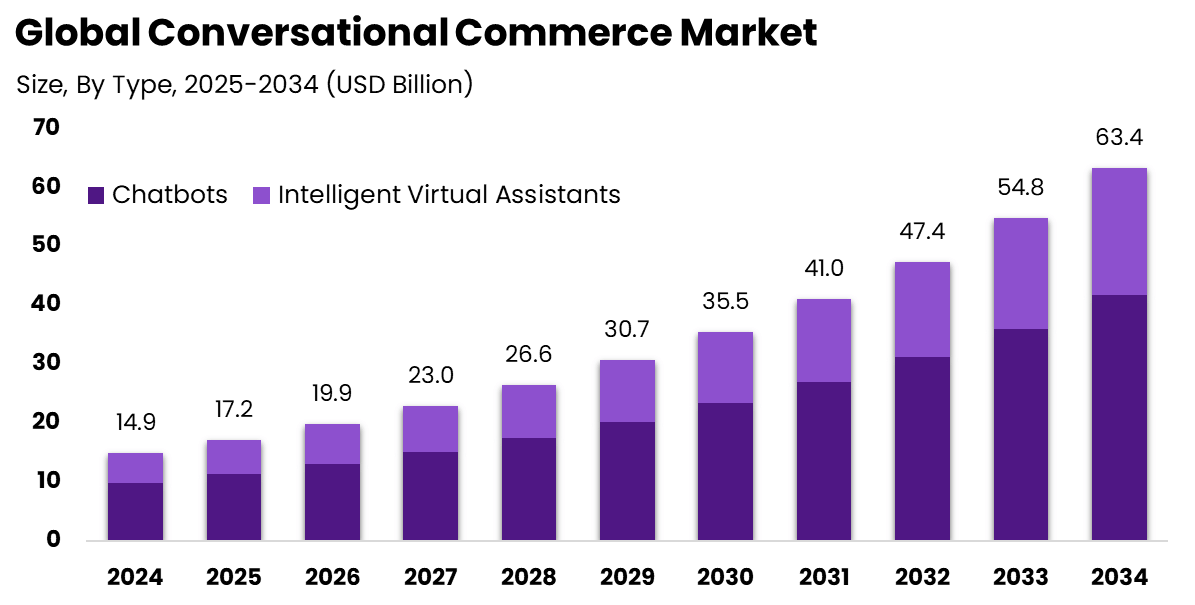
The forecasted conversational market size 2025-2034 (by market.us)
As we progress through 2026, conversational AI is evolving toward more proactive and predictive interactions. Rather than waiting for customers to ask questions, advanced systems can anticipate needs based on browsing behavior and proactively offer assistance.
Voice commerce integration is becoming more sophisticated, with AI assistants capable of handling complex multi-step purchases through voice commands. Visual search capabilities are also being integrated, allowing customers to upload images and receive conversational guidance about similar or complementary products.
The most significant trend is the shift toward AI agents that can complete transactions autonomously with customer permission - moving beyond assistance toward actual purchasing decisions based on established preferences and budgets.
Frequently Asked Questions
How long does it typically take to implement conversational AI?
Basic implementations can launch in 4-6 weeks, while comprehensive systems with deep integrations typically require 3-4 months. The key is starting with limited scope and expanding gradually.
What's the typical ROI for ecommerce conversational AI?
Most implementations see 15-25% reduction in support costs and 8-12% improvement in conversion rates for assisted sessions. ROI typically becomes positive within 6-9 months.
How do you prevent AI from providing incorrect information?
Implement confidence thresholds, restrict responses to verified knowledge bases, and design clear escalation paths. Regular monitoring and updating of responses is essential.
Should conversational AI replace human customer service?
No. The most effective approach uses AI to handle routine inquiries while escalating complex issues to human agents with full context. This improves efficiency for both customers and support teams.
What platforms work best for conversational AI in ecommerce?
Success depends more on integration quality than platform choice. Focus on solutions that connect deeply with your existing ecommerce platform, inventory systems, and customer data.
How do you maintain brand voice in AI conversations?
Develop detailed conversation guidelines, train the system on brand-appropriate responses, and regularly review interactions to ensure consistency. Consider working with copywriters familiar with conversational interfaces.