
What Is the Model Context Protocol (MCP)? A Practical Guide for Brands and Marketers
The Model Context Protocol (MCP) is an open standard that gives AI agents and large language models a consistent way to connect to external tools, data sources, and applications.
Instead of building one-off integrations for every model and every system, MCP lets you plug your commerce stack into an ecosystem of AI assistants using a shared protocol. Created by Anthropic and open-sourced in late 2024, MCP has quickly become a foundational building block for agentic commerce and AI-native workflows.
For marketers, brands, and developers, MCP is less about another integration format and more about treating your data and APIs as a shared context layer that any compliant AI agent can safely consume. This makes it easier to power AI shopping assistants, customer service agents, and internal copilots with your real commerce data.
What Is the Model Context Protocol (MCP)?
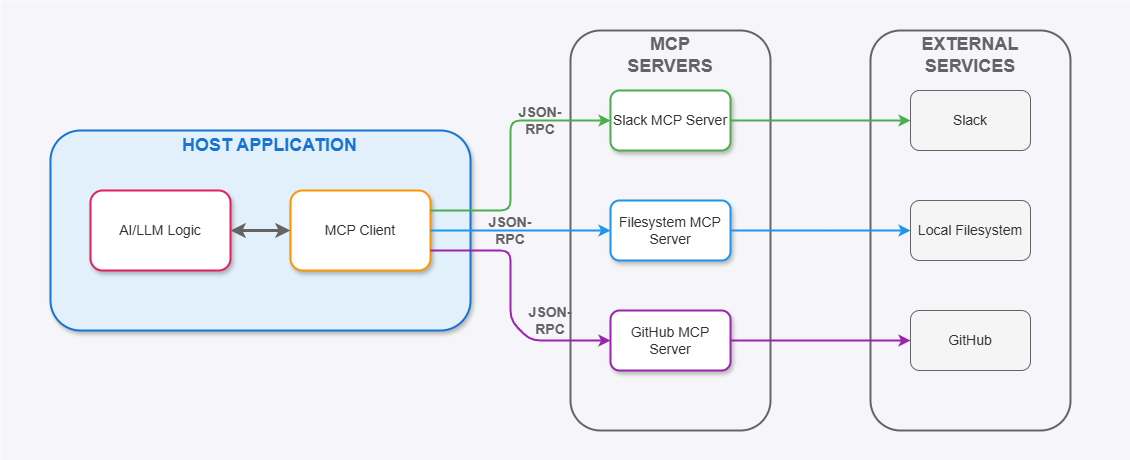
MCP is an open, vendor-neutral protocol for connecting AI applications (clients) to external systems via standardized "servers" that expose tools, resources, and prompts. Anthropic introduced MCP to solve the "N×M" integration problem, where every model–system pairing required a separate bespoke connector.
In MCP’s architecture, a host application (like Claude Desktop, an IDE, or a custom commerce agent) embeds an MCP client that discovers and connects to one or more MCP servers. Each server wraps a specific system—such as a product catalog, order management system, CRM, or analytics tool—and exposes a predictable interface for the agent to call.
The protocol emerged because AI agents need current, permissioned context to be useful, but enterprises were stuck with fragmented APIs and brittle plug-ins. MCP standardizes how that context is described, requested, and passed back, forming the "systems integration" layer in many agentic reference stacks.
How MCP Works (Simple Walkthrough)
Step-by-step example: AI shopping assistant using MCP
Imagine a brand’s AI shopping assistant running inside a chat experience that uses MCP to talk to back-end systems.
- User asks: A shopper types, "Find me neutral running shoes under $150 that ship to Boston this week."
- Agent analyzes request: The AI assistant parses intent including product preferences, budget, location, and delivery window.
- MCP client discovers servers: The host app's MCP client has registered servers for "Product Catalog," "Inventory & Shipping," and "Orders."
- Agent calls tools via MCP: The agent invokes a catalog search tool on the Product Catalog server and a delivery estimate tool on the Inventory & Shipping server using standardized MCP requests.
- Servers execute and return results: Each server queries underlying systems and returns structured product and logistics data back through MCP.
- Agent responds: The AI ranks options, explains trade-offs, and presents 3–5 choices that meet the criteria.
Under the hood, this flow uses MCP’s client–server model, capability discovery, and standardized message formats to ensure reliability and safety.
Practical Use Cases for Brands
- AI shopping assistants with live catalog access: Brands expose product, pricing, and availability data via MCP servers so agents can answer nuanced shopping queries with current information.
- Customer service copilots: Retailers wrap order history, returns policies, and shipping APIs as MCP tools so agents can resolve queries like "where is my order?" without fragile custom integrations.
- Developer productivity in commerce teams: Commerce engineering teams use MCP-connected IDEs to let AI agents read code, query logs, and inspect database schemas through standardized servers.
- Data unification across marketplaces: Agencies build MCP servers that normalize feeds from multiple marketplaces, giving agents a single interface for cross-channel analysis.
How to Prepare for MCP Adoption
On the technical side, teams should start by inventorying the systems that matter for agentic commerce—PIM, OMS, CRM, CMS—and mapping which ones could be exposed via MCP servers. Prioritize read-heavy use cases before write-heavy actions where governance is more complex.
Data readiness matters: MCP will surface whatever quality your underlying product content, attributes, and policies have. Clean, structured product data and clear business rules will make AI behavior more predictable and easier to monitor.
Organizationally, treat MCP endpoints as long-lived APIs rather than bespoke plug-ins for a single bot. Set up versioning, access control, and logging, and align marketing, product, and engineering teams on what agents are allowed to do with each tool.
Frequently Asked Questions
What is the Model Context Protocol (MCP)?
MCP is an open standard from Anthropic that lets AI applications connect to external tools and data sources through standardized servers and clients.
How does MCP work in practice?
An MCP client embedded in a host app connects to one or more MCP servers, discovers their capabilities, and sends structured requests so agents can invoke tools or fetch resources.
Is MCP widely adopted?
By early 2026, MCP is used in Anthropic products and has reference implementations and early adopters across dev tools and enterprise environments, with growing ecosystem support.
How does MCP affect e-commerce and retail?
MCP makes it easier to expose product catalogs, order data, and customer information to AI shopping assistants and service agents in a secure, structured way.
How is MCP different from A2A or AP2?
MCP focuses on agent-to-tool and agent-to-data integration, while A2A standardizes communication between agents and AP2 standardizes how agents perform payments.