
7 Practical Site Changes Retailers Should Make for AI-Powered Buying
Seven practical changes retailers can make now to improve catalog clarity, trust, and checkout readiness for AI-powered buying journeys.
AI-powered buying is turning site readiness into a board-level retail question. Consumers are increasingly starting product research in conversational interfaces, and the platforms enabling that behavior are moving closer to commerce execution. For retailers, the practical takeaway is simple: if your catalog, offers, and checkout flow are difficult for a machine to interpret, your store becomes harder to recommend and harder to convert.
You do not need to assume that every shopper will hand purchases to an autonomous agent this quarter. You do need to assume that more shoppers will arrive with AI-shaped expectations: better comparisons, clearer answers, and faster handoffs from recommendation to checkout.
This guide turns that shift into seven site changes and adds the quantitative evidence behind them, so the work is easier to prioritize with merchandising, product, growth, and executive teams.
Definition
AI-powered buying refers to shopping journeys where AI systems help evaluate options, answer buying questions, shortlist products, or move the shopper closer to checkout with minimal additional browsing.
The Hard Data: Why Retailers Should Treat This as an Operating Priority
The strongest argument for AI buying readiness is not hype. It is the combination of traffic growth, changing session quality, and persistent content gaps across retail catalogs.
| Metric | Latest public benchmark | What it suggests |
|---|---|---|
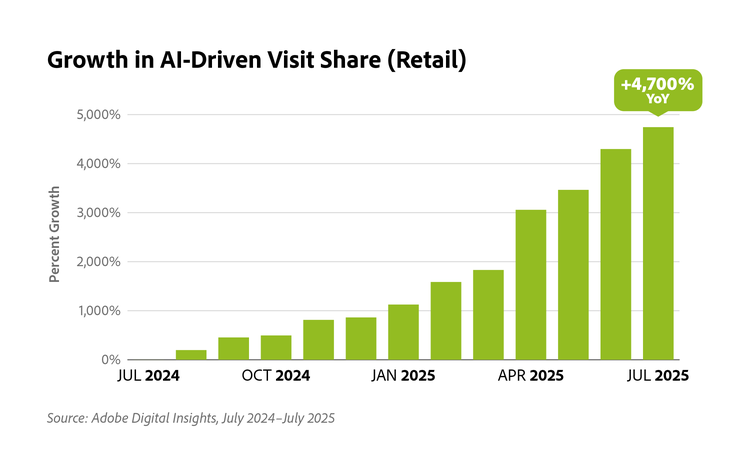
| AI traffic growth to U.S. retail sites | Adobe reported 1,200% growth from Jul. 2024 to Feb. 2025 and 4,700% year-over-year growth by Jul. 2025 | AI referral volume is still developing, but it is compounding fast enough to matter now. |
| Retail engagement from AI traffic | Adobe found AI visitors spent 8% longer and viewed 12% more pages in early 2025 | AI-originating sessions are often high-consideration and research-heavy. |
| Conversion quality | Similarweb reported 7% conversion for ChatGPT referrals to transactional sites versus 5% for Google referrals | Some AI-driven traffic is arriving with stronger purchase intent than standard search traffic. |
| Catalog trust gaps | Salsify found 54% of shoppers abandoned because of inconsistent product information, 53% because titles or descriptions were unclear, and 48% because reviews were missing or weak | Many retail catalogs are still not recommendation-ready even for human shoppers, let alone AI systems. |
| Product content friction | Syndigo found 66% of consumers abandoned purchases due to missing or incorrect product content | Content completeness remains a direct conversion issue. |
1. Standardize Product Data Across the Catalog
AI systems fail first on inconsistency. The same product family may use one naming pattern on the PDP, another in the feed, and a third in internal taxonomy. That is enough to weaken comparison quality and recommendation confidence.
Create required attribute sets by category and make them non-optional for revenue-driving SKUs. Apparel needs size, fit, material, care, and model details. Home goods need dimensions, capacity, finish, compatibility, and assembly notes. Electronics need ports, standards, battery life, and included accessories. Recommendation systems need the same completeness that disciplined merchants need for clean category pages.
2. Keep Price, Availability, and Delivery Signals Fresh
Many AI shopping flows depend on whether a system trusts the merchant's offer state. If the product page shows one price, the feed shows another, and structured data shows something else, the result is not just poor SEO hygiene. It is lower recommendation confidence.
Retailers should align product pages, structured markup, feeds, and promotional logic so a product can be quoted accurately in an answer interface. Delivery windows, pickup availability, and stock messages should also be visible before the cart step. Shoppers increasingly expect those details early, and AI interfaces need them to decide whether an offer is viable.
3. Make Product Pages More Machine-Readable
A visually polished storefront can still be hard for machines to interpret. Review your client-side rendering, canonicals, structured markup, and robots rules. Important product details should be available in clean HTML output, not only inside interactive modules or delayed JavaScript states.
Google's product and merchant listing guidance, along with OpenAI's merchant discovery guidance, point in the same direction: crawlable pages and dependable structured information remain foundational. Retail teams should treat schema validation and feed reliability the same way they treat broken pricing or dead PDP links.
4. Surface Policy Information Where Buying Decisions Happen
Returns, shipping thresholds, delivery promises, warranty terms, and subscription rules are often trapped in support centers or legal pages. But those are exactly the details AI assistants need when shoppers ask practical questions like which retailer has easier returns or which item can arrive before a trip.
Bring policy summaries closer to the PDP. A short returns box, delivery module, or fulfillment summary improves both human confidence and machine extractability.
5. Add Better Comparison and Use-Case Content
Retailers that rely only on filters and basic specs force shoppers to do too much interpretive work. AI buying interfaces reward merchants that already publish comparison logic, fit guidance, buying guides, ingredient summaries, and compatibility notes.
This matters because many prompts are not product-name prompts. They are need-state prompts: best carry-on for strict airline limits, best office chair for a small apartment, best moisturizer for winter with fragrance sensitivity. Rich buying context helps a retailer qualify for those prompts.
| Catalog readiness signal | Why AI systems care | Retail fix |
|---|---|---|
| Incomplete attributes | Hard to compare similar products | Set mandatory fields by category and publish them consistently. |
| Weak review proof | Low confidence in recommendation quality | Improve review collection and show rating volume clearly. |
| Missing use-case language | Hard to answer shopper-intent prompts | Add short sections for fit, scenario, audience, and tradeoffs. |
| Hidden policy details | Hard to determine merchant trustworthiness | Move returns, shipping, and warranty details closer to the PDP. |
6. Reduce Checkout Friction for High-Intent Sessions
AI-originating traffic often arrives later in the decision process. That is why post-click friction matters so much. Similarweb's 2026 benchmark found stronger conversion behavior from ChatGPT referrals to transactional sites than from Google referrals. If those visitors hit forced account creation, weak mobile checkout, or hidden cost surprises, the site wastes the intent compression that AI just created.
Support major wallets, keep guest checkout available, surface shipping costs earlier, and simplify variant selection. This is one reason Amazon's Buy for Me test and PayPal's agentic commerce partnership work are worth watching. They reflect a broader market expectation that recommendation and checkout will sit closer together.

7. Run AI Buying Readiness as a Cross-Functional Program
This work crosses too many operational boundaries to live with one team. Merchandising owns attribute quality. SEO or growth often owns structured data and feed health. Engineering owns page output, speed, and checkout reliability. Customer experience owns policy clarity. CRM and lifecycle teams understand repeat purchase behavior.
Create a monthly scorecard for the categories that matter most. Track attribute completeness, feed error rate, structured data validity, review coverage, policy visibility, wallet adoption, and mobile checkout completion. That gives the organization a way to treat AI buying readiness as an operating system issue, not a one-off experiment.
Suggested First 30 Days
- Audit the top 50 SKUs by revenue for missing attributes, policy visibility, and weak review proof.
- Validate structured markup and merchant-feed alignment for those SKUs.
- Rewrite three high-value category pages around real comparison questions customers ask.
- Remove one avoidable checkout step on mobile or add a major wallet if it is missing.
Future Implications
Retailers should expect AI to influence a larger share of product discovery during the next 12 to 24 months, especially in categories that already depend on comparison, replenishment, or time-sensitive delivery. The brands and retailers that benefit most will not necessarily be the ones that launch the most visible AI feature. They will be the ones that make their site easier to understand, easier to trust, and easier to transact through.
That is why this trend matters. Better catalog readiness, stronger policy clarity, and lower checkout friction improve standard ecommerce performance today while also preparing the retailer for AI-mediated buying tomorrow.
Frequently Asked Questions
What is the single most important fix for AI-powered buying readiness?
For most retailers, the highest-leverage fix is improving product data consistency and aligning that data across PDPs, structured markup, and merchant feeds. Without that foundation, AI systems cannot compare your offers or present them confidently.
Do retailers need autonomous checkout support right now?
Most teams should focus first on recommendation readiness and a cleaner human checkout flow. Those improvements create immediate value and make deeper agent-assisted transaction support easier when it becomes commercially relevant.
How should retailers measure progress?
Track structured data validity, feed accuracy, attribute completeness, review coverage, policy visibility, mobile checkout completion, and wallet adoption in high-value categories. Those metrics reflect both current ecommerce quality and future AI readiness.
What makes this more than a niche innovation trend?
The combination of rapid AI referral growth, stronger engagement in AI-driven sessions, and persistent catalog-quality problems makes this operationally important today. Even modest AI traffic gains become meaningful when the traffic arrives with stronger purchase intent.