
What Is the Universal Commerce Protocol (UCP)? An Open Standard for Agentic Shopping
The Universal Commerce Protocol (UCP) is an open standard co-developed by Google and Shopify to let AI agents and businesses coordinate the entire shopping journey across platforms.
Announced in early 2026, UCP provides a "common language" for agents, merchants, and payment providers. Unlike protocols focused on single ecosystems, UCP is explicitly cross-platform and compatible with A2A, MCP, and AP2.
For brands and retailers, UCP is a signal that agentic commerce is moving beyond single-vendor experiments toward industry-wide standardization, ensuring merchants can participate without losing control of the customer relationship.
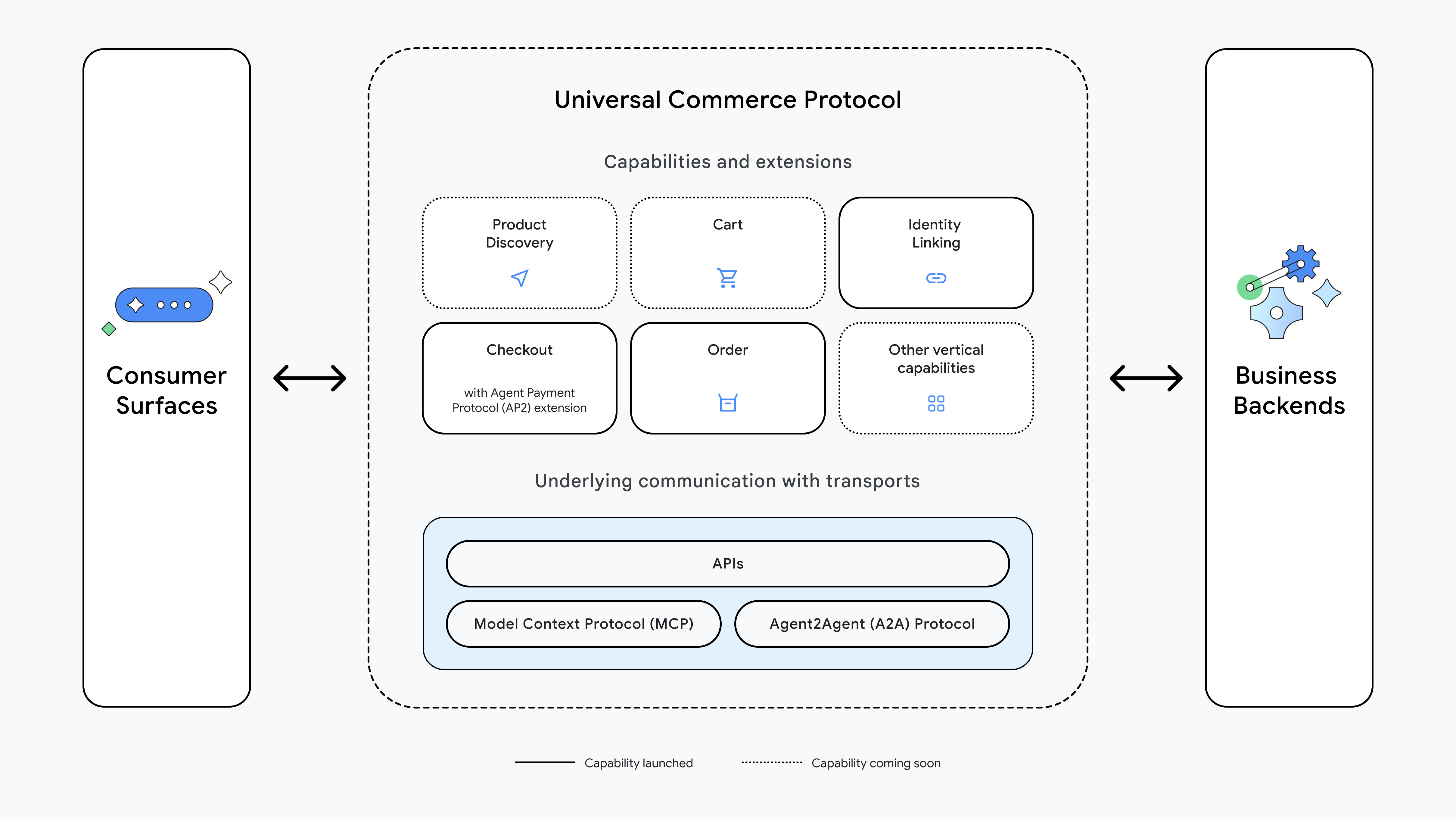
What Is the Universal Commerce Protocol (UCP)?
UCP is an open standard that defines how agents and merchants declare capabilities, negotiate what each side can do, and complete transactions using compatible mechanisms. Merchants describe supported operations—product retrieval, cart handling, promotions—while agents advertise their preferences.
The protocol emerged to avoid a fragmented future where every AI assistant requires bespoke integrations with each commerce platform. By creating common schemas, UCP lets many different agents transact with many different merchants in a predictable way.
UCP is designed to interoperate with other protocols: MCP for system integration, A2A for agent coordination, AP2 for payment consent, and ACP for certain checkout patterns.
How UCP Works (Simple Walkthrough)
Step-by-step example: AI shopping in Google Search
User starts a conversation: In Google’s AI Mode, a shopper types, "Find a mid-range espresso machine that fits in a small kitchen."
Agent discovers merchants: The agent uses UCP discovery to find merchants that expose compatible product and checkout capabilities.
Capability negotiation: The agent presents its profile and receives merchant descriptors, including available handlers like Shop Pay or Google Pay.
Offer evaluation: Using UCP-compatible feeds, the agent compares products across merchants factoring in attributes and pricing.
Cart creation: When the user chooses a product, the agent uses UCP to create a cart and negotiates which payment handler to use.
Checkout and payment: The merchant remains the seller of record, while payment authorization may leverage AP2.
Practical Use Cases (2026+)
AI Mode checkout in Search: UCP enables native, agentic checkout experiences inside Google Search and Gemini while retailers stay in control.
Business Agent experiences: Merchants expose richer product data and Q&A capabilities that UCP-aware agents can use for conversational shopping.
Multi-protocol participation: Shopify merchants can participate in both ACP and UCP ecosystems with cross-platform consistency.
Offer-level merchandising: UCP supports offer-level attributes to surface substitutes and richer context in AI responses.
How to Prepare for UCP Standardization
Merchants should ensure their product data, offers, and store policies are represented in structured, machine-readable formats. Investments in product information management (PIM) and taxonomy will directly influence how agents rank their offers.
Developers should map existing APIs to UCP schemas and determine how to implement capability handlers for carts and payments. For Shopify merchants, platform-level tooling may handle much of the work. Marketing and CX teams should think of UCP as a new distribution channel—akin to marketplaces—setting goals for visibility and conversion in AI-first experiences.
Frequently Asked Questions
What is the Universal Commerce Protocol (UCP)?
UCP is an open standard from Google and Shopify that lets AI agents and merchants negotiate capabilities and complete commerce flows across platforms.
How does UCP work?
Merchants declare supported capabilities; agents present their credentials; both sides negotiate carts and payments using shared schemas.
Is UCP widely adopted?
UCP is newly launched but already integrated into Google’s AI shopping experiences and aligned with Shopify’s ecosystem as of early 2026.
How does UCP affect e-commerce?
UCP standardizes how agents discover products and initiate checkout, pushing more commerce into conversational and AI-first surfaces.
UCP vs ACP — what’s the difference?
ACP is centered on OpenAI and Stripe; UCP is a broader, cross-platform standard working across Google surfaces and Shopify merchants.