
Why Agentic Payments May Scale in Asia Before the United States
The first mass-market autonomous-payment system may not emerge from the country with the best-known AI labs. It may emerge where instant payments, mobile identity, merchant acceptance, and programmable mandates already behave like public infrastructure.
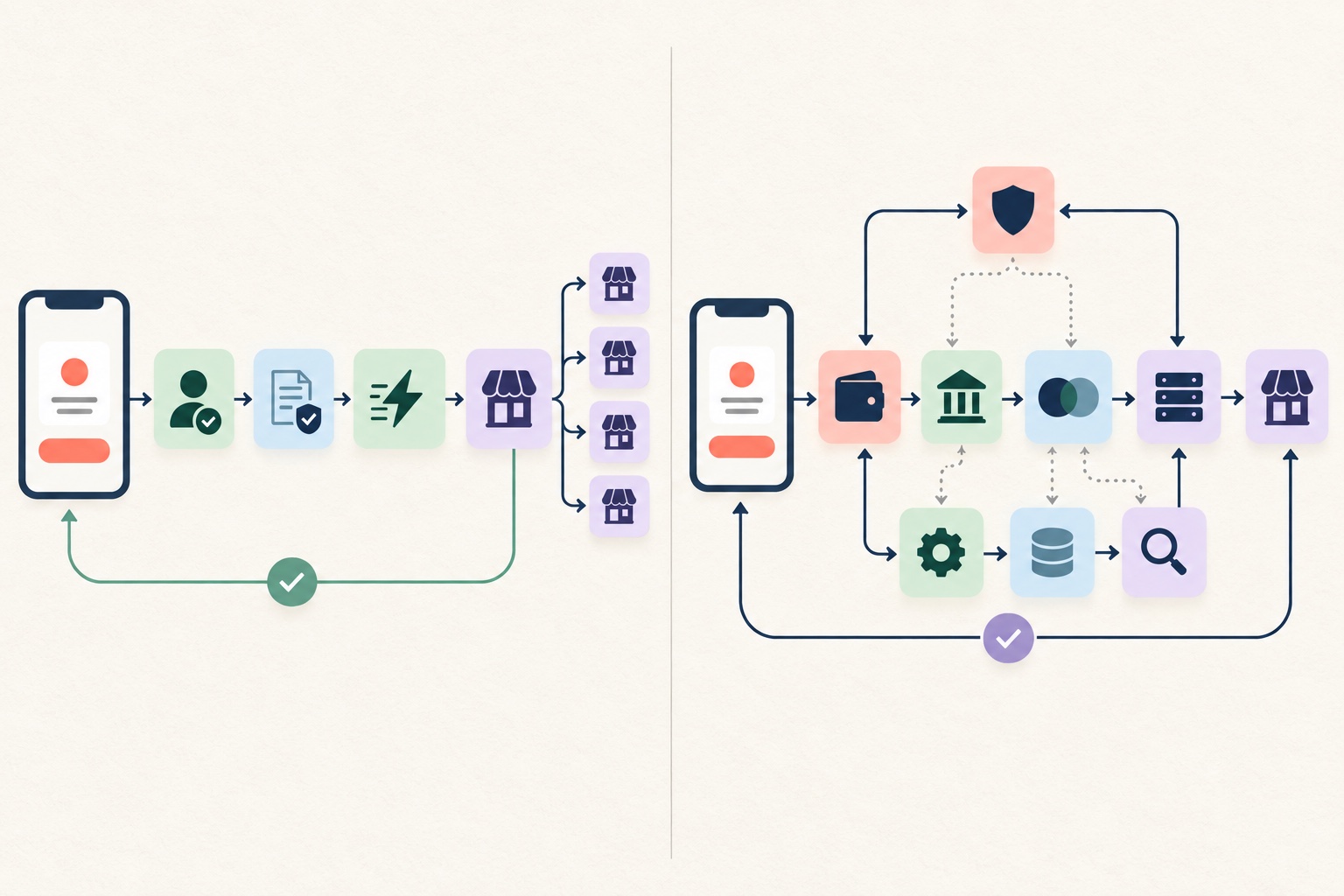
Short answer: Agentic payments are easier to scale when one interoperable rail already connects consumers, banks, wallets, and merchants; identity and mandates are native to that rail; low-value payments are inexpensive; and regulators can define shared controls. India and parts of East Asia have more of those conditions than the United States. Their advantage is not lower risk. It is a smaller number of seams where responsibility can disappear.
The usual story about agentic commerce begins with the model. A smarter assistant learns what a shopper wants, searches the market, and eventually presses buy.
That is the visible part. The harder system begins after the recommendation: identifying the agent, proving the user's authority, checking a limit, selecting a credential, routing a payment, authenticating the instruction, resolving a dispute, and telling the merchant that the traffic is legitimate. A model can improve weekly. Payment infrastructure changes more slowly.
This is why geography matters. Agentic payments will not scale everywhere at the same speed, even when the same AI models are available everywhere.
The infrastructure thesis
Markets with four characteristics have an early advantage:
- A shared real-time rail. Most participating banks and wallets can send money through common rules and addressing.
- Dense merchant acceptance. Small and large merchants can accept the rail without a bespoke integration for every agent provider.
- Programmable authority. Users can grant bounded, revocable permission rather than surrendering a general-purpose payment credential.
- Visible accountability. Operators can identify the agent, provider, customer account, merchant, and transaction when something fails.
These conditions reduce the number of bilateral negotiations required to launch an agent. A provider does not need separate commercial and technical arrangements with every issuer, wallet, processor, and merchant platform before it can test a narrowly constrained purchase.
India: UPI as an agentic-payment substrate
India's Unified Payments Interface is important here because it is not merely a popular wallet. It is an interoperable layer connecting regulated participants. Government reporting says UPI represented 84% of India's digital-payment volume in fiscal 2025–26. That scale means an agentic layer can potentially be introduced as a new instruction and control model over an existing acceptance network.
Reuters reported in September 2026 that Indian payment authorities were developing an agent registry alongside plans for agent-initiated UPI payments. The registry matters as much as the payment feature. If a merchant or bank can identify an approved agent and its provider, policy can vary by risk: discovery-only agents, low-value purchasing agents, business procurement agents, or revoked agents.
India also has earlier building blocks. NPCI introduced UPI Reserve Pay to let users block and manage credit limits for specific purposes, and UPI Help to assist with payments and disputes. Neither is equivalent to autonomous purchasing. Together, however, they show a system comfortable with purpose-bound funds, shared interfaces, and AI inside payment operations.
China and the super-app advantage
China offers a different path. Wallets and super apps combine identity, messaging, discovery, merchant services, payment, and post-purchase activity inside a smaller number of ecosystems. NIQ's 2026 East-meets-West report cited 120 million Alipay AI Pay transactions as an indicator of emerging scale.
That number should not be read as 120 million fully autonomous shopping trips. “AI Pay” can cover experiences with different degrees of automation. The more useful signal is operational: a payment platform with broad consumer and merchant reach can deploy an agent-related control across both sides of the transaction without waiting for the open web to coordinate.
The same concentration creates governance concerns. A super app can observe intent, rank products, route payment, and measure the sale. That integration lowers friction, but it also concentrates the power to decide which merchants are visible and which evidence counts.
Why the United States is harder
The U.S. card system has enormous reach and strong consumer protections, but its agentic path crosses more organizational boundaries. A typical transaction can involve an AI platform, agent provider, browser, merchant, commerce platform, gateway, acquirer, card network, issuer, wallet, fraud vendor, affiliate network, and identity provider.
Cards were designed to authorize a payment credential, not to carry a machine-readable explanation of the shopper's delegated intent. Networks are now adding agent identity, tokenization, and intent signals, but adoption requires many independent actors to recognize and preserve those signals.
| Infrastructure question | Unified instant-payment model | Fragmented card-and-wallet model |
|---|---|---|
| Merchant reach | Common acceptance layer | Broad acceptance, but many integration paths |
| Agent identity | Can be attached to shared network rules | May differ by network, wallet, platform, and merchant |
| Delegated limits | Potentially native mandate or reserved balance | Often implemented above the payment credential |
| Transaction cost | Well suited to frequent low-value payments | Economics vary by rail, merchant, and credential |
| Dispute evidence | Potentially common data model | Evidence may be split across several providers |
| Innovation path | Coordinated rule change | Competitive experimentation and slower interoperability |
Fragmentation is not purely a disadvantage. It can limit the blast radius of one operator's mistake and encourage competing trust models. The U.S. also has mature fraud, chargeback, and tokenization systems. The tradeoff is coordination: a strong agent experience built by one company may not transfer cleanly to another merchant, wallet, or network.
The five gates to real scale
1. Agent identity
Every participant needs to distinguish approved agent traffic from bots and credential abuse. Registries must support status, revocation, accountable providers, and privacy—not simply produce another identifier.
2. Delegated authority
A user should authorize a purpose, amount, time window, merchant scope, and confirmation rule. The agent must not receive a reusable credential with broader power than the task requires.
3. Transaction binding
The approval must attach to the actual merchant, seller, items, total, currency, and recurrence terms. Any material change should trigger a new decision.
4. Recourse
Consumers will not care that an agent, wallet, and merchant each followed a different protocol. They need one place to stop the agent, see what happened, dispute the order, and recover funds where rules permit.
5. Merchant economics
Autonomous payment cannot depend on an integration that only the largest marketplaces can afford. Small merchants need predictable fees, clear liability, and reusable acceptance.
What U.S. retailers should learn—not copy
The lesson is not that every market should recreate UPI or a super app. It is that agentic commerce needs shared infrastructure below the conversational interface.
Retailers can prepare by normalizing incoming agent identities, mandates, and transaction evidence into one internal policy model. They should separate agent recognition from authorization, preserve seller identity in marketplace checkouts, expose machine-readable totals and return terms, and build a single audit record across order and payment systems.
Payment teams should also test low-risk use cases first: replenishment below a cap, reservation with human confirmation, or procurement from an approved catalog. These reveal whether identity, mandate, replay protection, and dispute evidence survive the full journey.
A market-readiness scorecard
| Dimension | Question | Evidence of readiness |
|---|---|---|
| Rail coverage | Can one integration reach most consumers and merchants? | Interoperable acceptance and stable addressing |
| Mandates | Can authority be bounded and revoked? | Purpose, value, time, merchant, and reuse controls |
| Identity | Can participants identify the agent and provider? | Registry, attestation, status, revocation |
| Economics | Do low-value autonomous payments make sense? | Predictable costs and settlement |
| Recourse | Can a customer understand and challenge an action? | Common receipt, stop control, dispute path |
| Governance | Can rules change without one firm controlling the market? | Transparent standards and accountable operators |
The likely outcome
Asia will not become one agentic-payments market. India, China, Singapore, Japan, and Southeast Asian markets have different rails, regulation, and platform structures. Nor is first deployment the same as durable consumer trust.
But the first systems to reach everyday scale are likely to look less like an AI model bolted onto a checkout page and more like a payment network that learns to accept narrowly delegated machine instructions. On that measure, several Asian markets begin closer to the finish line.
Frequently asked questions
Does UPI already allow fully autonomous AI purchases?
No. Reporting describes frameworks under development. Existing UPI capabilities provide useful primitives, but agent identity, delegated authority, transaction binding, and recourse still require explicit rules.
Are super apps automatically safer for agentic commerce?
No. Integration can improve consistency and fraud visibility, but it also concentrates ranking, payment, and data power. Safety depends on controls, transparency, and recourse.
Will cards lose to instant-payment rails?
Not necessarily. Card networks are rapidly adding agent credentials, tokens, and trust signals. Their challenge is interoperable adoption across a more fragmented ecosystem.
What should merchants implement first?
Support a protocol-neutral authorization policy, preserve the agent and seller identities, bind approval to the cart, and create an auditable decision receipt before enabling autonomous checkout.
References & Further Reading
Continue Exploring
Verifiable Intent in Agentic Commerce
Understand the evidence chain behind delegated agent purchases.
AP2 and the Agentic Payments Stack
See how an emerging protocol coordinates agents, merchants, and payment providers.
The Agentic Commerce KPI Stack
Measure agent-driven commerce beyond visible referral traffic.