
The AI Ecommerce Strategy Stack: Five Layers That Determine Visibility in 2026
AI is not replacing the fundamentals of selling online. It is reshaping how five distinct layers of the ecommerce system interact. Here is a practical framework for understanding where AI actually fits — and where to invest.
The conversation about AI in ecommerce usually starts with chatbots and product recommendations. But the real question is more structural: where does AI actually change how ecommerce works, and where does it just add a new interface on top of the same mechanics?
After watching how algorithm-driven commerce is evolving in 2026, a clearer picture is emerging. AI is not replacing the fundamentals of selling online. It is reshaping how five distinct layers of the ecommerce system interact with each other. Brands that understand these layers — and where AI fits within each one — will make better decisions about where to invest.
What Is the AI Ecommerce Strategy Stack?
A framework for understanding AI's role in ecommerce across five operational layers: discovery, conversion, brand authority, behavioral data, and fulfillment. Each layer has different AI touchpoints, and success depends on how well they work together.
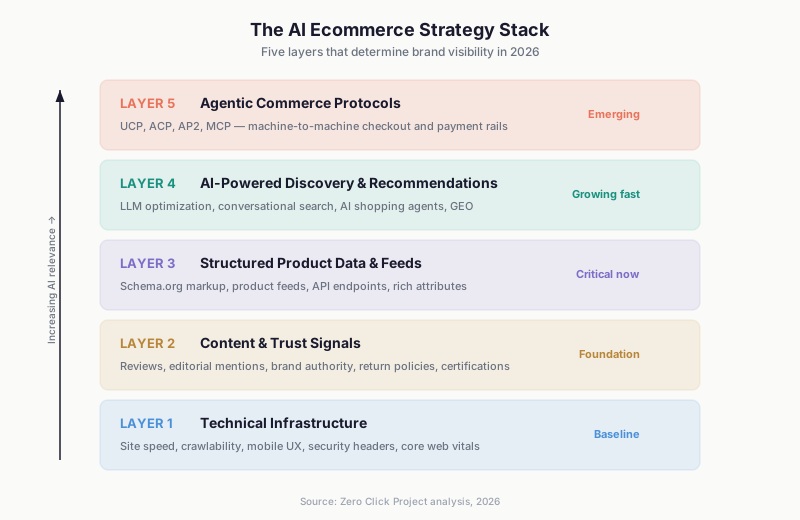
The five-layer AI ecommerce strategy stack: discovery, conversion, brand authority, behavioral data, and fulfillment.

Layer 1: Discovery and Algorithmic Visibility
Discovery is where AI changes the interface most visibly. Instead of typing short keyword queries into a search bar, shoppers increasingly interact with conversational systems. A customer might ask for "a durable carry-on suitcase for frequent travel" rather than searching for a specific brand or model. AI systems interpret that request, evaluate product attributes and reviews, and generate tailored suggestions.
But the underlying requirement remains the same: products must be structured in ways that algorithms can understand. Product descriptions, attributes, images, and reviews all serve as signals that help recommendation engines interpret what a product is and when it should appear.
Technical Implementation: Discovery Layer
To make your products retrievable by AI shopping assistants, the data layer must be explicit and machine-readable. Here is a minimal Product schema that addresses the core discovery signals:
{
  "@context": "https://schema.org",
  "@type": "Product",
  "name": "Traveler Pro 22\" Carry-On Spinner",
  "description": "Lightweight hardshell carry-on with TSA-approved lock, 360° spinner wheels, and expandable capacity. Fits overhead bins on all major US airlines.",
  "brand": { "@type": "Brand", "name": "Traveler Pro" },
  "sku": "TP-CO22-NVY",
  "gtin14": "00198765432109",
  "additionalProperty": [
    { "@type": "PropertyValue", "name": "Capacity", "value": "45L expandable to 52L" },
    { "@type": "PropertyValue", "name": "Weight", "value": "7.2 lbs" },
    { "@type": "PropertyValue", "name": "Material", "value": "Polycarbonate shell" },
    { "@type": "PropertyValue", "name": "Airline Compatibility", "value": "Fits overhead bins on Delta, United, American, Southwest" },
    { "@type": "PropertyValue", "name": "Warranty", "value": "Limited lifetime warranty" }
  ],
  "offers": {
    "@type": "Offer",
    "price": "189.99",
    "priceCurrency": "USD",
    "availability": "https://schema.org/InStock"
  }
}
The key insight: AI shopping agents do not browse your product pages like humans do. They retrieve structured attributes — weight, dimensions, material, compatibility — and use those to match against user intent. The more explicit and specific your attributes, the more accurately AI systems can recommend your products.
Voice search adds another dimension. Shoppers use spoken queries that are longer and more conversational than typed searches. Optimizing for these natural-language queries requires different keyword strategies — focused on how people actually speak about products rather than how they type.
Layer 2: The Conversion Experience
Discovery brings a shopper to a product page. The next challenge is turning interest into a purchase. This is where the tension between algorithm optimization and human persuasion becomes most visible.
Many ecommerce pages today are optimized heavily for algorithmic discovery. They contain keyword-rich descriptions and long lists of product attributes designed to improve search visibility. While these structures help ranking systems, they often do little to help customers understand why a product is worth buying.
Conversion depends on something different. Shoppers need clear explanations, compelling visuals, and confidence that the product solves their problem. The most effective product pages strike a balance — communicating clearly with algorithms while still guiding human readers toward a confident purchase decision.
The Dual-Audience Product Page
In 2026, every product page serves two audiences simultaneously: AI retrieval systems and human shoppers. Here is how to structure content for both:
| Content Element | AI Retrieval Purpose | Human Conversion Purpose |
|---|---|---|
| Product title | Category + brand + key differentiator for semantic matching | Clear identification of what the product is |
| Short description (150 chars) | Extracted by AI for summary answers and carousels | Quick value proposition for scanning |
| Long description | Semantic context for retrieval and comparison | Storytelling, use-case framing, objection handling |
| Structured attributes | Machine-readable specs for filtering and matching | Quick comparison and spec validation |
| FAQ section | Direct extraction for conversational answers | Objection handling and decision support |
| Reviews and ratings | Trust signals for recommendation confidence | Social proof and purchase validation |
AI can personalize product pages based on visitor behavior, adjusting which features are highlighted and what social proof is displayed. But the fundamental challenge remains the same: the page needs to persuade a human being to buy.
Layer 3: Brand Authority Signals
As AI systems become more capable of interpreting context, they increasingly rely on signals that reflect brand credibility. Customer reviews, historical purchase patterns, and reputation across platforms all contribute to how recommendation systems evaluate products.
AI assistants may favor brands with stronger reputational signals because those signals suggest a lower risk of disappointing the shopper. This reinforces something experienced operators already understand: visibility alone is rarely enough. Products that consistently earn positive feedback and customer trust generate signals that compound over time.
| Authority Signal | Why It Matters for AI | How to Strengthen It |
|---|---|---|
| Review volume and recency | AI systems weight recent, verified reviews when generating recommendations | Implement post-purchase review requests within 7–14 days; respond to negative reviews promptly |
| Cross-platform consistency | Consistent brand presence across channels strengthens retrieval confidence | Ensure brand name, descriptions, and imagery match across DTC, Amazon, and marketplace listings |
| Return rate and satisfaction data | Low return rates signal product quality and accurate descriptions | Improve product photography, size guides, and description accuracy to reduce returns |
| Third-party mentions and citations | Editorial coverage and expert mentions increase brand authority for LLMs | Invest in PR, expert roundups, and editorial product reviews on authoritative publications |
| Organization schema | Helps AI systems understand your brand entity and link signals | Implement Organization schema with sameAs links to social profiles, Wikipedia, Wikidata |
Organization Schema for Brand Authority
{
  "@context": "https://schema.org",
  "@type": "Organization",
  "name": "Example Electronics",
  "url": "https://www.example-electronics.com",
  "logo": "https://www.example-electronics.com/logo.png",
  "sameAs": [ "https://www.linkedin.com/company/example-electronics", "https://twitter.com/exampleelec", "https://www.facebook.com/exampleelectronics", "https://en.wikipedia.org/wiki/Example_Electronics"
  ],
  "contactPoint": {
    "@type": "ContactPoint",
    "telephone": "+1-800-555-0199",
    "contactType": "customer service",
    "availableLanguage": [ "English", "Spanish"]
  }
}
Layer 4: Customer Behavior Data
Behind every recommendation system lies an enormous volume of behavioral data. Every time a shopper searches for a product, reads reviews, compares alternatives, or completes a purchase, they generate signals that help platforms understand how customers evaluate products.
These signals accumulate across millions of interactions. Algorithms identify patterns between browsing behavior, product interest, and purchase decisions. In many environments, behavioral signals are tied to persistent identities — customer accounts, email addresses — allowing platforms to connect activity across devices and sessions.
The practical implication: brands that generate strong engagement signals — high click-through rates, long time on page, low bounce rates, repeat purchases — are training the algorithms to surface their products more frequently. This creates a compounding advantage that is difficult for competitors to replicate quickly.
Behavioral Signals That Influence AI Recommendations
| Signal | What AI Infers | How to Optimize |
|---|---|---|
| Click-through rate from search | Product relevance to search intent | Optimize product titles and thumbnail images for relevance and clarity |
| Time on product page | Content engagement and interest depth | Add rich content: videos, comparison tables, interactive size guides |
| Add-to-cart rate | Purchase intent strength | Reduce friction: clear pricing, prominent CTA, trust badges |
| Return rate | Product-description accuracy | Improve description specificity and set realistic expectations |
| Repeat purchase rate | Product satisfaction and brand loyalty | Build subscription/replenishment options; post-purchase engagement |
Layer 5: Fulfillment and Operational Execution
Once a customer decides to buy, ecommerce transitions from digital discovery to physical execution. The order must be picked, packed, shipped, and delivered. Delivery speed, packaging accuracy, and logistics reliability become the defining elements of the customer experience.
No recommendation system can compensate for a poor delivery experience. A delayed shipment, damaged product, or incorrect order erases the positive impression created during discovery. As AI systems increasingly factor operational reliability into their recommendations, fulfillment quality directly affects algorithmic visibility.
Modern fulfillment networks use AI for inventory placement, demand forecasting, and carrier selection. These systems leverage real-time data from IoT devices and sensors to optimize shipping routes and monitor inventory levels. But the core principle remains: the last mile of ecommerce is physical, not algorithmic.
Fulfillment Data in Structured Markup
AI shopping assistants increasingly surface shipping and return information directly in recommendations. Making this data machine-readable gives your products an edge:
"shippingDetails": {
  "@type": "OfferShippingDetails",
  "shippingRate": {
    "@type": "MonetaryAmount",
    "value": "0",
    "currency": "USD"
  },
  "shippingDestination": {
    "@type": "DefinedRegion",
    "addressCountry": "US"
  },
  "deliveryTime": {
    "@type": "ShippingDeliveryTime",
    "handlingTime": {
      "@type": "QuantitativeValue",
      "minValue": 0, "maxValue": 1, "unitCode": "DAY"
    },
    "transitTime": {
      "@type": "QuantitativeValue",
      "minValue": 1, "maxValue": 3, "unitCode": "DAY"
    }
  }
},
"hasMerchantReturnPolicy": {
  "@type": "MerchantReturnPolicy",
  "applicableCountry": "US",
  "returnPolicyCategory": "https://schema.org/MerchantReturnFiniteReturnWindow",
  "merchantReturnDays": 30,
  "returnFees": "https://schema.org/FreeReturn"
}
Why the Stack Matters
Looking at ecommerce through these five layers clarifies where AI actually fits into the system. Algorithms may reshape discovery. Data systems may improve recommendations. But ecommerce success still depends on how well these layers work together.
A brand that invests heavily in algorithm optimization may struggle if its product pages fail to convert. A company with strong marketing may disappoint customers if its fulfillment infrastructure cannot deliver reliably. The brands that succeed in an AI-driven environment are those that align discovery strategies with operational execution.
Practical Steps for 2026
- Audit your product data quality. Ensure every product has structured attributes, accurate descriptions, and current pricing that AI systems can parse. Use the Product schema example above as your baseline.
- Balance algorithm optimization with human persuasion. Product pages should satisfy both AI retrieval logic and human decision-making. Use the dual-audience framework to structure content.
- Invest in review generation and management. Volume, recency, and authenticity of reviews directly affect AI recommendation confidence. Aim for at least 10+ reviews per product with responses to negative feedback.
- Connect your fulfillment data to your visibility strategy. Shipping reliability and return rates increasingly influence how AI surfaces products. Add structured shipping and return policy markup to every product page.
- Treat behavioral data as a strategic asset. Engagement signals compound over time and train algorithms to favor your products. Monitor click-through rates, time on page, and return rates as leading indicators.
- Implement Organization schema. Help AI systems understand your brand as a distinct entity with sameAs links to social profiles and authoritative directories.
Frequently Asked Questions
What is the AI ecommerce strategy stack?
A framework for understanding AI's impact across five ecommerce layers: discovery, conversion, brand authority, behavioral data, and fulfillment. Each layer interacts with AI differently, and the strongest brands align all five.
Does AI replace the fundamentals of ecommerce?
No. AI changes interfaces and adds new optimization opportunities, but the core mechanics — structured product data, persuasive content, brand trust, and reliable fulfillment — remain the foundation of online selling.
Which layer should brands prioritize first?
Start with product data quality (Layer 1) and fulfillment reliability (Layer 5). These are the foundation. Without clean data, AI systems cannot find your products. Without reliable delivery, no algorithm will continue recommending them.
How do brand authority signals affect AI recommendations?
AI systems use reviews, cross-platform reputation, return rates, and third-party mentions to assess brand reliability. Stronger signals increase the likelihood of being included in AI-generated product recommendations. Implement Organization schema with sameAs links to strengthen entity recognition.
What structured data should I implement first?
Start with Product + Offer schema on every product page — including GTIN, pricing, availability, shipping details, and return policies. Then add Organization schema at the site level, BreadcrumbList on all pages, and FAQ schema on content pages. Use the additionalProperty field to add product-specific attributes that AI systems use for matching.