
The AI Readiness SEO Checklist: Preparing Your Ecommerce Site for LLM Discovery
AI shopping assistants rely on structured data, machine-readable content, and trust signals — not just keywords. This checklist covers the essential technical and content optimizations ecommerce sites need for AI visibility in 2026.
AI-powered search engines are changing how consumers discover products. Unlike traditional search that prioritizes keyword ranking, large language models and AI shopping experiences rely on semantic understanding, trusted data, and machine-readable content to synthesize answers and recommend products. For ecommerce teams, this means a passive SEO approach is no longer enough. Your site must be actively engineered for AI readiness.
This guide consolidates the essential optimizations into a practical checklist — covering on-page content, technical requirements, structured data, product feeds, and content strategy. Use it to audit your current state and prioritize the changes that will have the biggest impact on AI visibility.
What Is AI Readiness for Ecommerce?
AI readiness means your ecommerce site is structured, tagged, and written in a way that allows AI systems — including LLMs, AI shopping assistants, and generative search engines — to accurately retrieve, interpret, and recommend your products.
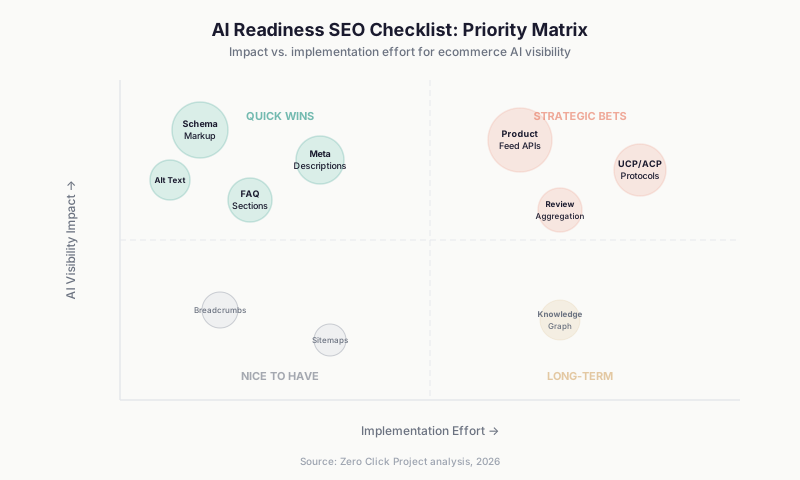
Priority matrix: the essential optimizations for AI-ready ecommerce sites, ranked by impact and implementation effort.

On-Page Requirements
| Element | Requirement |
|---|---|
| Page Titles | Unique, keyword-optimized: brand + product + variant/descriptor |
| Headings | One clear H1 per page with supporting H2/H3 hierarchy |
| Meta Descriptions | 150–165 characters: product name, brand, 1–2 unique selling points, call to action |
| Product Descriptions | Original content — avoid reusing manufacturer copy (AI may treat duplicates as low-value) |
| URL Structure | Short, descriptive, keyword-focused. Use hyphens, avoid query strings |
| Images | High-resolution (1200+ px), alt text and title attributes, 100–250 KB WebP/AVIF with srcset |
Technical Requirements
| Area | Action |
|---|---|
| AI Crawler Access | Explicitly allow AI crawlers (GPTBot, ClaudeBot, PerplexityBot) in robots.txt. Configure WAF (e.g., Cloudflare) to not block them. |
| Rendering | Use server-side rendering (SSR) or provide key content in raw HTML. Most AI crawlers do not render JavaScript. |
| Staging Environments | Ensure test/staging sites are not indexed — AI crawlers may ingest that content. |
| Indexing | Use canonical tags on product detail pages to consolidate signals. |
| Performance | Maintain fast load speed and healthy Core Web Vitals scores. |
| Merchant Center Connections | Submit products directly to LLM merchant programs (Google, Bing, ChatGPT). |
AI Crawler Access: robots.txt Configuration
As of 2026, major AI companies use multiple crawlers for different purposes. OpenAI separates GPTBot (training), OAI-SearchBot (search indexing), and ChatGPT-User (real-time browsing). Anthropic uses ClaudeBot, Claude-SearchBot, and Claude-User. Blocking one tier does not block the others — they operate independently.
A BuzzStream study found that 79% of top publishers block AI training bots, while 71% also block retrieval bots. The consequence: sites that blocked AI crawlers experienced a 23.1% decline in total monthly visits. The blocking costs traffic but does not reliably prevent citation.
Here is a recommended robots.txt configuration for ecommerce sites that want maximum AI visibility:
# Standard search engines
User-agent: Googlebot
Allow: /

User-agent: Bingbot
Allow: /

# OpenAI (all three tiers)
User-agent: GPTBot
Allow: /

User-agent: OAI-SearchBot
Allow: /

User-agent: ChatGPT-User
Allow: /

# Anthropic (all three tiers)
User-agent: ClaudeBot
Allow: /

User-agent: Claude-SearchBot
Allow: /

User-agent: Claude-User
Allow: /

# Perplexity
User-agent: PerplexityBot
Allow: /

User-agent: Perplexity-User
Allow: /

# Google AI features (Gemini, AI Overviews)
User-agent: Google-Extended
Allow: /

# Amazon AI (Alexa, Amazon shopping)
User-agent: Amazonbot
Allow: /

# Default
User-agent: *
Allow: /

# Block private areas
Disallow: /admin/
Disallow: /checkout/
Disallow: /account/

Sitemap: https://www.example.com/sitemap.xml
WAF configuration: Even with correct robots.txt, your Web Application Firewall (Cloudflare, AWS WAF, etc.) may block AI crawlers as "bot traffic." Check your WAF settings and add explicit allow rules for the user-agent strings above. In Cloudflare, navigate to Security → WAF → Custom Rules and create exceptions for these user agents.
Canonical Tags: Consolidating AI Signals
Canonical tags tell AI crawlers which version of a page is the authoritative source. This is critical for ecommerce sites where products appear at multiple URLs — filtered category pages, search results, campaign landing pages, and paginated listings.
Without canonical tags, AI systems may index duplicate versions of your product pages, diluting the authority signals and potentially returning outdated or incomplete information in recommendations.
<!-- On every product detail page -->
<"code-attr">class="code-tag">link "code-attr">rel="canonical" "code-attr">href="https://www.example.com/products/wireless-noise-cancelling-headphones-pro" />

<!-- On filtered/sorted category pages -->
<"code-attr">class="code-tag">link "code-attr">rel="canonical" "code-attr">href="https://www.example.com/headphones" />

<!-- Self-referencing canonical on the main page -->
<"code-attr">class="code-tag">link "code-attr">rel="canonical" "code-attr">href="https://www.example.com/products/wireless-noise-cancelling-headphones-pro?color=black" />
<!-- ❌ WRONG: includes query parameter -->

<"code-attr">class="code-tag">link "code-attr">rel="canonical" "code-attr">href="https://www.example.com/products/wireless-noise-cancelling-headphones-pro" />
<!-- ✅ CORRECT: points to clean URL -->
Key rules: Always use absolute URLs (not relative). Each variant page (color, size) should canonicalize to the main product URL unless variants have genuinely distinct content worth indexing separately. Never canonicalize to a URL that returns a 404 or redirect.
Schema and Structured Data
Structured data is the foundation of AI product retrieval. Without proper schema markup, AI systems may not be able to accurately interpret your product information. Here are the essential schema types with implementation examples.
Product + Offer Schema (Essential)
This is the minimum viable schema for any ecommerce product page. It tells AI systems exactly what the product is, how much it costs, and whether it is available.
{
  "@context": "https://schema.org",
  "@type": "Product",
  "name": "ProSound X7 Wireless Noise-Cancelling Headphones",
  "image": [ "https://www.example.com/images/x7-front.webp", "https://www.example.com/images/x7-side.webp", "https://www.example.com/images/x7-case.webp"
  ],
  "description": "Over-ear wireless headphones with adaptive noise cancellation, 40-hour battery life, and multipoint Bluetooth 5.3 connectivity.",
  "brand": {
    "@type": "Brand",
    "name": "ProSound"
  },
  "sku": "PS-X7-BLK",
  "gtin14": "00123456789012",
  "mpn": "X7-NC-2026",
  "color": "Matte Black",
  "material": "Protein leather earcups, aluminum frame",
  "weight": {
    "@type": "QuantitativeValue",
    "value": "250",
    "unitCode": "GRM"
  },
  "additionalProperty": [
    {
      "@type": "PropertyValue",
      "name": "Battery Life",
      "value": "40 hours"
    },
    {
      "@type": "PropertyValue",
      "name": "Bluetooth Version",
      "value": "5.3"
    },
    {
      "@type": "PropertyValue",
      "name": "Driver Size",
      "value": "40mm"
    },
    {
      "@type": "PropertyValue",
      "name": "Noise Cancellation",
      "value": "Adaptive ANC with transparency mode"
    }
  ],
  "aggregateRating": {
    "@type": "AggregateRating",
    "ratingValue": "4.6",
    "reviewCount": "1284"
  },
  "offers": {
    "@type": "Offer",
    "url": "https://www.example.com/products/prosound-x7-headphones",
    "priceCurrency": "USD",
    "price": "279.99",
    "priceValidUntil": "2026-12-31",
    "availability": "https://schema.org/InStock",
    "itemCondition": "https://schema.org/NewCondition",
    "seller": {
      "@type": "Organization",
      "name": "Example Electronics"
    },
    "shippingDetails": {
      "@type": "OfferShippingDetails",
      "shippingRate": {
        "@type": "MonetaryAmount",
        "value": "0",
        "currency": "USD"
      },
      "deliveryTime": {
        "@type": "ShippingDeliveryTime",
        "handlingTime": {
          "@type": "QuantitativeValue",
          "minValue": "0",
          "maxValue": "1",
          "unitCode": "DAY"
        },
        "transitTime": {
          "@type": "QuantitativeValue",
          "minValue": "2",
          "maxValue": "5",
          "unitCode": "DAY"
        }
      }
    },
    "hasMerchantReturnPolicy": {
      "@type": "MerchantReturnPolicy",
      "applicableCountry": "US",
      "returnPolicyCategory": "https://schema.org/MerchantReturnFiniteReturnWindow",
      "merchantReturnDays": 30,
      "returnMethod": "https://schema.org/ReturnByMail",
      "returnFees": "https://schema.org/FreeReturn"
    }
  }
}
FAQ Schema
FAQ schema helps AI systems extract question-and-answer pairs from your product pages, making your content eligible for direct citation in conversational responses.
{
  "@context": "https://schema.org",
  "@type": "FAQPage",
  "mainEntity": [
    {
      "@type": "Question",
      "name": "Does the ProSound X7 support multipoint Bluetooth?",
      "acceptedAnswer": {
        "@type": "Answer",
        "text": "Yes, the X7 supports simultaneous connection to two devices via Bluetooth 5.3 multipoint. You can switch between your laptop and phone without disconnecting."
      }
    },
    {
      "@type": "Question",
      "name": "How long does the battery last with ANC on?",
      "acceptedAnswer": {
        "@type": "Answer",
        "text": "With adaptive noise cancellation enabled, the X7 provides approximately 32 hours of playback. With ANC off, battery life extends to 40 hours."
      }
    }
  ]
}
Breadcrumb and ItemList Schema
Breadcrumb schema clarifies your site's hierarchy for AI crawlers. ItemList schema helps AI systems understand category pages and curated collections.
{
  "@context": "https://schema.org",
  "@type": "BreadcrumbList",
  "itemListElement": [
    { "@type": "ListItem", "position": 1, "name": "Home", "item": "https://www.example.com" },
    { "@type": "ListItem", "position": 2, "name": "Audio", "item": "https://www.example.com/audio" },
    { "@type": "ListItem", "position": 3, "name": "Headphones", "item": "https://www.example.com/audio/headphones" },
    { "@type": "ListItem", "position": 4, "name": "ProSound X7" }
  ]
}
Product Data and Attributes
- GTIN, MPN, and SKU: Mandatory identifiers that help AI systems match and compare products. Without GTIN, your products cannot participate in Google's Shopping Graph or ChatGPT's product carousels.
- Category and filter attributes: Product type, age group, gender — improve retrieval precision. Use Google's product taxonomy categories (e.g.,
Electronics > Audio > Headphones > Over-Ear Headphones). - Multiple product images: At least 3–5 angles. AI systems increasingly use multimodal analysis to assess product completeness and quality.
- Seasonal attributes: Indicate gift relevance or seasonal timing. Use
additionalPropertyin schema markup to flag seasonal products. - Seller ratings markup: Surface ratings in Shopping and AI panels. Use
AggregateRatingwith at least 10+ reviews for credibility.
Feed and Inventory Management
- Shipping and return policies: Clarify delivery cutoffs and return terms in machine-readable format. Use the
shippingDetailsandhasMerchantReturnPolicyproperties shown in the Product schema example above. - Price parity: Maintain consistent pricing across your DTC site and marketplaces. AI systems cross-reference prices — discrepancies reduce trust scores.
- Feed freshness: Keep data feeds current — stale pricing or availability data reduces AI confidence. Update at least every 24 hours; high-velocity catalogs should update every 4–6 hours.
- Supplemental feeds: Use supplemental feeds in Google Merchant Center to add AI-optimized descriptions, lifestyle images, and custom labels without modifying your primary feed.
Content Strategy for AI Retrievability
Beyond product pages, your content strategy directly affects how AI systems understand and recommend your brand. Key practices:
- Natural-language product descriptions that support conversational search queries. Instead of "BT 5.3, ANC, 40hr, 250g," write: "Connects to two devices at once via Bluetooth 5.3 and provides 40 hours of battery life at just 250 grams."
- TL;DR sections at the top of content pages — AI systems often extract these for summary answers. Place a 2–3 sentence summary in a visible callout box above the fold.
- FAQ sections with clear question-and-answer formatting using proper heading tags (H3 for questions).
- Comparison language that positions products against alternatives (e.g., "40% longer battery life than Sony WH-1000XM6" or "half the weight of comparable models").
- Author bios that indicate expertise and credibility. AI systems use authorship signals as trust indicators.
- Long-form content that gives AI more semantic context — buying guides, product comparisons, and how-to articles that reference your products in context.
- Internal linking from authority pages and seasonal hubs to distribute page authority and help AI crawlers discover related products.
Priority Action Plan
If you can only do five things this quarter, prioritize these:
- Allow AI crawlers in robots.txt and verify they are not being blocked by your WAF. Use the three-tier framework: explicitly allow training, search, and user-browsing bots.
- Implement Product and Offer schema with accurate pricing, availability, ratings, shipping, and return policies — using the JSON-LD format shown above.
- Add GTIN/MPN identifiers to all product data feeds and schema markup.
- Rewrite product descriptions in natural language — conversational, not keyword-stuffed. Include comparison language and use-case context.
- Submit products to AI merchant programs — Google Merchant Center, Bing Merchant Center, and ChatGPT's shopping integration via product feeds.
Frequently Asked Questions
Do AI crawlers use robots.txt?
Yes. GPTBot, ClaudeBot, and other AI crawlers respect robots.txt directives. As of 2026, major AI companies use three tiers of crawlers (training, search, user-browsing) that operate independently. Blocking one does not block the others. If you have not explicitly allowed them, they may be blocked by default, especially if your WAF or CDN blocks unknown bots.
Is traditional SEO still relevant for AI discovery?
Yes, but it is not sufficient on its own. Traditional SEO best practices — clean URLs, semantic headings, fast load times — remain important. AI readiness adds additional requirements like structured data depth, natural-language content, AI crawler access, and machine-readable policies. Think of AI readiness as a layer on top of traditional SEO, not a replacement.
How do I know if AI shopping assistants can see my products?
Test by asking AI assistants (ChatGPT, Google AI Mode, Perplexity) questions about your product category. If your products do not appear in their recommendations, check: (1) your robots.txt for AI crawler blocks, (2) your WAF/CDN for bot blocking rules, (3) your schema markup for completeness, and (4) your merchant center connections for feed status.
What is the most important schema type for ecommerce?
Product schema combined with Offer schema. Together they provide AI systems with the structured product details, pricing, availability, shipping, and return policy information needed to make accurate recommendations. Add AggregateRating schema for trust signals and FAQ schema for conversational retrieval.
How often should I update my product data feeds?
At minimum every 24 hours. High-velocity catalogs with frequent price or inventory changes should update every 4–6 hours. Stale data — especially out-of-stock products showing as available or prices that do not match your site — erodes AI system confidence and can lead to suppressed recommendations.
Should I block AI training crawlers but allow search crawlers?
This is a viable middle-ground strategy. You can block GPTBot and ClaudeBot (training) while allowing OAI-SearchBot, Claude-SearchBot, and the user-browsing variants. This prevents your content from being used in model training while still allowing AI search engines to index and surface your products. However, research shows blocking even training bots can reduce overall traffic by over 20%.