
ChatGPT Product Carousels and Google Shopping SEO: A Practical Guide
How ecommerce teams can optimize product feeds, pages, and merchant signals for a world where ChatGPT panels and Google Shopping increasingly shape discovery.
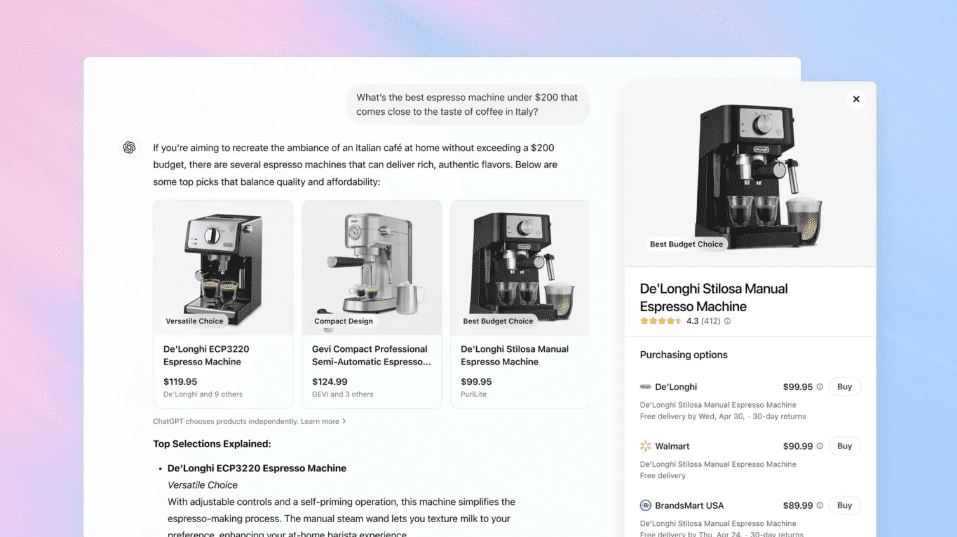
Product discovery is becoming more visual and more conversational. ChatGPT now supports shopping-style product results and deeper shopping research flows, while Google continues to connect AI shopping experiences to Merchant Center, product schema, and the Shopping Graph. For ecommerce teams, that creates a practical optimization problem: how do you prepare one catalog to perform well in both environments?
The most important point is that ChatGPT product panels and Google Shopping are not the same product. They do not use identical ranking logic, merchant data paths, or referral behavior. But they are increasingly shaped by the same underlying inputs: rich product identity, accurate offer data, merchant credibility, and pages that can be quoted or summarized without confusion.
Definition
ChatGPT product panel and Google Shopping optimization is the practice of structuring product data, product pages, feeds, trust signals, and post-click journeys so an AI or shopping system can surface the right product, explain it clearly, and hand the shopper to a usable checkout experience.
What Changed
Classic search results forced shoppers to do most of the comparison work after the click. Product panels and shopping research flows move part of that work upstream. The system chooses which fields matter, which products belong in the set, and how to explain tradeoffs in a compact recommendation interface.
That changes what makes a product page effective. The page no longer exists only to close a visitor after they arrive. It also exists to help an upstream system understand the product before the click.
Google Shopping SEO Still Matters Because Google's AI Shopping Stack Builds on It
Google's shopping AI is not detached from Google's merchant infrastructure. Google has explicitly connected AI shopping experiences to its Shopping Graph, which the company says contains more than 50 billion product listings, with over 2 billion refreshed every hour. That matters because it tells operators what continues to drive visibility on Google's side: Merchant Center feeds, structured product data, clean offer information, and merchant trust.
In practical terms, Google Shopping SEO remains an operations discipline more than a trick. Teams that treat feeds, schema, and on-page product quality as routine hygiene are better positioned for both classic shopping discovery and AI-assisted shopping experiences.
| Google-side input | Why it matters | Practical action |
|---|---|---|
| Merchant Center feed quality | Google needs current titles, availability, price, brand, identifiers, and imagery to populate shopping experiences accurately. | Review feed errors weekly and treat them as revenue issues. |
| On-page product markup | Structured data helps Google verify and interpret the product entity on the page. | Validate product schema on high-value categories and align it with feed content. |
| Offer freshness | Stale pricing or availability weakens trust in merchant offers. | Sync promotional logic, inventory, and schema updates more tightly. |
| Merchant trust signals | Ratings, returns, shipping clarity, and business legitimacy reduce risk in recommendations. | Make policy details easy to retrieve and consistent across site surfaces. |
What ChatGPT Product Visibility Depends On
OpenAI's merchant guidance is more direct than many operators realize. Merchants that want visibility in ChatGPT product discovery should not block `OAI-SearchBot`, and they should expose clean, current product information that the model can retrieve and compare. OpenAI's shopping experiences also surface merchant links, prices, ratings, and product details, which means product clarity and merchant trust are central to how useful the result feels.
ChatGPT does not simply mirror Google's merchant stack. But it still needs structured commercial truth. The model benefits from specific titles, attributes, review proof, and clear merchant policies.

How the Two Surfaces Differ Operationally
If you treat both surfaces the same way, you will miss important differences. Google is deeply tied to its merchant ecosystem and historical shopping infrastructure. ChatGPT is more natively conversational and often better at reframing a need-state request into a shortlist. Both can drive commerce value, but they create different optimization emphases.
| Dimension | ChatGPT product panels | Google Shopping and AI shopping |
|---|---|---|
| Core user behavior | Conversational product discovery and question-led comparison | Shopping-led discovery blended with search and merchant infrastructure |
| Primary readiness layer | Crawlability, clear product narratives, trust signals, and merchant accessibility | Feed quality, structured data, product entities, and merchant trust |
| Merchant dependency | OpenAI crawler access and retrievable product truth | Merchant Center, schema, and Shopping Graph participation |
| Typical prompt shape | Best product for a use case, budget, lifestyle, or constraint | Strong for both direct product search and narrowed shopping comparison |
| Optimization risk | Weak descriptive content and blocked access | Feed mismatch, stale offers, and under-specified schema |
The Quantitative Case for Taking This Seriously
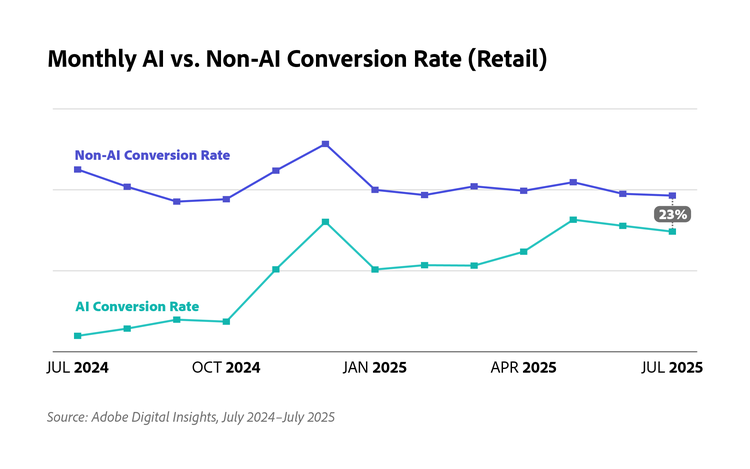
The traffic and conversion benchmarks are now strong enough to justify operational investment even if AI remains a minority channel in your analytics. Public studies show that AI-originating traffic is growing quickly and can perform well when it lands on the right pages.
| Benchmark | Finding | Implication for commerce teams |
|---|---|---|
| Adobe, Mar. 2025 | AI-driven traffic to U.S. retail sites up 1,200% from Jul. 2024 to Feb. 2025 | Referral volume is growing too fast to ignore in ecommerce planning. |
| Adobe, Mar. 2025 | AI visitors spent 8% longer and viewed 12% more pages on retail sites | Traffic from AI tends to show deeper consideration behavior. |
| Adobe, Mar. 2025 | AI traffic converted 9% less often than non-AI traffic in Feb. 2025 | Early AI traffic needed better landing-page and checkout handoffs. |
| Adobe, Oct. 2025 | By Sept. 2025, the conversion gap had narrowed to 16% from 43% in Jul. 2024 | AI-originating traffic quality improved materially over time. |
| Similarweb, 2026 Gen AI report | ChatGPT referrals to transactional sites converted at 7% versus 5% for Google referrals | Some AI-driven traffic is arriving with stronger purchase intent than standard search. |
| Similarweb, 2026 Gen AI report | ChatGPT referrals averaged 15 minutes and 12 pageviews versus 8 minutes and 9 pageviews from Google referrals | The best outcome is better-qualified AI traffic. |
An Optimization Framework That Works Across Both
1. Fix the product entity layer first
Unify titles, identifiers, variant logic, and critical attributes. If your internal product record is messy, no amount of channel-specific tuning will compensate for it.
2. Make PDPs answer comparison questions
Many AI prompts are comparative by default. Add concise sections for use case, fit, compatibility, materials, dimensions, ingredients, and tradeoffs. This helps both language-model retrieval and classic shopping comparison.
3. Treat feeds as merchandising infrastructure
Many teams still think of feeds mainly as paid-shopping inputs. That is too narrow. Feed quality now affects organic shopping visibility, AI readiness, product consistency, and merchant trust.
4. Raise the standard on imagery
Product panels depend heavily on thumbnails. Primary images should be clean and centered. Variant imagery should be dependable. The first image should explain the product immediately, not rely on brand context from the PDP.
5. Strengthen trust modules
Review volume, rating quality, return windows, shipping details, warranty terms, and seller clarity should be easy to retrieve. This is not cosmetic. It shapes whether the system feels safe surfacing the merchant.
6. Improve the post-click journey
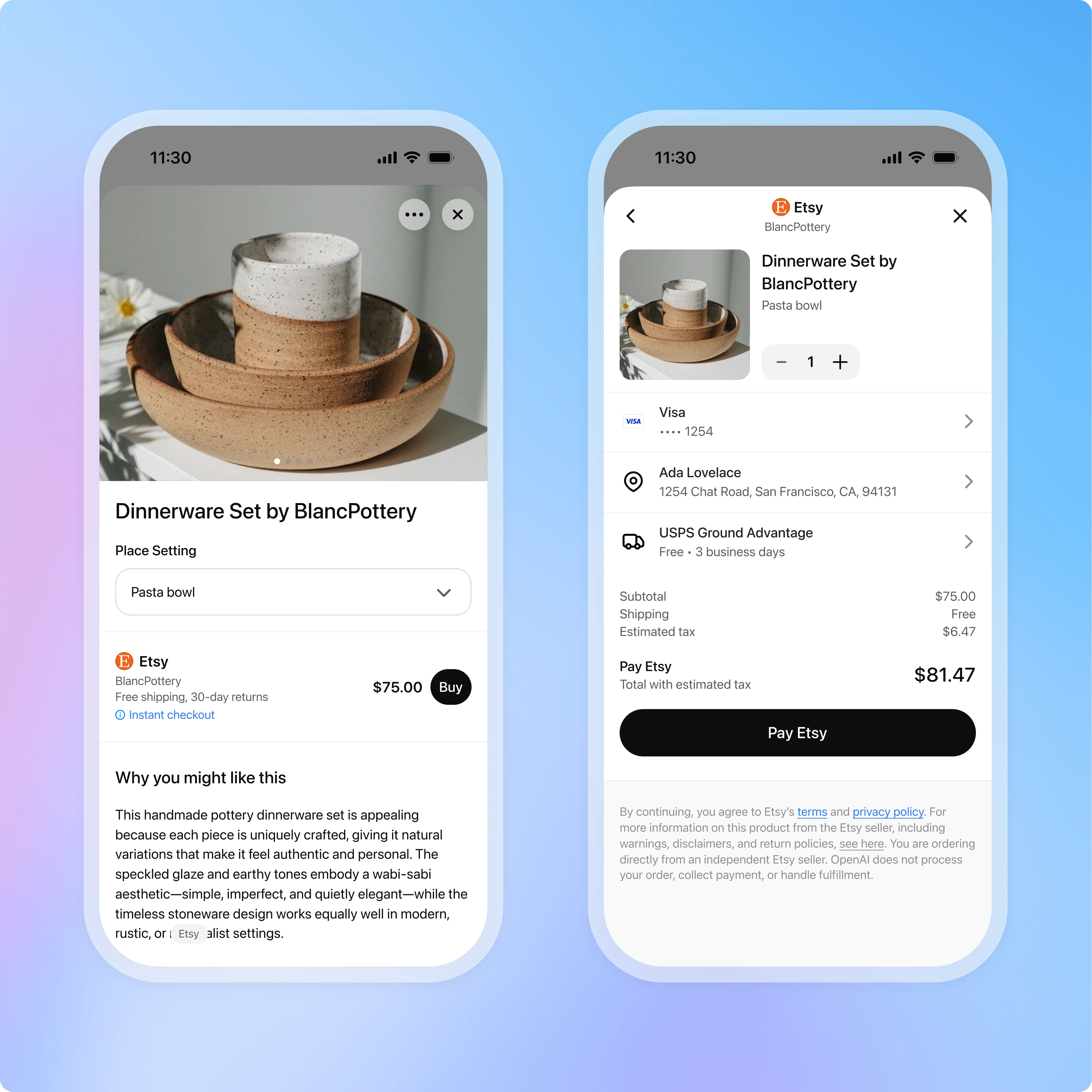
AI traffic often lands later in the decision process. Keep variant selection obvious, reveal shipping costs earlier, support major wallets, and avoid unnecessary sign-in walls. Recommendation value disappears quickly when checkout creates avoidable friction.
What to Measure
Do not stop at referral sessions. Track where AI-originating traffic lands, which categories benefit most, whether wallet adoption differs by traffic source, and how quickly visitors move from PDP to cart. Merchants should also measure attribute completeness, feed error volume, schema validity, rating coverage, and policy visibility for top categories.
A helpful operating approach is to combine channel metrics with content-quality metrics so teams can see whether better product records are actually improving visibility and conversion.
| Measurement area | Suggested KPI | Owner |
|---|---|---|
| AI referral quality | Sessions, landing pages, add-to-cart rate, checkout completion | Growth or analytics |
| Catalog clarity | Attribute completeness, image completeness, title standard compliance | Merchandising |
| Merchant infrastructure | Feed error rate, schema validity, crawl health | SEO or product operations |
| Trust readiness | Review coverage, policy visibility, shipping transparency | CX and ecommerce operations |
Strategic Advice
The most effective teams are not building separate workflows for ChatGPT and Google from scratch. They are building one recommendation-ready product system and then checking whether each channel can consume it properly. That means stronger product entities, cleaner feeds, better descriptive copy, more visible policy information, and lower-friction checkout.
If you need to prioritize, start with the categories where shoppers already ask nuanced questions. Those categories are most likely to benefit first from AI-led discovery and to underperform if the product record is weak.
Frequently Asked Questions
Are ChatGPT product panels and Google Shopping powered by the same system?
No. They are separate products with different ranking, retrieval, and merchant-data logic. But they both depend on clear product identity, accurate offer data, merchant trust signals, and a strong post-click experience.
Should I prioritize Merchant Center work if I care about AI shopping?
Yes. Merchant Center, feed health, and structured product data remain high-leverage because Google's shopping experiences build on them directly, and the discipline required there improves readiness for other AI shopping surfaces too.
What is the most common content mistake on product pages?
The most common mistake is relying on vague lifestyle copy without enough attributes, fit guidance, tradeoffs, or comparison context. Product panels need details they can summarize and defend.
What matters more for ChatGPT: feeds or page copy?
Page clarity, crawlability, and retrievable product truth matter most directly, but feeds still matter because many merchants use them to keep offer data normalized internally and across channels. The best approach is to improve both the product record and the page.
How should teams measure whether this work is paying off?
Track AI-originating sessions, landing-page engagement, add-to-cart rate, wallet usage, checkout completion, feed error rates, schema validity, and attribute completeness in the categories you are improving. Those metrics together show whether visibility work is turning into commercial value.
What should agencies package for clients in this area?
The most useful package is a combined audit covering merchant feeds, structured data, PDP clarity, review proof, policy visibility, image quality, and post-click conversion. That gives clients a roadmap that is practical across both ChatGPT and Google.