
How to Use ChatGPT for Website SEO and AIO/GEO Analysis in 2026
A practical 2026 guide to using ChatGPT for website SEO audits, answer-engine optimization, and AI-ready content reviews with reusable prompts and evaluation frameworks.
The assistant that became an auditor
Not long ago, running a serious website audit meant paying for at least three tools—a crawler, a rank tracker, and an on-page analyzer—plus someone patient enough to stitch the outputs together into a coherent action plan. ChatGPT changed that incrementally, then dramatically. With GPT-5.3 Instant handling fast audit work and GPT-5.4 Thinking rolling into deeper paid workflows, ChatGPT in 2026 can receive a list of URLs, reason through their structure and intent, surface what is broken or missing, and explain why each fix matters in plain language that a junior content manager or a VP of Marketing can both act on.
This article is for anyone who wants to get real, specific SEO and AIO/GEO value out of ChatGPT today—not generic prompts that could apply to any site, but structured approaches tuned to how GPT-5.3 and GPT-5.4 actually behave in early 2026.
Short answer
Use ChatGPT when you want the best combination of reasoning depth, consumer reach, shopping recommendations, and cross-engine answer simulation. It is especially strong for turning a URL set into a prioritized content and GEO plan that non-specialists can actually execute.
ChatGPT in 2026: why this audit workflow matters
| Signal | Latest benchmark | Why it matters for SEO and GEO |
|---|---|---|
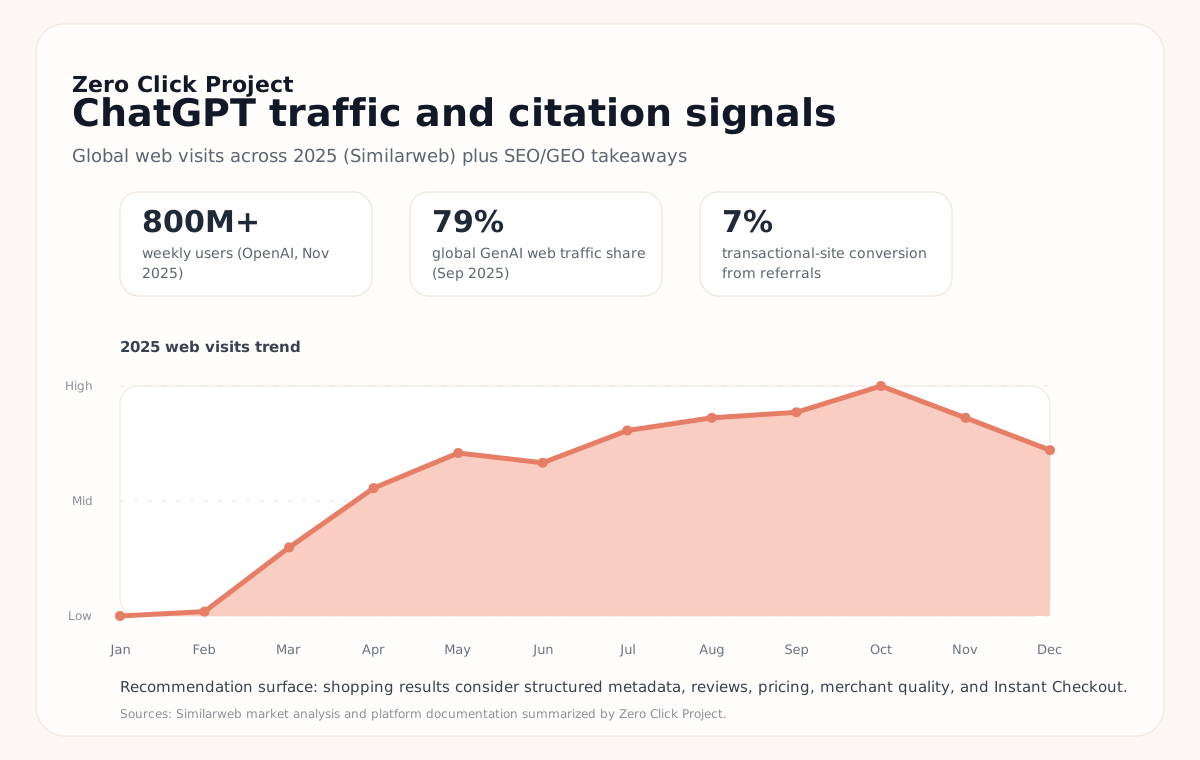
| Weekly user base | OpenAI said ChatGPT had more than 800 million weekly users on November 5, 2025. | What works inside ChatGPT now has direct discovery impact at consumer scale. |
| Web traffic scale | Similarweb recorded 5.52 billion ChatGPT web visits in December 2025, after peaking above 6.16 billion in October 2025. | ChatGPT is large enough that visibility work can no longer be treated as experimental. |
| GenAI traffic share | Similarweb estimated ChatGPT held roughly 79% of global generative-AI web traffic as of September 2025. | It remains the default benchmark when teams test whether a page is answer-engine ready. |
| Commerce referral quality | Similarweb reported ChatGPT referrals to transactional sites converted at 7%, versus 5% for Google referrals. | Traffic from ChatGPT can arrive later in the buying journey and deserves revenue-grade analysis. |
| Recommendations and citations | OpenAI says shopping results consider structured metadata, query context, reviews, price, merchant quality, and Instant Checkout, while ChatGPT Search adds inline citations and a Sources panel. | Clear product data and quotable copy help ChatGPT both recommend and cite your pages. |
What ChatGPT can (and cannot) do for website analysis in 2026
GPT-5.3 Instant vs. GPT-5.4 Thinking
ChatGPT in 2026 runs on two primary models, and choosing the right one changes your results noticeably.
GPT-5.3 Instant is the fast, web-aware default. It reads live URLs, summarizes pages quickly, and gives structured recommendations. Its web search behavior has shifted in recent months: it now surfaces fewer outbound links in web answers, instead building self-contained responses that name key sources inline rather than listing them. For SEO and AIO/GEO analysis, that behavioral shift is itself a signal—it means brands need to be the named entity inside an AI answer, not just a linked result.
GPT-5.4 Thinking allocates significantly more reasoning compute before responding. For multi-step analysis—compare five pages against competitors, identify the weakest content clusters, then recommend a rebuild sequence—it tends to produce more internally consistent, better-prioritized plans than 5.3 Instant. If you are running a serious site audit, switch to 5.4 Thinking via the model picker.
What ChatGPT does well
- Multi-URL narrative synthesis: Feed it a list of 10–20 URLs and ask for patterns; it organizes findings into coherent themes rather than page-by-page lists.
- Intent inference: It is strong at identifying the dominant search intent behind a page even when the title and content are misaligned.
- Prompt-driven competitor comparison: You can scope it to your domain plus 2–3 competitors and get a side-by-side gap analysis.
- GEO simulation: Because ChatGPT is itself an answer engine, asking it "would you cite this page?" gives a first-person view of what its own retrieval logic favors.
What it cannot replace
- Crawl data: ChatGPT cannot detect all broken links, redirect chains, or indexation issues without a crawler log.
- Verified search volumes: Treat keyword suggestions as ideation, not measurement—validate with Search Console or commercial tools.
- Live rankings: It can infer likely intent and difficulty but does not have real-time SERP data.
Before you start: what to prepare
Prepare a small input kit to maximize output quality:
- Your domain and any important subdomains
- A list of 10–20 priority URLs (home, pricing, core feature or product pages, top blog posts, key docs)
- A one-paragraph ICP and positioning summary (who you sell to, what you do, what makes you different)
- Optional: a sitemap.xml or URL export pasted as plain text for large sites
For GPT-5.4 Thinking, you can also upload screenshots of pages (home, pricing, landing pages) and ask the model to analyze visual layout, CTA placement, and UX-level SEO signals alongside on-page content.
Part 1 – SEO analysis with ChatGPT
How to invoke the right mode
Before pasting the prompt, add this line at the top:
Use GPT-5.4 Thinking for this task if available; otherwise use GPT-5.3 Instant and show web citations where helpful.This activates the slower but more reliable reasoning path for audits.
The SEO analysis prompt
**ChatGPT SEO site audit — 2026**

You are a senior technical SEO and content strategist in 2026.
Your task is to run a *reasoning-first* SEO audit of my website and turn it into a short, prioritized action plan.

**1. Context about my business**
- Brand: [BRAND NAME]
- Website: [https://www.example.com]
- ICP: [who we sell to, key segments]
- Main offer(s): [short description of products/services]
- Key markets/languages: [list]

**2. Scope**
Focus on:
- Homepage
- These 10–20 priority URLs (paste list):
  - [URL 1]
  - [URL 2]
  - …
- Any other URLs you discover that are clearly important (pricing, core feature pages, high-traffic guides, docs).

**3. What you should analyze**

1) **Technical/structural SEO (from what you can infer)**
   - Internal linking depth and patterns
   - Canonical use and obvious duplication signals
   - Crawlability/indexability hints (noindex patterns, blocked sections if visible)
   - Page experience signals you can infer (layout patterns, CLS-risk, performance red flags)

2) **On-page SEO & intent alignment**
   - For each key page, infer the dominant search intent and main query clusters
   - Evaluate and improve: title tag, meta description, H1/H2 structure
   - Call out keyword/entity gaps versus the intent you infer

3) **Content depth and architecture**
   - Identify 5–10 core topics my site should own for my ICP
   - For each topic, assess: pillar page presence, supporting content, cannibalization risk

**4. How to think and justify**
- Tie every recommendation to specific URLs, headings, or copy snippets you saw.
- When you say "improve X," propose an example rewrite or structural change.
- If you cannot see something (e.g., server config, full crawl), flag it and suggest how a human should verify.

**5. Outputs I want**
1) A plain-language executive summary (max 250 words) of SEO health and biggest risks/opportunities.
2) A table: one row per priority URL, columns = URL / inferred intent / scores 1–10 for on-page SEO + content depth + internal linking / 2–3 must-fix items.
3) A prioritized action list (top 15 items) with: impact level / effort level / why it matters for my ICP and business, not just rankings.
4) 3–5 quick wins I can ship this week.

When done, briefly state your confidence level and flag where a human should validate with dedicated SEO tools.
What to expect from the output
GPT-5.4 Thinking typically opens with a short plan of its reasoning approach, then works through each section methodically. It tends to be more decisive than other models about deprioritizing low-ROI fixes—expect explicit "skip this for now" statements alongside its top recommendations. If the output feels too long or too generic in any section, follow up with: "Make your top-10 action items one paragraph each—specific to this site, not generic SEO principles."
Part 2 – AIO/GEO analysis with ChatGPT
Why ChatGPT is uniquely self-referential for GEO
Because ChatGPT is an answer engine, asking it to evaluate your site's GEO readiness gives you a first-person view: it is essentially telling you whether it would cite your content when answering a user query on this topic. GPT-5.3/5.4's shift toward fewer links and richer in-answer naming means that showing up as a named source matters more than a backlink—and this prompt surfaces exactly that gap.
The AIO/GEO analysis prompt
Before the prompt, add:
Think like ChatGPT GPT-5.4 powering web answers: you choose a few high-trust pages, then synthesize one clear self-contained answer. Evaluate my site from that perspective.**ChatGPT AIO/GEO site audit — 2026**
You are a Generative Engine Optimization (GEO) strategist in 2026.
Evaluate how well my website is positioned to be **chosen and cited** by AI systems like ChatGPT, Gemini, Claude, Grok, and Perplexity when answering queries in my space.
**1. My context**
- Brand: [BRAND NAME]
- Website: [https://www.example.com]
- ICP + core use cases: [short description]
- 5–10 most important queries or problems we want to own:
- [query 1]
- [query 2]
- …
- 10–20 key URLs (paste list).
**2. Simulate answer-engine behavior**
For each target query:
1) Imagine you are ChatGPT building an answer.
- What kinds of pages would you pull from?
- Which signals say "this is safe and specific enough to quote"?
2) Review my URLs and answer:
- Would you use my content as a primary or secondary source? Why or why not?
- Are my intros written as a clear 80–150-word atomic answer block you can quote?
- Are there question-based headings with concise answers under them?
- Do I offer concrete examples, data, or opinions that differentiate me from generic overviews?
**3. GEO signals — score each key URL 1–10 on:**
- Primary-question clarity (answered in the first 150–200 words?)
- Atomic answers (short quotable blocks under question headings?)
- Entity & use-case clarity (who is this for and when is it best?)
- Trust & experience (case studies, examples, data, named authors?)
- Schema / structure (tables, FAQs, comparisons, structured data?)
Present as a table: URL / core question(s) / 5 scores / 2–3 notes.
**4. Recommendations**
Per URL:
- Rewritten opening 150–200 words optimized as an atomic answer source.
- 3–5 question-based headings to add or improve.
- 3–5 atomic answer blocks (80–120 words each) you would love to quote.
Site-wide:
- Top 10–15 GEO optimizations for the next 90 days.
- A global content playbook (structure, tone, evidence, length, formatting) for future pages to be answer-engine-ready by default.
**5. Epistemic status**
- Where is your analysis grounded in GPT-5.3/5.4 behavior vs. extrapolation?
- Highlight 3–5 trends my team should monitor over the next 6–12 months.How to interpret ChatGPT audit outputs critically
ChatGPT is confident by default. That is useful, but it means you have to push back:
- Ask for ranked uncertainty. After the full output, follow up: "Which of these recommendations are you most uncertain about, and why?"
- Challenge specificity. If an action item is vague, reply: "Name the exact URL, the exact heading, and write an example rewrite."
- Watch for GPT-5.3 hallucinations on technical details. It may state that a canonical tag is missing or that a page is noindexed when it cannot actually verify this. Validate technical flags with Search Console or a crawler.
- Compare GPT-5.3 Instant vs. 5.4 Thinking on the same URL set. The differences in prioritization are often instructive—where they agree, act; where they diverge, investigate.
What ChatGPT is best at in a 2026 website audit
- Cross-functional summaries: ChatGPT is unusually good at translating an audit into language a marketing lead, SEO manager, and founder can all act on.
- First-person GEO simulation: Because ChatGPT is itself a retrieval-and-answer surface, asking whether it would cite your page produces a highly practical answer-engine test.
- Commerce and recommendation analysis: ChatGPT now powers shopping-style results, so it can assess whether product feeds, review proof, and PDP copy are recommendation-ready.
- Prompt iteration: It handles follow-up instructions well, which makes it easy to compress a long audit into a short weekly execution list.
Frequently Asked Questions
Is ChatGPT mainly useful for GEO or for classic SEO?
It is useful for both. ChatGPT is strong at classic on-page analysis, intent alignment, internal-linking suggestions, and content prioritization, but its unique value is GEO because it can explain whether a page is clear and specific enough to quote in an answer engine.
Which ChatGPT mode should I use for a serious website audit?
Use the higher-reasoning mode when the task involves many URLs, competitors, or architectural tradeoffs. Use the faster mode for quick page reviews, rewrite requests, and weekly refresh checks.
Can ChatGPT replace a crawler or Search Console?
No. ChatGPT is best treated as a reasoning layer on top of crawl data, analytics, and Search Console. Use it to interpret patterns and propose fixes, but validate technical claims with dedicated SEO tooling.
What makes a page easier for ChatGPT to cite?
Pages that answer the core question early, define terms clearly, use explicit headings, include real examples or data, and avoid vague marketing language are easier for ChatGPT to summarize and quote.
How often should teams rerun a ChatGPT GEO audit?
Quarterly is a sensible default for strategic pages, with lighter monthly checks for high-value pages in fast-moving categories such as AI, ecommerce infrastructure, or competitive comparison content.