
How to Use Gemini for Website SEO and AIO/GEO Analysis in 2026
A practical 2026 guide to using Gemini for Google-specific SEO reviews, AI Overview audits, entity-gap analysis, and AI Mode readiness checks.
The auditor that runs the exam
Until recently, optimizing for Google meant optimizing for an opaque algorithm—you ran your crawlers, watched your rankings, and made educated guesses about what Search actually thought of your site. That gap just narrowed significantly. With Gemini 3 now powering both AI Overviews and AI Mode on Google Search, you can do something that was impossible before: ask the same AI that decides whether your site gets cited in a Google answer to evaluate your pages before you publish them.
This is the strategic edge that makes Gemini a unique auditing tool in 2026. It is not just an AI assistant—it is the closest thing to a live read-out from inside Google's answer engine. This article shows you how to use that access for both SEO analysis and AIO/GEO optimization, with prompts tuned to how Gemini 3 Flash, Pro, and Deep Think actually behave today.
Short answer
Use Gemini when your main question is how Google will interpret, summarize, and possibly cite a page. Gemini is the most direct audit surface for AI Overviews, AI Mode, query fan-out behavior, and Google-style entity expectations.
Gemini in 2026: why Google-specific audits look different now
| Signal | Latest benchmark | Why it matters for SEO and GEO |
|---|---|---|
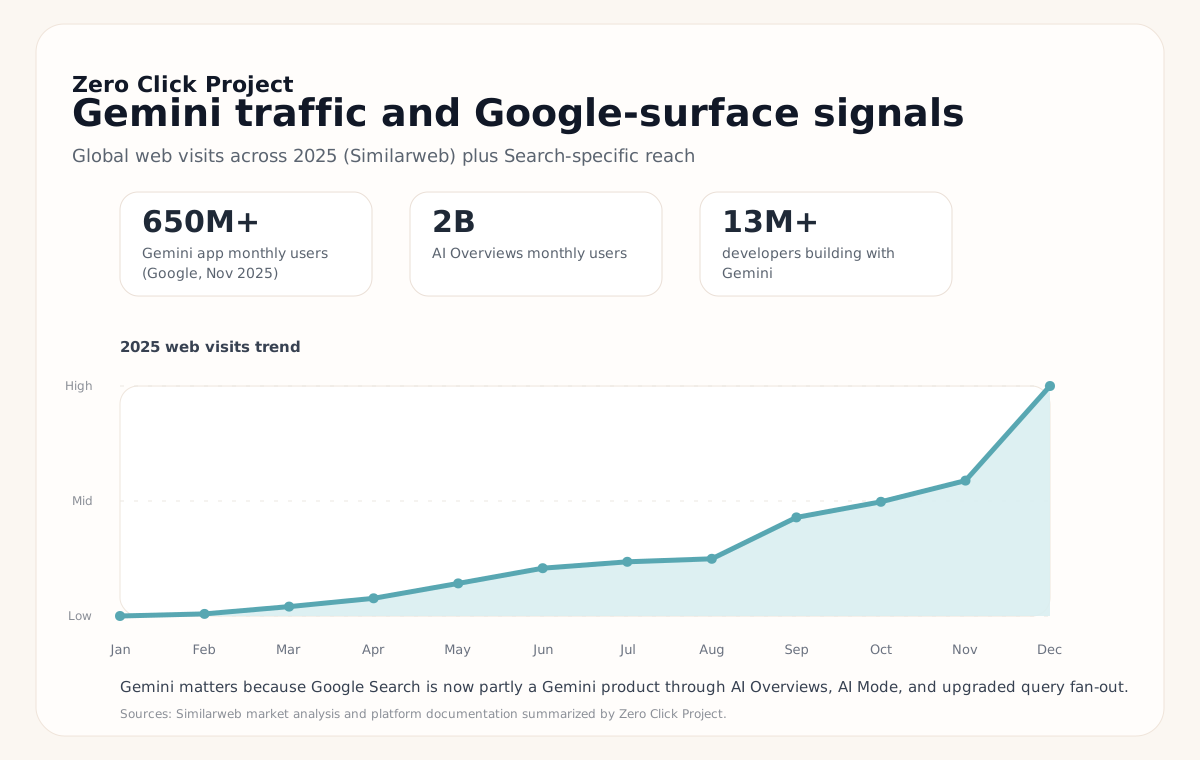
| Gemini app user base | Google said on November 18, 2025 that the Gemini app had surpassed 650 million monthly users. | Gemini is large enough on its own to matter as a discovery and research surface. |
| AI Overviews reach | Google said AI Overviews were already serving 2 billion users per month by November 18, 2025. | Many Google-originated impressions now happen in an answer format before a traditional click. |
| Search integration | Google’s March 2026 Search update says Gemini 3 is now available in AI Mode and is upgrading query fan-out to find more relevant web content. | Gemini is not just adjacent to Search anymore; it is part of how Search reasons. |
| Developer ecosystem | Google reported more than 13 million developers had built with Gemini by November 2025. | That scale matters because more retrieval, tooling, and answer experiences will inherit Gemini assumptions. |
| Web traffic growth | Similarweb recorded 1.74 billion Gemini web visits in December 2025, up from 267.7 million in January 2025. | Gemini’s growth rate is changing how quickly Google-centric GEO work becomes mandatory. |
What Gemini can (and cannot) do for website analysis in 2026
Gemini 3's model tiers
Gemini 3 runs in multiple configurations that matter for audit quality:
Gemini 3 Flash is the default, fastest model—deployed across most AI Overview queries and consumer surfaces. It gives quick, well-structured feedback and is ideal for fast on-page checks on a handful of URLs.
Gemini 3 Pro adds more reasoning depth. For multi-page audits and competitor comparisons, Pro gives noticeably more detailed gap analysis.
Gemini 3 Deep Think allocates extended compute for genuinely complex tasks. For a serious GEO audit where you want Gemini to reason about why it would or wouldn't cite your content in an AI Overview—and what specifically would change that—Deep Think is the mode to request if available.
What Gemini does exceptionally well
- AI Overview simulation: Because Gemini 3 powers Google's AI Overviews, asking it to "write the AI Overview you would generate from this page" is the most direct possible proxy for how Google will actually summarize your content.
- Google entity and knowledge graph alignment: Gemini's understanding of entities, relationships, and topical authority tracks Google's index more closely than any external model. Its critique of missing entities on your pages is grounded in how Google's systems actually understand topics.
- Intent modeling for Google queries: Gemini has strong intuitions about what users want from different query types and can identify intent mismatches between your content and the queries it is likely to surface on.
- Freshness and authority signals: Gemini notices recency signals and authority cues that Google cares about—authorship, sourcing, expertise signals—and flags their absence.
What it cannot replace
- Verified crawl and indexation data: Gemini cannot confirm whether Google has actually crawled or indexed a page. Use Search Console for ground truth.
- Actual AI Overview appearance: Gemini simulating your AI Overview is a strong proxy, not a guarantee. What actually appears in Search depends on real-time ranking and retrieval decisions.
- Third-party GEO (non-Google): Gemini is the best proxy for Google's AI surfaces but is less representative of how ChatGPT, Claude, or Grok would evaluate your content.
Before you start: what to prepare
- Your domain and any important subdomains
- A list of 10–20 priority URLs
- A 1–2 paragraph ICP and positioning summary
- The 5–10 most important queries you want to rank and appear in AI Overviews for
- Optional: competitors' domains or URLs for side-by-side comparison
For Gemini's Google-specific analysis to be most useful, think in terms of specific Google queries rather than general topics. The more you can frame your inputs as "queries a user would type into Google," the more Gemini's evaluation will reflect real AI Overview behavior.
Part 1 – SEO analysis with Gemini
How to set the right mode
Before the prompt, add:
Use Gemini 3 with Deep Think or equivalent if available when evaluating intent alignment and content gaps. Show which URLs and signals most informed each recommendation.The SEO analysis prompt
**Gemini SEO site audit — 2026**

You are a senior technical SEO and content strategist with deep expertise in how Google Search evaluates content in 2026.
Your task is to run a *reasoning-first* SEO audit of my website and turn it into a short, prioritized action plan.

**1. Context about my business**
- Brand: [BRAND NAME]
- Website: [https://www.example.com]
- ICP: [who we sell to, key segments]
- Main offer(s): [short description of products/services]
- Key markets/languages: [list]

**2. Scope**
- Homepage
- These 10–20 priority URLs (paste list):
  - [URL 1]
  - [URL 2]
  - …
- Any other pages you discover that are clearly important to this site's SEO performance.

**3. What you should analyze**

1) **Technical/structural SEO (from what you can infer)**
   - Internal linking depth and patterns
   - Canonical use and duplication signals
   - Crawlability/indexability hints (noindex patterns, blocked sections if visible)
   - Page experience signals you can infer (layout, CLS-risk, performance red flags)

2) **On-page SEO & intent alignment — evaluated through a Google Search lens**
   - For each key page, infer the dominant Google search intent (informational, commercial, transactional, navigational) and primary query clusters
   - Evaluate: title tag, meta description, H1/H2 structure — are they aligned with how Google users would phrase related queries?
   - Identify entity and topic gaps that Google would notice between my content and the full set of topics it associates with this subject

3) **Content depth and Google topical authority**
   - Identify 5–10 core topics my site should own for my ICP and market
   - For each, assess whether my content demonstrates enough depth, specificity, and internal connections for Google to view me as a topically authoritative source
   - Flag cannibalization and content duplication from Google's likely perspective

**4. How to think and justify**
- Frame every recommendation in terms of how Google evaluates content—not generic SEO theory.
- Tie recommendations to specific URLs, headings, or copy you saw.
- If you cannot verify something (server config, actual index status), flag it for Search Console validation.

**5. Outputs I want**
1) A plain-language executive summary (max 250 words) of SEO health and biggest Google-specific risks/opportunities.
2) A table: one row per priority URL, columns = URL / inferred Google query cluster / scores 1–10 for intent alignment + content depth + entity coverage / 2–3 must-fix items.
3) A prioritized action list (top 15 items): impact level / effort level / how this specifically affects Google's evaluation.
4) 3–5 quick wins I can ship this week.

State your confidence level and flag what a human should verify in Search Console or with a crawler.
What makes Gemini's SEO output distinctive
Gemini consistently surfaces entity-level gaps that other models miss—topics, product attributes, and related concepts that Google likely expects a thorough resource on this subject to cover. It also tends to be more direct about intent mismatches (e.g., "this page is written as a feature overview, but the queries it should rank for are comparison-intent—rewrite the opening to address 'vs. competitor' framing directly"). If recommendations feel too Google-centric and you want cross-engine perspective, run the same URL set through Claude or ChatGPT afterward.
Part 2 – AIO/GEO analysis with Gemini
Why Gemini is the gold standard for AI Overview optimization
Gemini 3 is AI Overviews. Asking Gemini to evaluate your page's GEO readiness is the closest approximation available to a real Google AI Overview decision. 2026 SEO and GEO practitioners use this framing deliberately: run your pages through Gemini's GEO audit, implement the suggestions, then monitor AI Overview appearances in Search Console to close the loop.
The AIO/GEO analysis prompt
Before the prompt, add:
Think like Gemini 3 powering AI Overviews and AI Mode on Google Search. You are deciding whether and how to feature each page I provide as a source in an AI Overview or AI Mode response. Evaluate my site from that first-person perspective.**Gemini AIO/GEO site audit — 2026**
You are a Generative Engine Optimization (GEO) strategist with specific expertise in how Google AI Overviews and AI Mode select and cite content.
Evaluate how well my website is positioned to be **chosen and cited** in Google AI Overviews, AI Mode, and other AI answer engines.
**1. My context**
- Brand: [BRAND NAME]
- Website: [https://www.example.com]
- ICP + core use cases: [short description]
- 5–10 most important queries I want to appear in AI Overviews for:
- [query 1]
- [query 2]
- …
- 10–20 key URLs (paste list).
**2. Simulate AI Overview behavior**
For each target query:
1) Imagine you are Gemini 3 building an AI Overview or AI Mode response.
- Write the AI Overview summary you would generate if my relevant page were your primary source.
- Then evaluate: is my page actually good enough to be used as a primary source? Why or why not?
2) For each key URL, assess:
- Does the page answer the primary query in the first 150–200 words?
- Are there clear question-based headings and concise, quotable answers under them?
- Is the content specific enough to be safely attributed to my brand in an AI summary?
- Are there authority and experience signals (named authors, data, case studies, sources)?
**3. GEO signals — score each key URL 1–10 on:**
- Primary-question clarity (answered in the first 150–200 words?)
- Atomic answers (short quotable blocks under question headings?)
- Entity & use-case clarity (who is this for and when is it best?)
- Trust & experience (case studies, examples, data, named authors?)
- Schema / structure (tables, FAQs, comparisons, structured data?)
Present as a table: URL / target query / AI Overview simulation (100 words) / 5 GEO scores / 2–3 notes.
**4. Recommendations**
Per URL:
- Rewritten opening 150–200 words that would make this page an obvious AI Overview source.
- 3–5 question-based headings to add or improve.
- 3–5 atomic answer blocks (80–120 words each) optimized for AI Overview extraction.
Site-wide:
- Top 10–15 GEO optimizations for the next 90 days.
- A global content playbook (structure, tone, evidence, length, formatting) for future pages to be AI Overview-ready by default.
- How my site compares to typical competitor patterns you have seen for these queries in Google AI Overviews.
**5. Epistemic status**
- Where is your analysis grounded in known Gemini 3 AI Overview behavior vs. extrapolation?
- Highlight 3–5 changes in Google's AI surfaces that my team should monitor over the next 6–12 months.How to interpret Gemini audit outputs critically
Gemini's Google-centric framing is its strength and its limitation:
- It may over-index on Google signals. Gemini's recommendations will naturally track what Google's systems favor. If your GEO strategy extends to ChatGPT, Claude, or Perplexity, complement this with Claude or ChatGPT audits.
- AI Overview simulation ≠ guaranteed appearance. What Gemini simulates as an AI Overview is a high-quality proxy, not a real-time guarantee. Validate with live Search Console data and manual Google searches after implementing changes.
- Entity recommendations need checking. Gemini sometimes flags entity gaps that are real but low-priority for your ICP. After the audit, ask: "Which of these entity gaps actually matter for my specific ICP and conversion path?"
- Watch for generic Google advice. If a recommendation sounds like it could be in any SEO guide from 2022, push back: "Be specific to these exact URLs and this ICP."
What Gemini is best at in a 2026 website audit
- Google-specific intent checks: Gemini tends to surface the entity and query-coverage gaps that matter most for AI Overviews and AI Mode.
- AI Overview simulation: Asking Gemini to draft the answer it would show in Search is one of the clearest ways to see whether your opening paragraphs are strong enough.
- Entity and topical completeness: Gemini is useful for spotting where a page covers a topic, but not the wider set of entities Google associates with it.
- Search-surface prioritization: It is a strong choice when the business goal is specifically Google visibility rather than cross-engine parity.
Frequently Asked Questions
When should I start with Gemini instead of ChatGPT or Claude?
Start with Gemini when Google Search is the primary source of demand and you care specifically about AI Overviews, AI Mode, and Google’s interpretation of your entities, topics, and query intent.
Does Gemini replace Search Console for AI Overview analysis?
No. Gemini helps you predict and improve what might happen in AI Overviews, but Search Console remains the source of truth for impressions, clicks, and actual appearance data.
What kind of pages benefit most from Gemini audits?
Pages targeting high-volume informational or commercial-intent Google queries benefit the most, especially comparison pages, glossary pages, category guides, and expert explainers that could surface inside AI summaries.
Why does Gemini often recommend more entity coverage?
Because Google’s systems map topics as clusters of related entities, not just keywords. Gemini often exposes the concepts, subtopics, and scenarios Google likely expects a thorough page to address.
How often should Google-focused teams rerun a Gemini audit?
Quarterly is a good baseline, and teams should also rerun important pages after major Gemini or AI Mode rollouts because Google’s source preferences and summary styles can shift quickly.