
How to Use Claude for Website SEO and AIO/GEO Analysis in 2026
A practical 2026 guide to using Claude for deep website SEO audits, large-site GEO reviews, schema analysis, and content architecture planning.
The model that reads everything
Not long ago, auditing a large website meant stitching together a crawler export, a keyword spreadsheet, and an analytics report—then paying someone to spend a week synthesizing it all into a plan that actually made sense for your business. Claude changed that equation. With Sonnet 4.6 shipping Opus-class reasoning at a faster speed and an expanded context window, and Opus 4.6 available for the most complex diagnostic challenges, Claude in 2026 can ingest your full URL set, product catalog, schema snippets, and even page screenshots—then reason across all of it simultaneously to produce audits that feel like they came from a senior strategist who actually read the brief.
This article shows you exactly how to put that capability to work for SEO analysis and AIO/GEO optimization, with prompts tuned to how Claude Sonnet 4.6 and Opus 4.6 actually behave today, and placeholders for the results you'll collect when you run them yourself.
Short answer
Use Claude when the audit requires long context, schema review, file uploads, and cross-site reasoning. Claude is particularly effective for large documentation libraries, complex content clusters, and pages where structure matters as much as copy.
Claude in 2026: the case for using it on large sites
| Signal | Latest benchmark | Why it matters for SEO and GEO |
|---|---|---|
| Current model family | Anthropic’s Transparency Hub lists Claude Sonnet 4.6 and Claude Opus 4.6 as current February 2026 models. | The 4.6 generation is explicitly positioned for complex reasoning and professional workflows. |
| Web search and citations | Anthropic’s web-search tool gives Claude access to real-time web content and automatically cites sources in the final answer. | That makes Claude unusually strong for evidence-backed audit reports and citation-sensitive GEO work. |
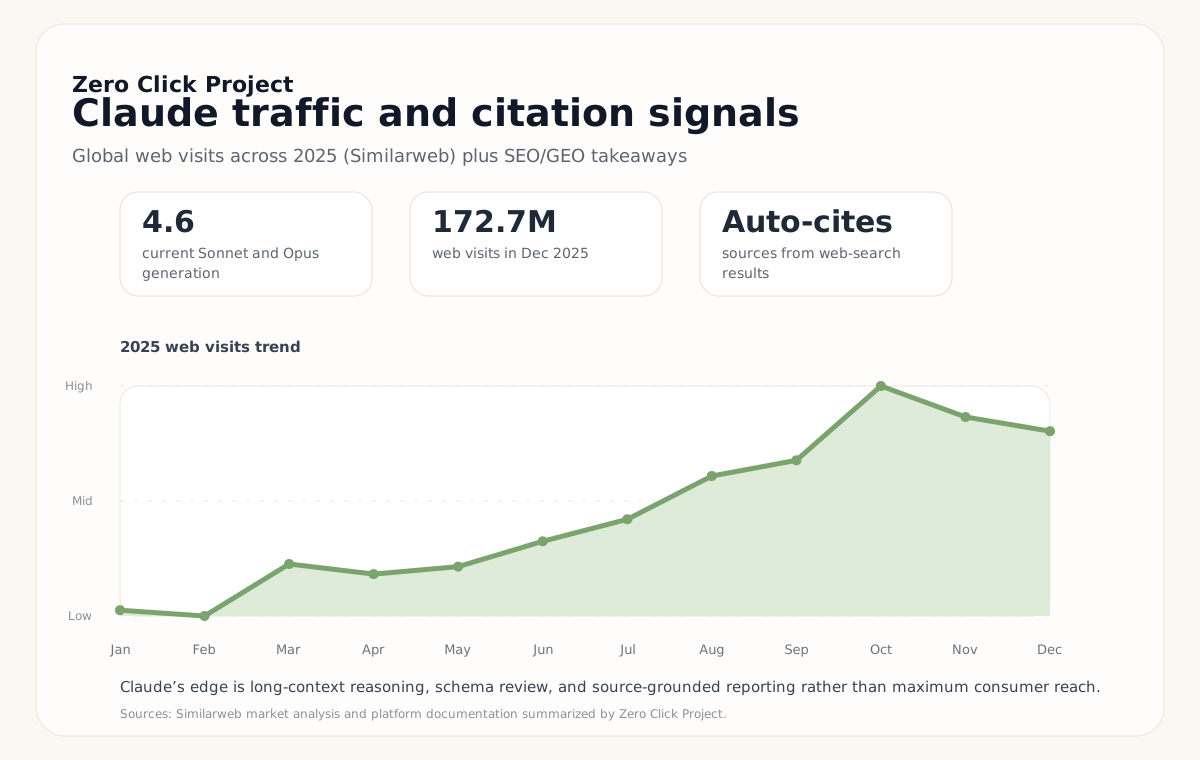
| Web traffic scale | Similarweb recorded 172.7 million Claude web visits in December 2025, up from 76.8 million in January 2025. | Claude is not the largest answer engine, but it has become a durable research and analyst workflow. |
| Traffic growth | Similarweb’s January 2026 market review put Claude’s 2025 traffic growth at roughly 125%. | Its audience is still growing fast enough to matter as a discovery and evaluation surface. |
| Recommendation and citation posture | Claude’s API docs emphasize source-grounded web search, dynamic filtering, and citation verification. | Pages with clean structure, clear evidence, and unambiguous schema tend to perform best in Claude-led analysis. |
What Claude can (and cannot) do for website analysis in 2026
Sonnet 4.6 vs. Opus 4.6
Claude's two current flagship models serve different roles in a website audit workflow.
Claude Sonnet 4.6 is Anthropic's fast, high-capability default. It combines Opus-level reasoning on most knowledge-work tasks with a significantly expanded context window, making it ideal for feeding in large URL lists, blog archives, or product feeds and asking for synthesized insights. For the majority of SEO and GEO audits, Sonnet 4.6 is the right starting point.
Claude Opus 4.6 is the frontier model for the hardest, most ambiguous problems. If you need Claude to work through genuinely conflicting signals—competing interpretations of intent across a large site, complex schema redesigns, or multi-layered GEO gap analysis across dozens of topics—Opus 4.6 produces more internally consistent and nuanced reasoning. The practical workflow: start with Sonnet 4.6, escalate specific sections to Opus 4.6 when you hit contradictions or need deeper exploration.
What Claude does exceptionally well
- Long-context synthesis: Feed it a full sitemap export, a CSV of URLs with metadata, or a brand guideline document alongside your priority pages, and it holds all of it in context while auditing.
- Schema and structured data review: Claude handles JSON-LD snippets fluently—it can validate, extend, and rewrite them while explaining why each change matters for search and GEO.
- Visual page analysis: Upload screenshots of landing pages, pricing pages, or product detail layouts, and Claude combines visual UX signals with on-page SEO reasoning.
- Content architecture and internal linking: Claude's reasoning over large URL sets is particularly strong for information architecture—spotting cannibalization, orphaned content, and missing pillar structures across a whole site.
- Persistent Projects context: Claude Projects let you store brand guidelines, product descriptions, prior audit notes, and audience personas in a persistent workspace, so every new prompt can reference the full business context without re-pasting it.
What it cannot replace
- Real crawl data: Claude cannot detect all redirect chains, server errors, or blocked resources without an actual crawler log.
- Live search volume: Keyword suggestions should be validated with Search Console or commercial tools.
- Real-time web retrieval (without tools): In most configurations, Claude reasons over pages you provide rather than crawling the live web autonomously—ensure you paste or upload the URLs and content you want it to analyze.
Before you start: what to prepare
Because Claude's long context is its superpower, front-loading your session with rich inputs pays off:
- Your domain and subdomains
- A CSV or pasted list of 10–50 priority URLs with columns: URL, page type (home/product/blog/doc/landing), primary topic, last modified
- A 1–2 paragraph ICP and positioning summary
- Optional: JSON-LD schema snippets from key pages (paste directly into the chat or upload as a file)
- Optional: screenshots of homepage, pricing, product detail, and key landing pages (drag-and-drop into Claude)
If you use Claude Projects, create a dedicated project for your website audit and upload brand guidelines, competitor positioning notes, and any prior audit reports before running the prompts. Claude will reference this context automatically.
Part 1 – SEO analysis with Claude
How to set the right effort level
Before the prompt, add this line:
Use Claude Sonnet 4.6 with medium-to-high reasoning effort. Escalate specific sections to Opus 4.6 if you encounter conflicting signals or need deeper architectural reasoning.The SEO analysis prompt
**Claude SEO site audit — 2026**

You are a senior technical SEO and content strategist in 2026.
Your task is to run a *reasoning-first* SEO audit of my website and turn it into a short, prioritized action plan.

**1. Context about my business**
- Brand: [BRAND NAME]
- Website: [https://www.example.com]
- ICP: [who we sell to, key segments]
- Main offer(s): [short description of products/services]
- Key markets/languages: [list]

**2. Scope**
I've provided a CSV (or pasted list) of my priority URLs. Use those as your primary scope.
Also review any other URLs you can infer are important from the site's structure (pricing, core feature pages, high-traffic guides, docs).

**3. What you should analyze**

1) **Technical/structural SEO (from what you can infer)**
   - Internal linking depth and patterns
   - Canonical use and obvious duplication signals
   - Crawlability/indexability hints (noindex patterns, blocked sections if visible)
   - Page experience signals you can infer from layout and structure

2) **On-page SEO & intent alignment**
   - For each key page, infer the dominant search intent and main query clusters
   - Evaluate and rewrite: title tag, meta description, H1/H2 structure
   - Call out keyword/entity gaps versus the intent you infer

3) **Content depth and architecture**
   - Cluster all my URLs into topic groups
   - Identify pillar pages, supporting pages, orphaned/weak pages that duplicate coverage
   - Propose an improved internal linking structure: for each pillar, list 5–15 supporting URLs with suggested anchor text focused on entities and problems, not just keywords
   - Flag stale content (older than [X] months in fast-changing topics) and recommend: merge, refresh, or retire

4) **Schema and rich-result readiness**
   If I've provided JSON-LD snippets, review them:
   - Identify type and completeness for current rich results
   - Suggest additional properties that connect content to specific use cases and audiences
   - Rewrite each snippet with explanations between blocks

**4. How to think and justify**
- Tie every recommendation to specific URLs, headings, or copy snippets you saw.
- When you say "improve X," propose an example rewrite or structural change.
- If you cannot see something (server config, live crawl), flag it explicitly and suggest human verification steps.

**5. Outputs I want**
1) A plain-language executive summary (max 250 words) of SEO health and biggest risks/opportunities.
2) A topic-cluster table: cluster name / pillar URL / supporting URLs / key entity coverage gaps / 1–2 priority actions per cluster.
3) A prioritized action list (top 15 items): impact level / effort level / why it matters for my ICP, not just rankings / example implementation for each item.
4) 3–5 quick wins I can ship this week.

When done, state your confidence level and flag where a human should validate with dedicated SEO tools.
What makes Claude's SEO output distinctive
Claude tends to produce the most architecturally detailed content audits of any current model. Where ChatGPT might give you a punchy top-10 list, Claude will more often produce a genuinely argued content strategy: why certain clusters are underserved, how the internal linking creates dead ends for both crawlers and readers, and what the sequencing of a fix should look like. If the output is more detailed than you need, follow up: "Summarize the action list to 10 high-impact items only, with one-sentence rationale each."
Part 2 – AIO/GEO analysis with Claude
Why Claude is especially powerful for GEO
Claude's large context window allows it to reason over your entire content library in a single session. That matters for GEO because the question isn't just "is this page good?"—it's "across all my content, do I build a coherent, authoritative picture of my topic that an AI system would trust enough to cite?" Claude is also one of the answer engines evaluating your content in real user queries, so its critique of your GEO readiness has the same first-person value as ChatGPT's.
The AIO/GEO analysis prompt
Before the prompt, add:
Think like Claude 4.6 embedded inside a research assistant that must show reasoning, sources, and trade-offs to a user. Evaluate my site from the perspective of an AI system deciding whether this content is specific, trustworthy, and quotable enough to use in an answer.**Claude AIO/GEO site audit — 2026**
You are a Generative Engine Optimization (GEO) strategist in 2026.
Evaluate how well my website is positioned to be **chosen and cited** by AI systems like ChatGPT, Gemini, Claude, Grok, and Perplexity when answering queries in my space.
**1. My context**
- Brand: [BRAND NAME]
- Website: [https://www.example.com]
- ICP + core use cases: [short description]
- 5–10 most important queries or problems we want to own:
- [query 1]
- [query 2]
- …
- 10–50 key URLs (paste list or upload CSV).
**2. Simulate answer-engine behavior**
For each target query:
1) Imagine you are Claude or a similar AI building an answer.
- What kinds of pages and evidence would you want to pull from?
- Which signals say "this is safe, useful, and specific enough to quote"?
2) Review my URLs and answer:
- Would you use my content as a primary or secondary source? Why or why not?
- Are my intros written as a clear 80–150-word atomic answer block?
- Are there question-based headings with concise answers under them?
- Do I offer concrete examples, data, or opinions that differentiate me from generic overviews?
**3. GEO signals — score each key URL 1–10 on:**
- Primary-question clarity (answered in the first 150–200 words?)
- Atomic answers (short quotable blocks under question headings?)
- Entity & use-case clarity (who is this for and when is it best?)
- Trust & experience (case studies, examples, data, named authors?)
- Schema / structure (tables, FAQs, comparisons, structured data?)
Present as a table: URL / core question(s) / 5 scores / 2–3 notes.
**4. Recommendations**
Per URL:
- Rewritten opening 150–200 words optimized as an atomic answer source.
- 3–5 question-based headings to add or improve.
- 3–5 atomic answer blocks (80–120 words each) that an AI system would find easy and safe to quote.
Site-wide:
- Top 10–15 GEO optimizations for the next 90 days.
- A global content playbook (structure, tone, evidence, length, formatting) for all future pages to be answer-engine-ready by default.
If I've provided JSON-LD snippets, also:
- Identify how each schema type can be enriched to help AI systems understand *who* the product is for and *when* it is the best answer.
- Rewrite 3–5 snippets with properties that map to real user questions and use cases.
**5. Epistemic status**
- Where is your analysis grounded in current Claude 4.6 and Gemini 3 behavior vs. extrapolation?
- Highlight 3–5 trends my team should monitor over the next 6–12 months.How to interpret Claude audit outputs critically
Claude is thorough and well-reasoned, but it has its own failure modes:
- Over-engineering. Claude sometimes recommends structural overhauls when a smaller targeted change would do. After the full audit, ask: "Which three items on this list have the highest impact-to-effort ratio?"
- Confidence without crawl access. Claude will reason about internal linking and canonical patterns from what it can see in HTML and URLs, but it cannot verify server-side redirects or dynamically generated content. Flag technical issues for crawler validation.
- Context drift on very long sessions. Even with a large context window, very long sessions can produce slight inconsistencies between the early and late parts of an audit. For large sites, run separate sessions per topic cluster or URL set.
- Schema rewrites need validation. Claude's JSON-LD rewrites are generally high quality, but always run the output through Google's Rich Results Test before deploying.
What Claude is best at in a 2026 website audit
- Large-context synthesis: Claude is excellent when you need to feed in a sitemap export, internal notes, product docs, screenshots, and schema snippets in one session.
- Schema critique: Claude handles JSON-LD review and enrichment well, making it useful for pages where structure and semantics need work.
- Information architecture: It is particularly strong at spotting thin clusters, orphan pages, duplicate coverage, and missing internal-linking bridges.
- Evidence-aware reporting: Because Claude can search and cite sources, it is well-suited to audits that need to show why a recommendation is grounded.
Frequently Asked Questions
When is Claude a better choice than ChatGPT for SEO work?
Claude is usually the better choice when the job is document-heavy, architecture-heavy, or schema-heavy. If you need to reason across many URLs, long briefs, screenshots, and structured data at once, Claude often produces the cleaner plan.
Should I start with Sonnet or Opus?
Start with the faster general-purpose Claude mode for most audits, then escalate to the most capable model when the site has conflicting signals, complex taxonomy problems, or multiple possible restructuring paths.
Does Claude cite sources automatically during web search?
Yes. Anthropic’s web-search documentation says Claude automatically cites sources from search results, which makes it useful for audits where you want more transparent evidence and easier QA.
What kinds of pages benefit most from a Claude GEO audit?
Dense educational pages, comparison pages, documentation hubs, pricing pages, and pages with meaningful schema or file-based context benefit the most because Claude can absorb more supporting material before judging the page.
What should teams validate outside Claude?
Teams should still validate crawlability, redirects, canonical behavior, real indexation, and performance data with crawlers, Search Console, and page-speed tooling. Claude is a reasoning assistant, not a crawler.