
Understanding the 2026 Ecommerce Shift: A Marketer's Guide to Preparing for What's Next
Global ecommerce will hit $3.8 trillion this year, climbing toward $4.9 trillion by 2030. But the infrastructure powering these sales is changing. Here's what marketers and agencies need to know about the major trends reshaping commerce in 2026.
Think about how you shopped online five years ago. You probably visited a brand's website, used the search bar, clicked through categories, added items to cart, filled out payment forms, and finally - after several minutes - checked out. That process is disappearing faster than you might realize.
In 2026, your customers are starting to shop in fundamentally different ways. They're asking AI assistants to find products for them. They're buying directly inside Instagram without ever visiting a website. They're using voice commands while cooking dinner to reorder household essentials. They're watching livestreams where clicking "buy now" feels as natural as liking a post.
This guide breaks down the major ecommerce trends of 2026 in plain language, explaining not just what's happening, but why it matters for your marketing strategy and how you can start preparing today.
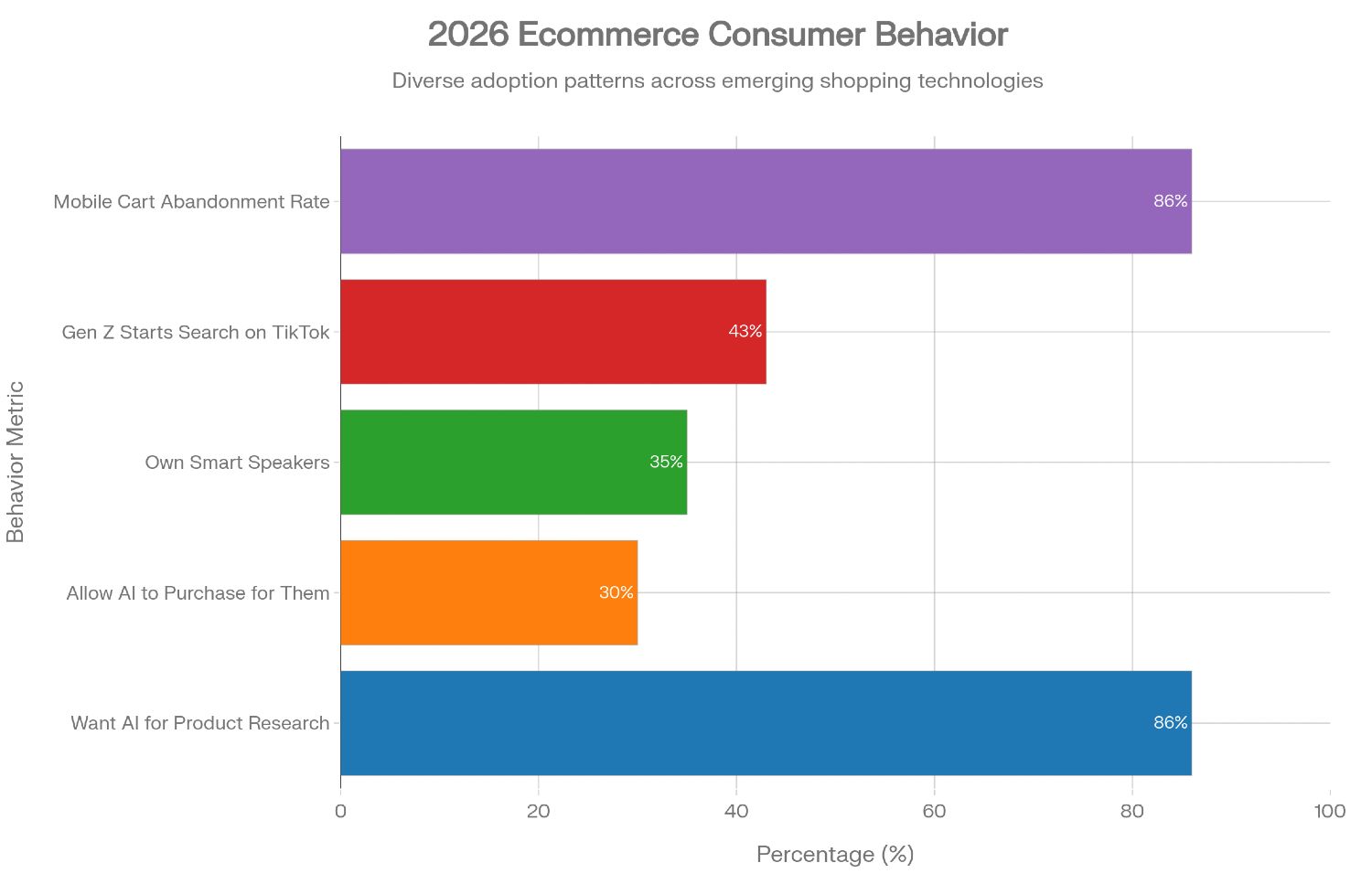
Dramatic shift in how consumers are shopping in 2026 (Source: ZeroClickProject)
The Big Picture: Why "Boring" Backend Infrastructure Now Determines Marketing Success
In 2026, having brilliant marketing campaigns matters less than having flexible systems behind them.
The brands pulling ahead right now are moving focus away from surface innovation and more into logistics and structure. What does that actually mean? It means that bringing customers to your website is only half the battle. The real competitive advantage comes from how quickly you can launch new experiences, fulfill orders, connect to new channels, and recover when something breaks.
Think of it this way: You can create the most compelling Instagram campaign in the world, but if your ecommerce system can't support direct Instagram checkout, customers hit a wall. That friction - clicking over to your website, searching for the product again, going through checkout - causes most people to abandon the purchase entirely.
How AI Shopping Assistants Actually Work (And Why You Should Care)
AI Assistants Are Becoming Autonomous Shoppers
An AI shopping assistant is software that helps people find and buy products through conversation. Instead of browsing websites, customers describe what they want in natural language:
Find me moisturizer for sensitive skin under $30" or "Reorder my usual coffee.
Here's how they work in simple terms: The customer asks a question or makes a request. The AI uses natural language processing to understand intent - not just matching keywords, but grasping what the person actually wants. It searches product catalogs, applies filters, checks inventory, and compares options using machine learning trained on millions of past shopping behaviors. The assistant presents relevant products with images, descriptions, and prices. In advanced cases, it completes the purchase automatically if the customer has given permission.
Research shows 86% of consumers now want AI help with product research, and roughly 30% of US shoppers already allow AI to make purchases on their behalf. That last statistic is the one marketers need to internalize: Nearly one-third of customers are comfortable letting AI buy things without visiting your website.
What This Means for Your Marketing
When AI assistants shop on behalf of customers, traditional marketing touchpoints disappear. Your carefully designed homepage? They don't see it. Your banner ads? Irrelevant. Your conversion-optimized product pages? Bypassed entirely.
Your marketing strategy needs to adapt:
Optimize product data like you optimize ad copy. Write clear, detailed product descriptions with attributes that AI can easily parse. If your product listing says "great quality," an AI assistant has no idea what that means. If it says "100% organic cotton, GOTS-certified, 300-thread-count," the AI can compare it to other options intelligently.
Invest in review quantity and quality. AI assistants heavily weight verified customer reviews when making recommendations. Brands with rich, recent reviews win autonomous purchases.
Ensure your technical infrastructure supports AI access. This is where you need to talk with your tech team: Can AI shopping assistants access your product catalog? Do you have APIs that external systems can query? If not, you're invisible to this growing channel.
Voice Commerce: Why People Are Talking to Their Speakers
Voice shopping sounds futuristic, but it's already mainstream. As of 2025, 35% of Americans aged 12 and up own smart speakers, and voice-enabled shopping is becoming routine.
How Voice Shopping Actually Works
Picture this: Someone is cooking dinner, their hands covered in flour. They realize they're out of olive oil. Instead of stopping to search on their phone, they say:
Alexa, order the organic olive oil I bought last time.
The voice assistant understands the request, checks their purchase history, confirms the product is in stock, processes payment using saved credentials, and confirms delivery - all in about 10 seconds.
Voice shopping works best for replenishment purchases (restocking things you buy regularly) rather than discovery shopping (browsing for something new). But that distinction is important: Replenishment purchases represent steady, recurring revenue. Brands that capture voice-based reorders build customer loyalty that's incredibly sticky.
Optimizing for Voice Search
Voice searches sound different from typed searches. When typing, someone might search: "best running shoes men." When speaking, they say:
What are the best running shoes for men who need arch support?
The second query is longer, more conversational, and includes context. This is called natural language, and it requires different optimization strategies.
Use conversational keywords in product descriptions. Think about how people actually speak when describing what they want.
Answer questions directly. Structure product information to address common voice queries.
Claim and optimize business listings. Voice assistants pull information from Google Business profiles and other directories.
Make reordering easy. Work with your platform provider to enable voice reordering through Alexa, Google Assistant, or Siri.
Composable Commerce: Understanding Why "Lego Block" Systems Matter
The Old Way: Monolithic Platforms
Traditional ecommerce platforms are monolithic, meaning everything is bundled together. Your storefront design, product catalog, checkout process, payment handling, and order management all exist in one giant system. It's like buying a complete computer where you can't swap out individual parts.
The New Way: Composable Commerce
Composable commerce is like building with Lego blocks. Instead of one giant system doing everything, you select specialized tools - best-of-breed components - for each function: One system manages your product catalog, another handles payments, another manages shipping and fulfillment, another runs your customer loyalty program, and another powers your mobile app.
These components connect through APIs (think of APIs as standardized plugs that let different systems talk to each other). When everything connects through APIs, you can swap components without rebuilding your entire system.
Why Marketers Should Care
Composable systems give you three major advantages: Speed (launch new experiences faster), Flexibility (adapt when customer behavior changes), and Best tools for each job (choose the absolute best tool for each function).
The tradeoff is complexity: Managing multiple integrated components requires more coordination than using one all-in-one platform. But for most growing brands, the flexibility is worth it.
Social Commerce: Turning Social Media Into Storefronts
Social commerce means selling directly inside social media platforms - Instagram, TikTok, Facebook, Pinterest - without making customers leave to visit your website.
The Numbers Tell the Story
Over 110 million Americans made purchases directly through social channels in 2024. Global social commerce will hit roughly $908 billion in 2026. Generation Z starts 43% of their product searches on TikTok, not Google. The pattern is clear: Younger customers treat social platforms as search engines and shopping destinations.
Livestream Shopping: QVC for the Internet Age
Livestream ecommerce hit $50 billion in the US in 2023 and will reach $68 billion by 2026. Here's how it works: A brand or influencer goes live on TikTok, Whatnot, or similar platforms. They demonstrate products in real-time, answer questions in the chat, and viewers can purchase instantly without ending the video.
Livestream shopping typically converts at 10X the rate of traditional ecommerce: 30% conversion versus 2-3%. That difference comes from reduced friction and increased emotional engagement.
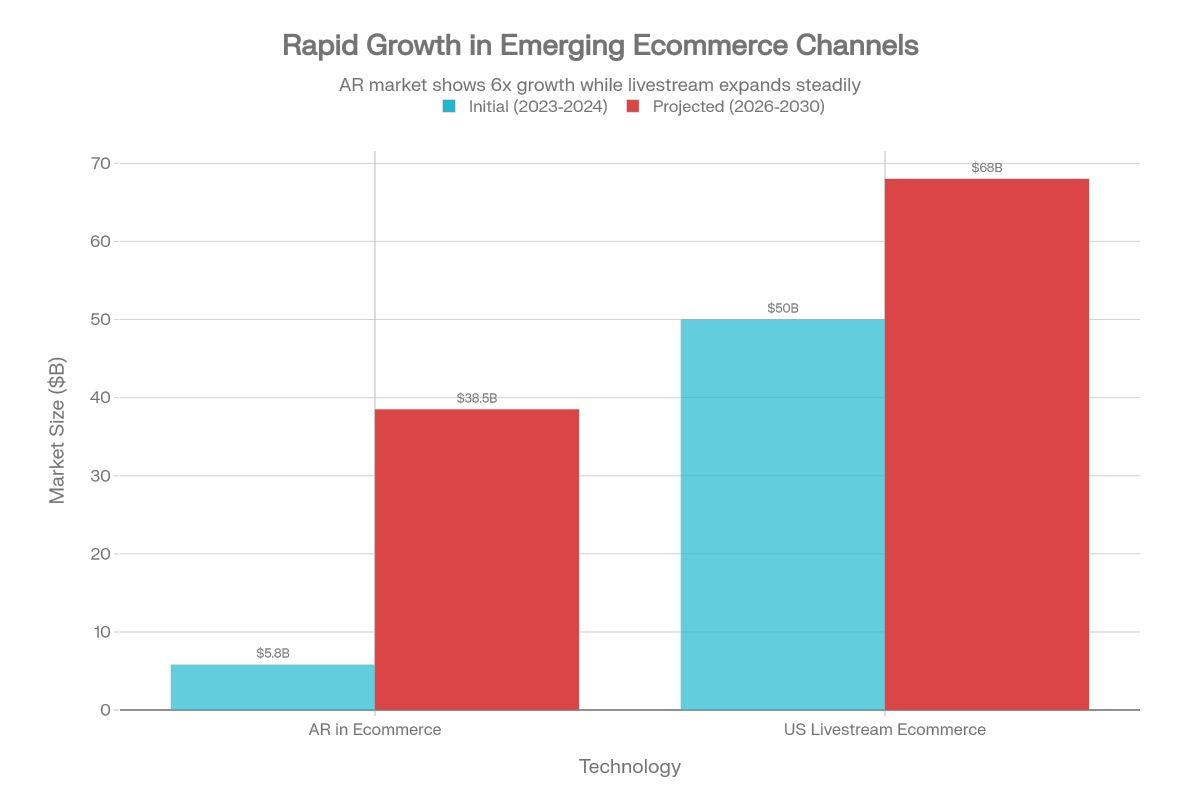
Market size growth in AR and livestream ecommerce channels from 2024 to 2030 (Source: ZeroClickProject)
Augmented Reality: Helping Customers "Try Before They Buy" Digitally
AR in ecommerce lets customers visualize products in their real environment before purchasing. Point your phone at your living room and see how that couch looks in your space. Use your phone's camera to preview how glasses look on your face. Test makeup shades virtually.
The Business Case for AR
The global AR in ecommerce market was $5.8 billion in 2024 and will hit $38.5 billion by 2030 - that's 35.8% annual growth. Brands using AR report 20-30% fewer returns because customers make better-informed purchase decisions.
Returns are expensive. Beyond the obvious cost of reverse shipping and restocking, returns hurt margins and customer satisfaction. If AR reduces returns even modestly, the ROI is significant.
Personalization That Actually Feels Personal
Generic product recommendations are dead. In 2026, effective personalization means treating every shopper as unique based on their actual behavior.
What Hyper-Personalization Actually Means
Hyper-personalization uses real-time data - clicks, scrolls, time on page, purchase history, abandoned carts - to dynamically adjust what each person sees. Two customers visiting your homepage at the same time should see different featured products based on their individual behaviors and preferences.
AI-powered personalization can boost conversion rates by 10-15% and drives up to 200% revenue increases when implemented well. Those gains come from showing people products they're actually interested in, rather than forcing everyone through the same generic experience.
Mobile-First Isn't a Trend Anymore - It's the Default Expectation
Mobile commerce isn't a separate channel. It's where most shopping happens. 98% of active internet users access the internet through mobile devices. Mobile cart abandonment rates approach 86%, partly because traditional checkout flows require too much typing on small screens.
One-Click Payments Solve Mobile Friction
The solution is digital wallet payments: Apple Pay, Google Pay, PayPal One Touch, and similar services. These tools let customers complete checkout with literally one tap by using securely saved payment and shipping information.
The pattern is clear: Every tap you eliminate from mobile checkout increases conversion. The goal is zero typing: no manual entry of credit card numbers, addresses, or contact information.
Preparing Your Marketing Strategy for 2026 and Beyond
These trends aren't isolated developments - they're interconnected shifts that all point toward the same principle: Customers want to buy with less effort. Every technology, platform, and strategy succeeding in 2026 reduces friction between wanting something and owning it.
Practical Next Steps for Marketers
Audit your current capabilities: Go through each trend in this guide and honestly assess where you stand. Make a list of gaps.
Prioritize based on your audience: Not every trend matters equally for every brand. Focus on trends where your specific customers are actually shopping.
Start conversations with your tech team: Share this article with your developers or platform provider and ask which capabilities you currently support.
Test incrementally: Pick one trend, run a pilot, measure results, then expand. Incremental progress beats paralysis.
Think about channels, not just campaigns: Modern ecommerce marketing thinks in terms of channels - ensuring products are discoverable wherever customers are searching.
The Convergence: Where Technology Meets Customer Expectations
All these trends share a common theme: They eliminate steps between desire and purchase. Voice search removes typing. AI assistants remove browsing. Social commerce removes website visits. One-click checkout removes form-filling. AR removes uncertainty.
The ecommerce industry is converging toward frictionless transactions. The winning marketing strategies understand this and build for speed, convenience, and presence across every channel where customers show intent.
Your customers aren't necessarily asking for these technologies explicitly. They're asking for something simpler: "Make it easy for me to buy from you." These technologies - AI, voice, social commerce, AR, personalization, composable systems - are the infrastructure that makes "easy" possible at scale.
The $3.8 trillion ecommerce market isn't slowing down. The brands capturing that growth are the ones building flexible, customer-centric systems that meet shoppers wherever they are. Make sure your brand - or your clients' brands - are among them.