
How to Use Grok for Website SEO and AIO/GEO Analysis in 2026
A practical 2026 guide to using Grok for real-time SEO reviews, live-language GEO audits, and freshness checks grounded in web and X search.
The auditor that never stops reading the room
Until recently, website audits lived in snapshots: a crawl report from Tuesday, a keyword export from last month, a competitor analysis that was already three quarters stale by the time someone acted on it. Grok changed that dynamic. With current Grok 4 models, xAI's real-time web search, and X Search working together, an audit powered by Grok doesn't just evaluate what your site says—it checks whether what your site says still matches how people are actually talking about your topic right now, what questions are trending, and where your content has quietly fallen behind the current conversation.
That live-awareness is a distinct edge for SEO and AIO/GEO work. This article shows you how to put it to work with structured prompts tuned to what Grok's current live-search stack actually does in March 2026, with placeholders for the results you'll collect when you test them on your own site.
Short answer
Use Grok when you need to know whether your language matches live discourse right now. Grok is most useful for freshness checks, current-question audits, and content that competes in fast-moving markets where social phrasing shapes discovery.
Grok in 2026: why it is useful even if it is not the largest platform
| Signal | Latest benchmark | Why it matters for SEO and GEO |
|---|---|---|
| Current model stack | xAI’s docs currently highlight Grok 4.20 early access and Grok 4 Fast production models, with web search and X search available through the API. | The key differentiator is not just the model name; it is the live retrieval stack attached to it. |
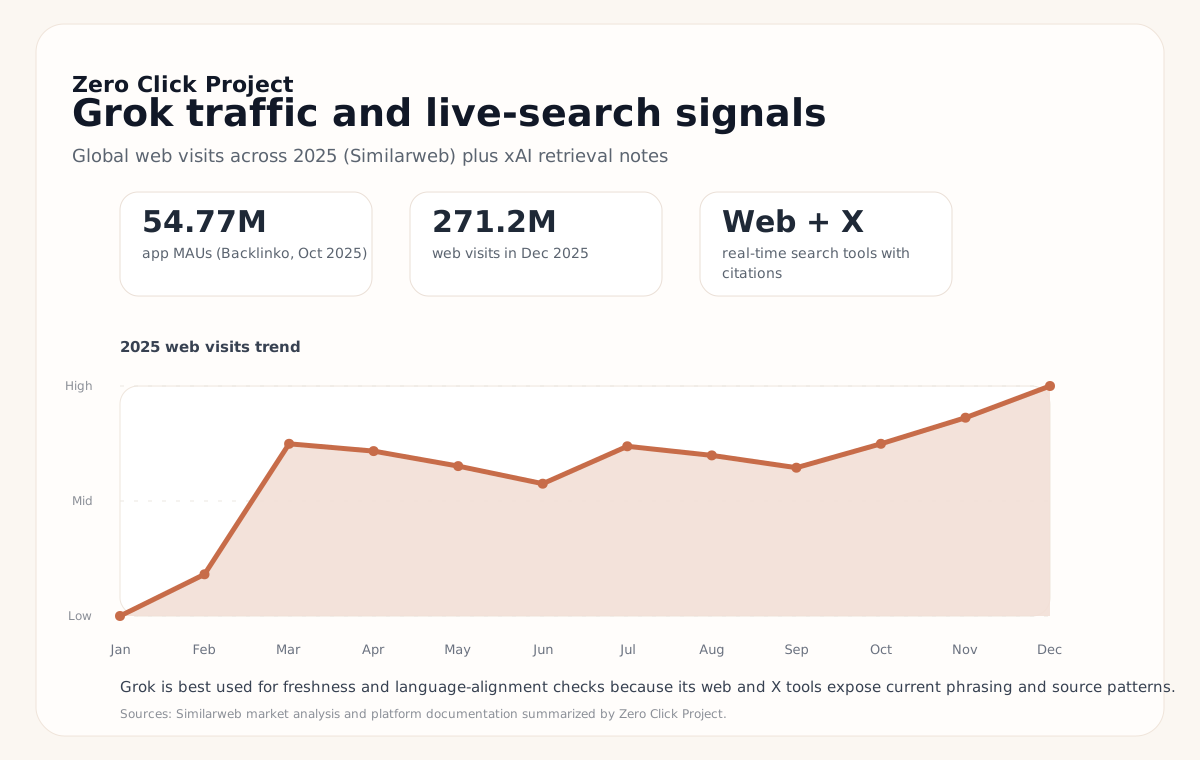
| Web traffic trend | Similarweb recorded 271.2 million Grok web visits in December 2025, up from roughly 1.2 million in January 2025. | Grok grew from niche traffic to meaningful discovery volume in under a year. |
| Growth spike | Similarweb’s January 2026 market review reported Grok traffic grew more than 4,000% in February 2025 after the Grok 3 launch. | Grok is highly sensitive to launches, live-news cycles, and current-conversation demand. |
| App user base | Backlinko estimated Grok reached 54.77 million monthly active app users in October 2025. | It is smaller than ChatGPT or Gemini, but large enough to matter in niches that follow X closely. |
| Citations and traceability | xAI’s docs say the API returns all citations by default and supports inline citations, while X Search adds direct access to live posts and threads. | That makes Grok a practical tool for auditing how your content aligns with current phrasing and sources. |
What Grok can (and cannot) do for website analysis in 2026
Grok's key capabilities in 2026
Grok 4 Fast and the newer Grok 4.20 early-access stack pair strong reasoning with deep real-time retrieval from both the open web and X's public stream. That combination makes it uniquely good at two things most LLM auditors can't do:
- Live query-language alignment: Grok can pull the exact phrases and questions people are using right now about your topic and compare them to how your pages are actually written—surfacing language gaps that traditional keyword tools miss because they measure search volume rather than conversational phrasing.
- Real-time topical coverage gaps: Grok notices when your content does not reflect developments, debates, or questions that are actively circulating in your space, flagging outdated sections that a static audit would miss.
What Grok does exceptionally well
- Real-time conversational phrasing: Grok reflects how people are phrasing questions about your topic on X and across the live web—more useful for GEO than synthetic search volume numbers.
- Trend and freshness detection: It can flag when your key pages have not kept pace with industry shifts, product category changes, or competitive developments that are actively being discussed.
- Question-driven content critique: Grok is tuned to answer questions directly, which means it is naturally calibrated to spot when your content buries the answer or uses jargon rather than the question-shaped language users and AI systems prefer.
- Brand conversation analysis: For brands with significant X presence or community discussion, Grok can surface how your brand, product, and category are being talked about and whether your site content reflects or contradicts that framing.
What it cannot replace
- Technical crawl data: Grok cannot detect redirect chains, server-side errors, or indexation issues without a dedicated crawler.
- Historical search volume trends: Its real-time strength is also a limitation—it reflects what is happening now, not long-term volume patterns. Pair with Search Console for trend validation.
- Deep content architecture planning: Grok's output on large-site IA tends to be less exhaustive than Claude's long-context synthesis. For complex pillar-cluster redesigns, use Grok for real-time language alignment, then Claude for architectural depth.
Before you start: what to prepare
Grok's output is sharpest when your prompts connect your site to specific current conversations:
- Your domain and key subdomains
- A list of 10–20 priority URLs
- A 1–2 paragraph ICP and positioning summary
- The 5–10 most important topics or queries you care about (described in natural language, not just keywords)
- Optional: your most important X handle or brand community if Grok should factor in how your brand appears in live conversations
Because Grok reasons with live web context, you don't need to paste full page content—URL lists are enough for it to read pages in real time.
Part 1 – SEO analysis with Grok
How to activate real-time context
Before the prompt, add:
Use Grok 4.2 with live web and X access. Where helpful, draw on current conversations, trending questions, and recent content in my space to contextualize recommendations.The SEO analysis prompt
**Grok SEO site audit — 2026**

You are a senior technical SEO and content strategist in 2026.
Your task is to run a *reasoning-first* SEO audit of my website and turn it into a short, prioritized action plan—using your real-time web and X access to ground recommendations in how my topic is actively being discussed and searched.

**1. Context about my business**
- Brand: [BRAND NAME]
- Website: [https://www.example.com]
- ICP: [who we sell to, key segments]
- Main offer(s): [short description of products/services]
- Key markets/languages: [list]

**2. Scope**
- Homepage
- These 10–20 priority URLs (paste list):
  - [URL 1]
  - [URL 2]
  - …
- Any other pages you discover that are clearly important.

**3. What you should analyze**

1) **Technical/structural SEO (from what you can infer)**
   - Internal linking depth and patterns
   - Canonical use and obvious duplication signals
   - Crawlability/indexability hints (noindex patterns, blocked sections if visible)
   - Page experience signals you can infer from layout and structure

2) **On-page SEO & live intent alignment**
   - For each key page, infer the dominant search intent and primary query clusters
   - **Use your real-time web and X access** to identify:
     - The top 10–15 questions people are currently asking about this topic
     - The phrases, terminology, and framing that appear most often in current discussions
   - Compare those against what my pages actually say:
     - Which questions does each page answer well?
     - Which does it partially answer?
     - Which important questions is it missing entirely?
   - Evaluate and rewrite: title tag, meta description, H1/H2 structure to reflect current language

3) **Content freshness and topical gaps**
   - Identify content that is likely stale based on what is actively being discussed in my space right now
   - Flag topics that are gaining traction in current conversations but have no page on my site
   - Recommend: refresh, merge, new content, or retire—with priority based on current demand

**4. How to think and justify**
- Tie every recommendation to specific URLs and, where relevant, specific current conversations or questions you found.
- When you say "add a section on X," write an example heading and a 80-word draft of what that section should say.
- If you cannot verify something technical, flag it for crawler validation.

**5. Outputs I want**
1) A plain-language executive summary (max 250 words) of SEO health and biggest content-freshness risks.
2) A "questions gap" table: one row per priority URL, columns = URL / top current questions on this topic / questions the page answers / questions it misses / priority score.
3) A prioritized action list (top 15 items): impact level / effort level / why it matters for my ICP right now, not just in theory.
4) 3–5 quick wins I can ship this week—prioritizing language and freshness fixes over technical changes.

State your confidence level and flag where a human should validate with dedicated SEO tools.
What makes Grok's SEO output distinctive
Where Claude produces content architecture depth and Gemini maps to Google's entity model, Grok gives you live language intelligence. Its most useful output format for SEO is the questions-gap analysis: a direct comparison of what people are asking right now versus what your pages say. That alignment—or misalignment—between current discourse and your content is often invisible to other tools and is increasingly the gap that determines whether AI answer engines choose your content or a more conversationally-aware competitor.
Part 2 – AIO/GEO analysis with Grok
Why Grok's real-time access is uniquely valuable for GEO
GEO is about structuring your content so AI answer engines reach for it when answering user questions. Grok's live-web awareness means it can tell you what those user questions actually look like today—not based on historical keyword data but based on what is being asked on X, in search queries, in forums, and across the current web. That is the raw material GEO is built from: if your content speaks the same language as active user questions, AI systems find it easier to match and quote.
The AIO/GEO analysis prompt
Before the prompt, add:
Think like Grok 4.2, combining live X conversations and web pages to answer what people are actually asking right now. Evaluate my site's content through the lens of: would a real-time AI answer engine, drawing on current discourse, find this content clear, specific, and trustworthy enough to quote?**Grok AIO/GEO site audit — 2026**
You are a Generative Engine Optimization (GEO) strategist in 2026 with real-time web and X access.
Evaluate how well my website is positioned to be **chosen and cited** by AI systems like Grok, ChatGPT, Gemini, Claude, and Perplexity when answering queries in my space—grounded in how those queries are *actually being phrased right now*.
**1. My context**
- Brand: [BRAND NAME]
- Website: [https://www.example.com]
- ICP + core use cases: [short description]
- 5–10 most important queries or problems we want to own:
- [query 1]
- [query 2]
- …
- 10–20 key URLs (paste list).
**2. Simulate real-time answer-engine behavior**
For each target query:
1) Use your live web and X access to identify:
- How are people actually phrasing this question right now?
- What level of specificity, detail, and format do current answers use?
- Which brands or sources are currently being mentioned as authorities in live discussions?
2) Evaluate my URLs against that real-time standard:
- Does my content use the same language and framing active users are using?
- Would a real-time answer engine find my content more specific and useful than what it's currently pulling from?
- Are there claims, comparisons, or details in current discourse that my content should be addressing but isn't?
**3. GEO signals — score each key URL 1–10 on:**
- Primary-question clarity (answered in the first 150–200 words in today's language?)
- Atomic answers (short quotable blocks under question headings?)
- Entity & use-case clarity (who is this for and when is it best?)
- Trust & experience (case studies, examples, data, named authors?)
- Language freshness (does it use current terminology, or is it written in 2023 language for a 2026 audience?)
Present as a table: URL / top current query variant / 5 GEO scores / 2–3 notes tied to live discourse you found.
**4. Recommendations**
Per URL:
- Rewritten opening 150–200 words using current language that makes this an obvious real-time answer source.
- 3–5 question-based headings that reflect how people are asking this question today.
- 3–5 atomic answer blocks (80–120 words each) that would feel current and specific enough to quote in a 2026 AI answer.
Site-wide:
- Top 10–15 GEO optimizations for the next 90 days, prioritized by what is actively trending in my space.
- A global content playbook (structure, tone, freshness cadence, evidence requirements) that keeps my content aligned with live discourse over time.
**5. Epistemic status**
- Be explicit about what you found through live web/X retrieval vs. what is extrapolated from general patterns.
- Flag 3–5 topics or questions gaining momentum in my space right now that my site is not yet addressing.How to interpret Grok audit outputs critically
Grok's real-time framing is its superpower—and the source of its main failure modes:
- Live retrieval can be noisy. Grok may surface fringe conversations or very recent but not-yet-mainstream questions as "critical gaps." Ask: "Which of these gaps reflect durable shifts in how people talk about this, versus short-term noise?"
- X-centric bias. Grok's live retrieval is anchored heavily to X. If your ICP doesn't live on X, the "current conversations" Grok references may not reflect your actual audience. Validate against Search Console query data.
- Less architectural depth. Grok tends to prioritize freshness and language alignment over deep structural analysis. For complex pillar-cluster redesigns, use Grok for language and tone input, then Claude for architecture.
- Always ask for sources. When Grok attributes something to "current discussions," ask it to name the actual sources or threads. This separates genuine live intelligence from hallucinated plausibility.
What Grok is best at in a 2026 website audit
- Freshness checks: Grok can show whether your page language sounds current or whether it still reads like last year’s version of the market.
- Live phrasing analysis: The X Search and Web Search tools make it useful for seeing how questions are actually being asked right now.
- Fast-moving categories: Grok is especially useful in categories where discourse changes quickly, such as AI software, ecommerce tooling, media, finance, or creator platforms.
- Source-grounded prompts: xAI’s citations tooling makes it easier to separate live evidence from plausible but unsupported synthesis.
Frequently Asked Questions
When is Grok more useful than the other audit models?
Grok is most useful when the main problem is freshness rather than structure. If you need to know whether your page reflects current language, current objections, or current source patterns, Grok can be very effective.
Should I trust Grok for full technical SEO audits?
No. Grok can help with structural inference and page-level critique, but it should not replace a crawler, Search Console, or log analysis. Its strongest contribution is live language and discourse analysis.
What is the practical GEO advantage of X Search?
X Search lets Grok inspect live posts, threads, and social phrasing. That can reveal how people frame a topic today, which helps teams write headings and summaries that feel more aligned with current intent.
Does Grok provide citations for live research?
Yes. xAI’s agent tools API returns citations by default and supports inline citations, which makes it easier to inspect where Grok found evidence during a research-heavy answer.
How often should teams use Grok for GEO work?
Monthly is reasonable for fast-moving markets, especially when new launches or narratives change how buyers frame a problem. For slower categories, quarterly checks are usually enough.