
Multi-Agent AI Architecture for Retail: How Coordinated AI Agents Are Transforming Shopping
The next generation of AI shopping assistants uses multi-agent architectures — specialized agents collaborating to handle everything from customer profiling to product matching. Here is how it works and what it means for product data.
Retail AI is evolving beyond single-purpose chatbots. The next generation of shopping assistants uses multi-agent architectures — systems where multiple specialized AI agents collaborate to handle different parts of the customer journey. Instead of one monolithic bot trying to do everything, a coordinator agent routes customer requests to specialists: one for product knowledge, another for customer profiling, another for inventory and pricing.
This architecture is already being deployed in beauty retail, electronics, and fashion. Understanding how it works — and how it affects product visibility — is becoming important for brands that want to participate in AI-mediated commerce.
What Is Multi-Agent AI Architecture?
A system design where a main coordinating agent routes customer requests to multiple specialized sub-agents, each with its own expertise and data sources. The agents collaborate to handle complex shopping queries that no single bot could manage well.
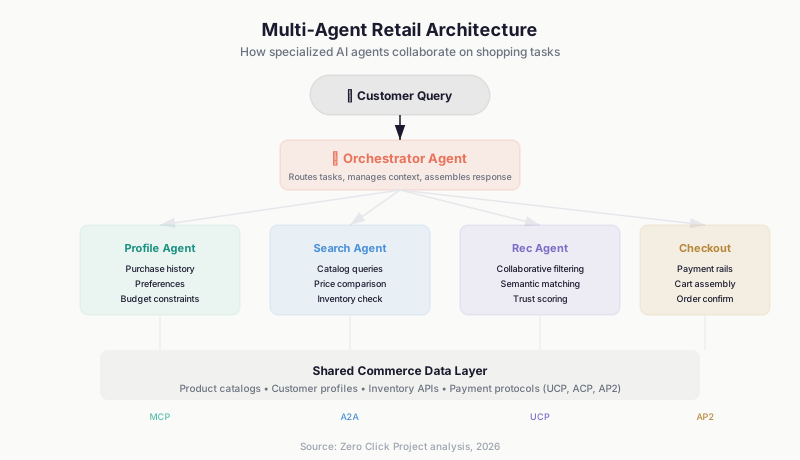
Multi-agent architecture: a coordinator routes customer queries to specialized agents for profiling, domain expertise, and product matching.
Why Single-Agent Chatbots Fall Short
Traditional retail chatbots operate as a single system trying to handle every type of request — product questions, inventory checks, troubleshooting, recommendations. This approach creates three persistent problems:
- Knowledge breadth vs. depth. A single system cannot be deeply knowledgeable about every product category, ingredient, specification, and use case. When a customer asks about retinol interactions with vitamin C serums, a general-purpose bot either gives a vague answer or hallucinates specifics.
- Data source conflicts. Product catalog data needs to be accurate and controlled. General knowledge needs to be current and comprehensive. These requirements pull in opposite directions — one needs a curated database, the other needs web-scale retrieval.
- Complex query handling. Customers often have multi-part needs ("I have sensitive skin, I need a serum under $50 that does not contain retinol"). A single system struggles to handle diagnosis, ingredient analysis, and product matching simultaneously without losing context.
The Multi-Agent Architecture Pattern
The emerging pattern uses a coordinator agent that routes requests to specialized sub-agents. Each sub-agent has its own focus, capabilities, and data sources.
| Component | Role | Data Source |
|---|---|---|
| Coordinator Agent | Intent recognition, workflow orchestration, response assembly | System prompts + routing logic |
| Customer Profiler Agent | Customer needs assessment, preference analysis, history context | CRM data, session history, web search |
| Domain Expert Agent | Technical analysis (ingredients, specs, compatibility checks) | Web search, technical databases, regulatory data |
| Product Recommender Agent | Catalog matching, regimen/bundle suggestions, inventory checking | Brand product knowledge base, inventory API |
| Pricing/Promotions Agent | Price optimization, discount eligibility, bundle pricing | Pricing engine, promotional calendar |
Technical Architecture: LangGraph Implementation
Multi-agent retail systems are commonly built using orchestration frameworks like LangGraph, AutoGen, or CrewAI. Here is a simplified architecture showing how agents are coordinated using LangGraph's state graph pattern:
# Simplified multi-agent retail architecture (LangGraph pattern)

from langgraph.graph import StateGraph, END
from typing import TypedDict, Annotated

class ShoppingState(TypedDict):
    customer_query: str
    customer_profile: dict
    domain_analysis: dict
    product_matches: list
    final_response: str

def coordinator(state: ShoppingState) -> dict:
    """Routes to appropriate specialist agents"""
    query = state["customer_query"]
    # Intent classification determines routing
    if needs_domain_expertise(query):
        return {"next": "domain_expert"}
    return {"next": "product_recommender"}

def customer_profiler(state: ShoppingState) -> dict:
    """Analyzes customer context and preferences"""
    # Retrieves customer history, preferences, skin type, etc.
    profile = analyze_customer(state["customer_query"])
    return {"customer_profile": profile}

def domain_expert(state: ShoppingState) -> dict:
    """Provides technical domain knowledge"""
    # Uses web search + technical databases
    analysis = analyze_domain(state["customer_query"],
                              state["customer_profile"])
    return {"domain_analysis": analysis}

def product_recommender(state: ShoppingState) -> dict:
    """Matches products from catalog"""
    # Queries product knowledge base with constraints
    matches = find_products(
        profile=state["customer_profile"],
        constraints=state["domain_analysis"],
        catalog=product_catalog
    )
    return {"product_matches": matches}

# Build the state graph
graph = StateGraph(ShoppingState)
graph.add_node("coordinator", coordinator)
graph.add_node("profiler", customer_profiler)
graph.add_node("domain_expert", domain_expert)
graph.add_node("recommender", product_recommender)

# Define routing
graph.set_entry_point("profiler")
graph.add_edge("profiler", "coordinator")
graph.add_conditional_edges("coordinator", route_decision)
graph.add_edge("domain_expert", "recommender")
graph.add_edge("recommender", END)
The key design choice is separating data sources. Product information — prices, inventory, ingredients, specifications — comes from a controlled knowledge base where accuracy is critical. General domain knowledge — how ingredients interact, which skin types suit which products, compatibility rules — comes from web search to stay current.
How the Workflow Operates
Consider a customer asking: "I have sensitive skin and I'm looking for a gentle moisturizer without parabens, under $40."
- Coordinator identifies the need: skin type = sensitive, product = moisturizer, constraint = paraben-free, budget = under $40
- Customer Profiler confirms: sensitive skin characteristics, relevant skincare precautions, any known allergies or previous purchases
- Domain Expert analyzes: which ingredients are safe for sensitive skin, what to avoid (fragrances, sulfates, essential oils), why parabens are problematic for this skin type, recommended ingredient categories (ceramides, hyaluronic acid, centella asiatica)
- Product Recommender matches: qualifying products from the catalog with rationale for each recommendation, ordered by relevance score and price
- Coordinator assembles: complete response combining diagnosis, ingredient rationale, and product recommendations with purchase links
The result is an answer that feels like consulting with a knowledgeable specialist — not just a product search filtered by price.
Industry Applications
| Industry | Sub-Agent Specializations | Example Complex Query |
|---|---|---|
| Beauty | Ingredient analyzer, skin type profiler, routine builder | "Build me a nighttime routine for acne-prone skin that's safe during pregnancy" |
| Electronics | Compatibility checker, spec analyzer, setup assistant | "Which soundbar works with my 2024 Samsung TV and supports Dolby Atmos under $300?" |
| Fashion | Style profiler, size/fit advisor, outfit coordinator | "I'm 5'4, athletic build, need business casual for a tech conference in Miami in July" |
| Health & Wellness | Needs assessor, ingredient safety checker, regimen builder | "What supplements support joint health if I'm already taking blood thinners?" |
| Home Improvement | Project scope analyzer, material compatibility checker, tool recommender | "I need to tile a 120 sq ft bathroom floor — what materials and tools do I need?" |
| Pet Products | Breed/species advisor, nutrition analyzer, health supplement recommender | "My 8-year-old golden retriever has hip dysplasia — what food and supplements help?" |
What This Means for Product Data
Multi-agent systems raise the bar for product data quality. Each sub-agent needs different data to function effectively.
Product Knowledge Base Structure
For multi-agent systems to recommend your products accurately, your product data needs to be structured at a level of depth beyond what traditional PIM systems require. Here is an example of the data structure a multi-agent beauty assistant would consume:
{
  "product_id": "MOIST-CER-001",
  "name": "CeraVe Moisturizing Cream",
  "category": "Skincare > Moisturizers > Face & Body",
  "price": 18.99,
  "availability": "in_stock", "// Data for Domain Expert Agent"
  "ingredients": {
    "active": [ "Ceramide NP", "Ceramide AP", "Ceramide EOP"],
    "key_actives": [ "Hyaluronic Acid", "MVE Technology"],
    "free_from": [ "Parabens", "Fragrance", "Sulfates"],
    "ph_level": 5.5,
    "comedogenic_rating": 1
  }, "// Data for Customer Profiler Agent"
  "suitable_for": {
    "skin_types": [ "dry", "sensitive", "normal", "eczema-prone"],
    "concerns": [ "dryness", "barrier repair", "irritation"],
    "age_range": "all ages",
    "contraindications": [ "none known"]
  }, "// Data for Product Recommender Agent"
  "use_cases": [ "daily moisturizer", "post-procedure recovery"],
  "pairs_with": [ "CeraVe Hydrating Cleanser", "CeraVe PM Lotion"],
  "replaces": [ "basic petroleum-based moisturizers"], "// Trust signals for ranking"
  "ratings": { "average": 4.7, "count": 48200 },
  "dermatologist_recommended": true,
  "certifications": [ "National Eczema Association Seal"]
}
The critical difference from traditional product data: multi-agent systems need relational data — which products pair well together, what they replace, what conditions they address, and what contraindications exist. This is fundamentally different from the flat attribute lists most PIMs produce.
Measuring Multi-Agent System Performance
| Metric | What It Measures | Target |
|---|---|---|
| Query resolution rate | Percentage of queries fully resolved without human handoff | > 85% |
| Recommendation acceptance rate | How often users add recommended products to cart | > 25% |
| Cross-sell effectiveness | Average items per order from agent-assisted sessions | 1.5x baseline |
| Agent accuracy score | Correctness of technical claims made by domain expert agent | > 95% |
| Session satisfaction (CSAT) | Customer satisfaction with agent interaction quality | > 4.2/5 |
Getting Started
- Enrich your product knowledge base. Go beyond basic attributes. Include use cases, compatibility notes, suitable customer profiles, contraindications, and pairing recommendations.
- Structure data for interoperability. Use standardized ingredient names (INCI for beauty, industry-standard SKUs for electronics), consistent taxonomy, and structured formats so sub-agents can cross-reference your data with external knowledge.
- Monitor AI-generated recommendations. Test how multi-agent shopping assistants describe and recommend your products. Correct data gaps before they affect purchase decisions.
- Prepare for explainable recommendations. Multi-agent systems explain why they recommend products. Your data needs to support that explanation — including comparison data, ingredient rationale, and suitability criteria.
- Start with one vertical. Build or integrate a multi-agent system for your highest-complexity product category first. Beauty, supplements, and electronics are natural starting points because customer queries are inherently multi-dimensional.
Frequently Asked Questions
What is a multi-agent AI architecture for retail?
A system where a coordinating AI agent routes customer requests to multiple specialized sub-agents — each handling a specific aspect like customer profiling, domain expertise, or product matching. This produces more accurate and contextual recommendations than single-agent systems. Frameworks like LangGraph, AutoGen, and CrewAI provide the orchestration layer.
Why use separate data sources for product info vs. domain knowledge?
Product data (prices, inventory, ingredients) must be accurate and controlled — best served by a curated knowledge base. Domain knowledge (how ingredients interact, compatibility rules, safety considerations) updates frequently and covers broad scope — best served by web search or RAG retrieval for timeliness and coverage.
How does this affect my product data requirements?
Multi-agent systems raise the bar significantly. Beyond basic attributes, your products need use-case descriptions, customer profiles, contraindications, compatibility data, and pairing recommendations — all structured for machine interpretation. Think of it as building a product knowledge graph, not just a product catalog.
Can small retailers implement multi-agent systems?
Yes, though at a different scale. Open-source frameworks like LangGraph and CrewAI make multi-agent development accessible. Small retailers can start with two agents — a product recommender and a domain expert — and expand as they see results. The bigger investment is in structuring product data, which benefits all AI channels regardless of architecture.
How does multi-agent architecture compare to RAG?
RAG (Retrieval-Augmented Generation) is a technique used within multi-agent systems. Each agent can use RAG to retrieve relevant information from its data source. The multi-agent architecture adds the orchestration layer — routing queries to the right specialist, combining outputs, and managing conversation state. RAG is a building block; multi-agent is the system design.