
Optimizing Beauty and Skincare Product Data for AI Discovery
Beauty product data is the most complex in ecommerce — and the most valuable to get right for AI discovery. This guide covers INCI ingredient structuring, skin type mapping, routine compatibility data, schema markup, and compliance management for skincare, cosmetics, and clean beauty brands.
Beauty and clean personal care is one of the most complex ecommerce verticals for AI-mediated discovery — and one of the most rewarding for brands that get their product data right. Skincare routines are deeply personal. Ingredient sensitivities vary by individual. Product interactions can cause adverse reactions. And consumers in this space are increasingly "ingredient-savvy," researching formulations before they buy.
This creates a category where AI assistants can deliver genuine value — diagnosing skin concerns, checking ingredient compatibility, building personalized routines — if brands provide the structured data these systems need. Brands that treat product data as a strategic asset will capture a disproportionate share of AI-mediated discovery. Those that rely on marketing copy alone will become invisible.
Why This Guide Exists
A SALT.agency audit of the top 100 ecommerce sites found that 45% of product URLs contained no structured data at all, and another 27% contained structured data with errors. That means 72% of even the largest retailers are either invisible or broken for AI systems. In beauty — where ingredient-level data matters more than in any other category — the gap is even wider.
The AI Beauty Discovery Funnel
AI assistants handling beauty queries follow a diagnostic pattern fundamentally different from traditional product search. A customer asking "what serum should I use for dry, sensitive skin with early signs of aging" triggers a multi-step evaluation:
Source: Tencent Cloud ADP — beauty retail AI shopping guide workflow
| Agent Step | Function | Data Required From Brand |
|---|---|---|
| 1. Skin Profile Assessment | Determines skin type, active concerns, sensitivity level | Skin type suitability tags (oily, dry, combination, sensitive) as structured attributes |
| 2. Ingredient Compatibility Check | Cross-references actives for interactions and contraindications | Full INCI list, active concentrations, known contraindications (e.g., retinol + AHA) |
| 3. Product Matching | Ranks products by relevance to profile | Concern targeting (acne, aging, hyperpigmentation), price, format (serum, cream, oil) |
| 4. Routine Building | Assembles compatible multi-product regimen with application order | Routine compatibility data, AM/PM usage, layering order, frequency |
Each step requires data that most beauty brands do not currently provide in machine-readable format. Marketing copy that says "suitable for all skin types" is useless to an AI system trying to build a personalized recommendation. The system needs structured attributes it can filter, compare, and combine.
Structured Product Data: What AI Systems Actually Need
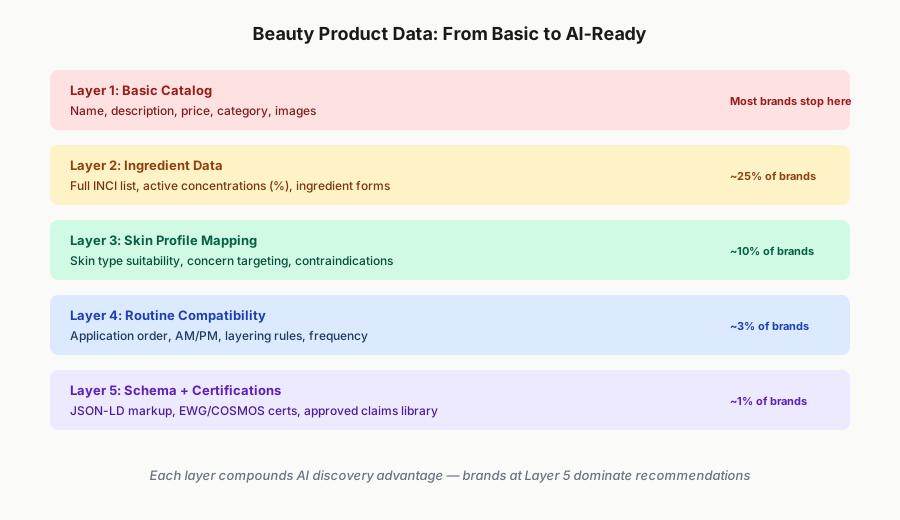
Beauty product data for AI discovery goes far beyond basic catalog information. Here is what a properly structured product record looks like versus what most brands currently provide:
❌ Typical Product Data (Insufficient for AI)
Name: Radiance Boost Serum
Description: Our best-selling serum for glowing skin.
Category: Skincare > Serums
Price: $48.00
✅ AI-Ready Product Data (Structured for Discovery)
{
  "name": "Radiance Boost Vitamin C Serum",
  "inci_ingredients": [ "Aqua", "Ascorbic Acid", "Propanediol", "Glycerin", ...],
  "active_ingredients": [
    {"name": "Vitamin C (L-Ascorbic Acid)", "concentration": "15%", "function": "antioxidant, brightening"},
    {"name": "Hyaluronic Acid", "concentration": "1.5%", "function": "hydration"}
  ],
  "skin_types": [ "normal", "dry", "combination"],
  "skin_concerns": [ "dullness", "hyperpigmentation", "fine_lines", "uneven_tone"],
  "contraindications": [ "Do not layer with niacinamide above 10%", "Use SPF when active"],
  "routine_position": {"step": "treatment", "order": 3, "time": "AM", "frequency": "daily"},
  "format": "serum",
  "volume_ml": 30,
  "certifications": [ "EWG Verified", "Leaping Bunny", "Vegan"],
  "free_from": [ "parabens", "sulfates", "phthalates", "mineral_oil"],
  "fragrance": "fragrance-free",
  "pH_range": "2.5-3.5",
  "shelf_life_months": 12,
  "PAO_months": 6
}
The difference is stark. The first record tells an AI system almost nothing useful. The second gives it everything needed to match this product to a customer with dull, dry skin looking for a brightening serum that works with their existing niacinamide moisturizer.
The Seven Data Categories That Drive Beauty AI Discovery
| Data Category | What to Include | Why It Matters for AI |
|---|---|---|
| Full INCI Ingredient List | Complete list in standardized INCI nomenclature, not marketing names | AI cross-references INCI with safety databases (EWG, CIR) and efficacy research |
| Active Concentrations | % of key actives: retinol, niacinamide, vitamin C, AHAs/BHAs, peptides | Determines efficacy claims and interaction risks — 0.3% retinol vs. 1% changes recommendations entirely |
| Skin Type Suitability | Oily, dry, combination, sensitive, normal as filterable boolean attributes | Primary filter for personalized recommendations — must be structured, not buried in copy |
| Concern Targeting | Acne, aging, hyperpigmentation, dehydration, redness, pores — mapped to products | Maps customer goals to product benefits at the attribute level |
| Contraindications & Interactions | Ingredient conflicts, pregnancy warnings, sensitivity alerts, SPF requirements | Safety-critical for routine building — prevents harmful combinations |
| Certifications & Claims | EWG Verified, COSMOS Organic, Leaping Bunny, vegan, specific "free-from" lists | Verifiable trust signals AI can reference confidently vs. unverifiable "clean" claims |
| Routine Compatibility | Application order, AM/PM usage, compatible products, frequency guidance | Enables multi-product regimen recommendations — the highest-value beauty AI use case |
Schema Markup for Beauty Products
Beyond internal data structures, beauty brands need proper schema markup on product pages to feed AI systems through search engines. A beauty product page should include JSON-LD with extended Product schema:
{
  "@context": "https://schema.org",
  "@type": "Product",
  "name": "Radiance Boost Vitamin C Serum",
  "brand": {"@type": "Brand", "name": "ExampleBrand"},
  "description": "15% L-Ascorbic Acid serum for brightening and antioxidant protection. Suitable for normal, dry, and combination skin.",
  "sku": "RBS-VC15-30ML",
  "gtin13": "0123456789012",
  "image": [ "https://example.com/images/rbs-front.jpg", "https://example.com/images/rbs-ingredients.jpg"],
  "offers": {
    "@type": "Offer",
    "price": "48.00",
    "priceCurrency": "USD",
    "availability": "https://schema.org/InStock"
  },
  "aggregateRating": {
    "@type": "AggregateRating",
    "ratingValue": "4.6",
    "reviewCount": "342"
  },
  "additionalProperty": [
    {"@type": "PropertyValue", "name": "Skin Type", "value": "Normal, Dry, Combination"},
    {"@type": "PropertyValue", "name": "Active Ingredient", "value": "Vitamin C 15%"},
    {"@type": "PropertyValue", "name": "Certification", "value": "EWG Verified, Leaping Bunny"}
  ]
}
The additionalProperty field is critical. Standard Product schema does not have dedicated fields for skin type or active ingredients, but additionalProperty lets you add structured key-value pairs that AI systems can parse. Google's Knowledge Graph ingests these properties and makes them available to AI Overviews.
The Clean Beauty Data Challenge
"Clean" is not a regulated term. Sephora's Clean + Planet Positive standards differ from Credo Beauty's criteria, which differ from EWG's standards. This ambiguity creates a real problem for AI systems trying to make accurate clean beauty claims.
Instead of labeling products as generically "clean," brands should provide:
- Specific third-party certifications — EWG Verified, COSMOS Organic, USDA Organic, Leaping Bunny, B Corp. These are verifiable claims AI can reference with confidence.
- Complete "free-from" lists as structured attributes — paraben-free, sulfate-free, phthalate-free, silicone-free, each as a boolean field. Do not bury these in marketing copy.
- Packaging sustainability data — recyclable, refillable, PCR (post-consumer recycled) percentage, ocean plastic. Increasingly important for AI filters.
- Ingredient sourcing transparency — fair trade certifications, country of origin for key ingredients, ethical sourcing documentation.
Compliance: Managing AI-Generated Beauty Claims
Beauty is a regulated category, and AI-generated product descriptions create real compliance risk. AI assistants may amplify marketing claims beyond what is approved, simplify efficacy statements, or make connections between products and medical outcomes that the brand has not endorsed.
Practical steps to manage this risk:
- Maintain an approved claims library. Create a structured database of exact language AI systems should use for each product. Include what can and cannot be said about efficacy.
- Regularly audit AI-generated descriptions. Search for your products in ChatGPT, Perplexity, and Google AI Overviews. Document any claims that exceed your approved language.
- Structure claims by regulatory category. Cosmetic claims ("helps reduce the appearance of") vs. drug claims ("treats acne") must be clearly distinguished in your data.
- Keep descriptions consistent across all channels. Inconsistent product descriptions across your site, Amazon, and retailer listings give AI systems conflicting data to paraphrase from.
Building for UGC and Review Data
AI systems heavily weight customer reviews when making beauty recommendations — especially reviews that mention specific skin types, concerns, and outcomes. Brands should actively encourage structured review data:
- Add review prompts for skin type and concern. Ask reviewers to select their skin type and primary concern before writing. This creates structured metadata that AI systems can aggregate.
- Implement structured review schemas. Use Review schema markup that includes
author,reviewRating, and structured attributes like skin type and age range. - Highlight ingredient-specific reviews. Surface reviews that mention specific ingredients and outcomes — these are the reviews AI systems find most useful for recommendation logic.
Action Plan: 8-Week Beauty AI Readiness Roadmap
- Weeks 1–2: Audit existing product data. Map every product against the seven data categories above. Identify gaps — most brands will find they have marketing copy but no structured attributes for skin type, concern targeting, or ingredient concentrations.
- Weeks 3–4: Structure ingredient data using INCI. Convert all ingredient lists to standardized INCI nomenclature. Add concentration percentages for all active ingredients. Document known contraindications.
- Weeks 5–6: Build routine compatibility maps. Document which products work together, recommended application order, AM/PM usage, and frequency. This is the highest-value data for AI routine building.
- Week 7: Implement schema markup. Add Product schema with
additionalPropertyfields for skin type, actives, and certifications on every product page. - Week 8: Set up monitoring. Create a monthly audit process to check how AI systems describe your products. Search your brand and key products in ChatGPT, Perplexity, and Google AI mode.
Frequently Asked Questions
Why is beauty a high-value category for AI product discovery?
High margins, complex customer needs, and ingredient-level decision-making make beauty ideal for AI systems that can provide consultative, personalized recommendations. A customer asking about serums for sensitive skin with rosacea needs diagnostic-level matching that generic search cannot provide.
What is INCI and why does it matter for AI discovery?
INCI (International Nomenclature of Cosmetic Ingredients) is the standardized naming system for cosmetic ingredients. AI systems use INCI names — not marketing names like "botanical brightening complex" — to cross-reference ingredients with safety databases (EWG Skin Deep, CIR), published research, and interaction charts.
How do clean beauty brands handle the lack of standardized definitions?
Provide specific third-party certifications (EWG Verified, COSMOS, Leaping Bunny) as structured data attributes rather than generic "clean" labels. Also provide complete "free-from" lists as boolean fields. This gives AI systems verifiable claims to work with rather than ambiguous marketing terms.
What is the biggest product data gap for beauty brands today?
Routine compatibility data. Most brands list individual products reasonably well but provide no structured data about which products work together, application order, contraindicated combinations, or AM/PM usage. This is the data AI systems need most to build the multi-product regimen recommendations that drive the highest basket values.
How should brands monitor AI-generated descriptions of their products?
Set up a monthly audit: search your brand name and top 10 products in ChatGPT, Perplexity, Google AI Mode, and Gemini. Document what each system says. Flag any claims that exceed your approved language — especially anything crossing from cosmetic claims into drug/medical claims territory. This audit takes 2–3 hours per month and is essential for compliance.