
How Retail AI Agents Are Reshaping Product Discovery: A Guide for CMOs and Ecommerce Leaders
AI agents are reshaping how customers find products — compressing discovery from browsing to a single shortlist. Here is how retrieval logic, trust signals, and first-party data determine which products make the cut.
Product discovery is being restructured. For years, retailers optimized visibility through search rankings, marketplace placement, and onsite merchandising. AI agents introduce a fundamentally different dynamic: instead of navigating storefronts, shoppers increasingly rely on systems that interpret their intent, evaluate available options, and present a shortlist of products — often without the customer ever visiting a retailer's website.
This shift compresses the entire shopping journey into a much shorter decision path: Ask → Shortlist → Action. For retail leaders, understanding how these AI agents evaluate and choose products is becoming a strategic priority.
What Are Retail AI Agents?
Retail AI agents are systems that help shoppers discover products by interpreting intent, evaluating available options, and presenting recommendations or shortlists. They replace traditional browsing with conversational, AI-driven product selection — and the products they surface depend on data quality, trust signals, and machine-readable policies.
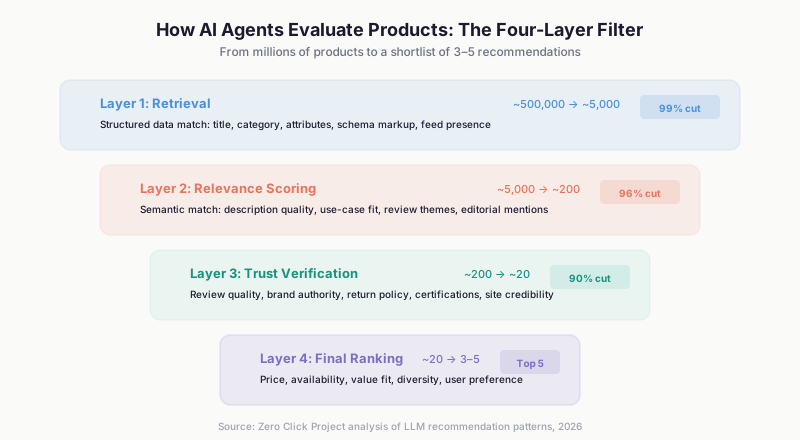
How AI shopping agents evaluate products: retrieval logic determines visibility, trust logic determines ranking, and action logic determines purchase feasibility.

How AI Agents Choose Products
AI agents do not evaluate products the way human shoppers do. Instead of scanning visual layouts or exploring categories, they rely on structured signals. Three types of logic typically guide their decisions:
| Evaluation Layer | What the Agent Evaluates | Why It Matters |
|---|---|---|
| Retrieval Logic | Structured data, taxonomy, inventory, pricing accuracy | Incomplete data means the product may not be retrieved at all |
| Trust Logic | Reviews, ratings, return policies, shipping reliability | AI prioritizes products it can confidently recommend |
| Action Logic | Clear purchase pathways, availability confirmation, checkout capability | Agents prefer products they can transact on without friction |
How Retrieval Logic Works in Practice
When a customer asks ChatGPT, Perplexity, or Google AI Mode for product recommendations, the AI system performs a multi-step retrieval process:
- Intent parsing: The system decomposes the query into product category, attributes, constraints, and preferences. "Best noise-cancelling headphones under $300 for commuting" becomes: category=headphones, feature=ANC, price<300, use_case=commute.
- Candidate retrieval: The system queries its index for products matching these parameters. Products with incomplete schema (missing price, no ANC attribute) are excluded at this stage.
- Trust scoring: Remaining candidates are ranked by trust signals — review count, average rating, return policy clarity, brand recognition, and third-party editorial mentions.
- Shortlist generation: The top 3–5 products are presented with structured rationale: why each product matches the query, key differentiators, and trade-offs.
The critical insight: if your product is missing structured data at step 2, it never reaches steps 3 or 4. Retrieval is binary — you are either in the candidate set or invisible.
The Eligibility Signals Behind AI Shortlisting
Getting shortlisted by an AI agent depends on machine-readable signals, not visual merchandising. Here is the complete signal framework:
| Signal Category | What AI Evaluates | Operational Implication |
|---|---|---|
| Product Data Quality | GTIN, SKU, attributes, taxonomy, variant clarity, image quality | Invest in standardized catalog structures with exhaustive attributes |
| Pricing & Inventory | Accurate pricing, real-time availability, price consistency across channels | Synchronize systems for reliable signals; update feeds every 4–6 hours |
| Policy Transparency | Shipping terms, returns, warranties in structured format | Add shippingDetails and hasMerchantReturnPolicy to Product schema |
| Evidence Signals | Reviews (volume and recency), specs, fit guides, compatibility data | Strengthen AggregateRating schema; add FAQ schema for common questions |
| Brand Entity Signals | Organization schema, sameAs links, Wikipedia/Wikidata presence | Build a knowledge graph entry for your brand across authoritative sources |
Product Data Audit Checklist
Use this checklist to evaluate your product catalog's AI readiness:
Product Data Completeness Audit
================================

□ GTIN/EAN/UPC present for all products
□ MPN (Manufacturer Part Number) populated
□ SKU follows consistent naming convention
□ Product title: Brand + Product + Key Differentiator
□ Short description: 150 chars, value-focused
□ Long description: Natural language, use-case context
□ Category taxonomy: Google Product Category mapped
□ All filterable attributes populated:
  □ Color, Size, Material, Weight
  □ Age group, Gender (where applicable)
  □ Product-specific: battery life, compatibility, etc.
□ Images: 3+ angles, 1200px+, WebP format
□ Image alt text: descriptive, keyword-relevant
□ Price: accurate, matching checkout price
□ Availability: real-time inventory status
□ Shipping: structured delivery time and cost
□ Returns: machine-readable return policy
□ Reviews: AggregateRating schema with 10+ reviews
□ FAQ: at least 3 product-specific Q&As

Schema Completeness Check
=========================
□ Product schema with all required properties
□ Offer schema with price, availability, shipping
□ AggregateRating schema
□ BreadcrumbList schema
□ Organization schema (site-wide)
□ FAQ schema (where applicable)
Brand Representation in AI: Control and Compliance
When AI agents describe your brand, they may paraphrase marketing claims, emphasize certain attributes, or frame the brand narrative differently from your original messaging. This creates both opportunity and risk.
Three areas require particular attention:
- Brand voice and claims governance. Ensure product claims are clearly defined and descriptions are consistent across channels. AI systems rely on existing content to generate explanations — inconsistent messaging leads to inconsistent AI descriptions.
- Regulated category compliance. In health, beauty, supplements, or financial services, AI-generated descriptions can create compliance risk by amplifying or simplifying claims. Monitor how AI assistants describe your products in regulated categories.
- Narrative drift monitoring. Over time, AI assistants may describe brands in ways that gradually diverge from original messaging. Set up quarterly audits: ask ChatGPT, Perplexity, and Google AI Mode about your brand and products, then compare against your official positioning.
AI Brand Monitoring Protocol
Quarterly AI Brand Audit Protocol
==================================

1. Query each AI assistant with:
   - "Tell me about [Brand Name]"
   - "What products does [Brand Name] sell?"
   - "Is [Brand Name] [specific product] worth buying?"
   - "Compare [Brand Name] vs [Competitor]"

2. Document responses across:
   - ChatGPT (latest model)
   - Google AI Mode
   - Perplexity
   - Claude

3. Compare against official messaging:
   - Are claims accurate?
   - Is pricing current?
   - Are discontinued products still mentioned?
   - Is the brand narrative aligned?

4. Corrective actions:
   - Update product descriptions on DTC site
   - Publish correction content where AI pulls info
   - Submit updated data to Merchant Centers
   - Request corrections through AI platform feedback
First-Party Data as a Competitive Advantage
When every shopper asks a generic AI assistant for recommendations, the assistant relies on the same public information for everyone. Discovery converges toward the same small set of widely recognized products. Differentiation increasingly depends on customer context.
AI agents that incorporate first-party data — purchase history, browsing behavior, product affinity, lifecycle stage — can move beyond generic recommendations and match products to individual customer needs.
| Signal Type | Example | Impact on Discovery |
|---|---|---|
| Affinity Signals | Brand preferences, historical purchases | Recommends products aligned with known preferences |
| Lifecycle Stage | First-time visitor, repeat buyer, loyalty member | Tailors discovery to acquisition vs. retention goals |
| Behavioral Context | Abandoned carts, comparison patterns, review reading | Adjusts recommendations based on real-time intent signals |
| Purchase Cadence | 30-day replenishment cycle for consumables | Proactive replenishment prompts timed to predicted need |
New KPIs for AI-Mediated Discovery
Traditional last-click attribution cannot capture how AI influences purchase decisions. Retailers need new metrics that measure visibility, influence, and conversion within AI-mediated channels:
| Metric | What It Measures | How to Track |
|---|---|---|
| Agent Visibility Share | How often products appear in AI recommendations | Automated queries to AI assistants for your product categories, tracked weekly |
| Assisted Discovery Sessions | Shopping sessions influenced by AI agents | Track referral sources from AI platforms (chatgpt.com, perplexity.ai, etc.) |
| Conversation-to-Cart Rate | Percentage of AI interactions leading to cart additions | UTM tracking on AI-referred traffic; measure cart events within 30 minutes |
| Margin Impact Metrics | Discount levels, returns, and cost to serve from AI-driven sales | Segment financial metrics by AI vs. non-AI traffic source |
| Brand Narrative Accuracy | How accurately AI describes your brand and products | Quarterly audit using the brand monitoring protocol above |
What to Do Now
- Audit your product data for AI readiness. Use the product data audit checklist above. Prioritize GTIN/SKU completeness, attribute depth, and schema markup.
- Monitor brand representation in AI assistants. Run the quarterly AI brand audit. Document discrepancies and address root causes in your product content.
- Integrate first-party data into discovery experiences. Connect customer intelligence to on-site AI recommendation systems. Use purchase cadence data for proactive replenishment.
- Develop AI-specific KPIs. Add agent visibility share, conversation-to-cart rate, and brand narrative accuracy to your analytics dashboard.
- Structure policies for machine readability. Add shippingDetails and hasMerchantReturnPolicy schema to every product page. AI agents surface this information directly in recommendations.
- Build your brand knowledge graph. Claim and optimize your presence on Wikipedia, Wikidata, and industry directories. Implement Organization schema with sameAs links.
Frequently Asked Questions
How are retail AI agents different from chatbots?
Chatbots typically follow scripted conversation flows. Retail AI agents use large language models to interpret open-ended shopper intent, evaluate product catalogs, and make contextual recommendations — functioning more like a knowledgeable shopping assistant than a decision tree. They also retrieve real-time product data from structured sources rather than relying on pre-programmed responses.
Can small brands compete in AI-driven discovery?
Yes, if their product data is strong. AI agents evaluate data quality and trust signals, not brand size or advertising budget. A niche brand with excellent structured data, genuine reviews, and transparent policies can outperform a larger competitor with poor product feeds. The key is being retrievable: complete schema, accurate pricing, and machine-readable policies.
What is narrative drift in AI brand representation?
Narrative drift occurs when AI assistants gradually describe your brand in ways that diverge from your official messaging — often by prioritizing third-party reviews, outdated content, or simplified descriptions over your own positioning. It is particularly risky in regulated industries where AI-generated claims could create compliance issues.
What data should I track for AI-driven discovery?
Focus on agent visibility share (how often your products appear in AI recommendations), assisted discovery sessions (traffic from AI referrals), conversation-to-cart rates, margin impact from AI-influenced transactions, and brand narrative accuracy. These metrics supplement — not replace — traditional ecommerce KPIs.
How often should I audit my AI brand representation?
At minimum quarterly. For brands in regulated categories (health, supplements, financial services), monthly audits are recommended. The audit should cover all major AI assistants (ChatGPT, Google AI Mode, Perplexity, Claude) and include both brand-level and product-level queries.