
Optimizing Fashion and Athleisure Product Data for AI Discovery
Fashion has the highest return rate in ecommerce — 30-40% — because AI systems lack the sizing, style, and fit data to make accurate recommendations. This guide covers garment measurements, fit prediction data, social commerce optimization, and style tagging for apparel and athleisure brands.
Fashion and athleisure present the hardest product discovery challenge for AI systems: purchase decisions are driven by aesthetic preference, body fit, trend timing, and social context — factors that are inherently difficult to quantify. Unlike electronics where specs are objective, or beauty where ingredient data is standardized, fashion requires AI to understand subjective style profiles, navigate wildly inconsistent sizing across brands, and interpret social commerce dynamics where most discovery now happens.
The stakes are high. Online fashion has the highest return rate of any ecommerce category — 30–40% of all purchases come back, representing $550 billion in returned merchandise annually. 52% of those returns stem from fit issues. AI systems that can match customers to the right size and style the first time represent a massive commercial opportunity — but only if brands provide the data these systems need.
The True Fit Signal
In February 2026, True Fit launched an AI shopping agent built on 20 years of purchase and return data across 91,000 brands. The key insight: 67% of fashion ecommerce returns are size-related. True Fit's agent uses "outcome-based" fit data — what customers actually kept vs. returned — to predict fit confidence. This is the direction fashion AI is heading: away from static size charts toward probabilistic fit prediction.
How AI Systems Evaluate Fashion Products
When a customer asks an AI assistant "find me a casual dress for a summer wedding under $200," the system must interpret dress code context, seasonal appropriateness, style preferences from past behavior, size constraints, and price. This is fundamentally different from finding a laptop with specific specs.
Effective fashion AI uses three specialized capabilities, each requiring different data:
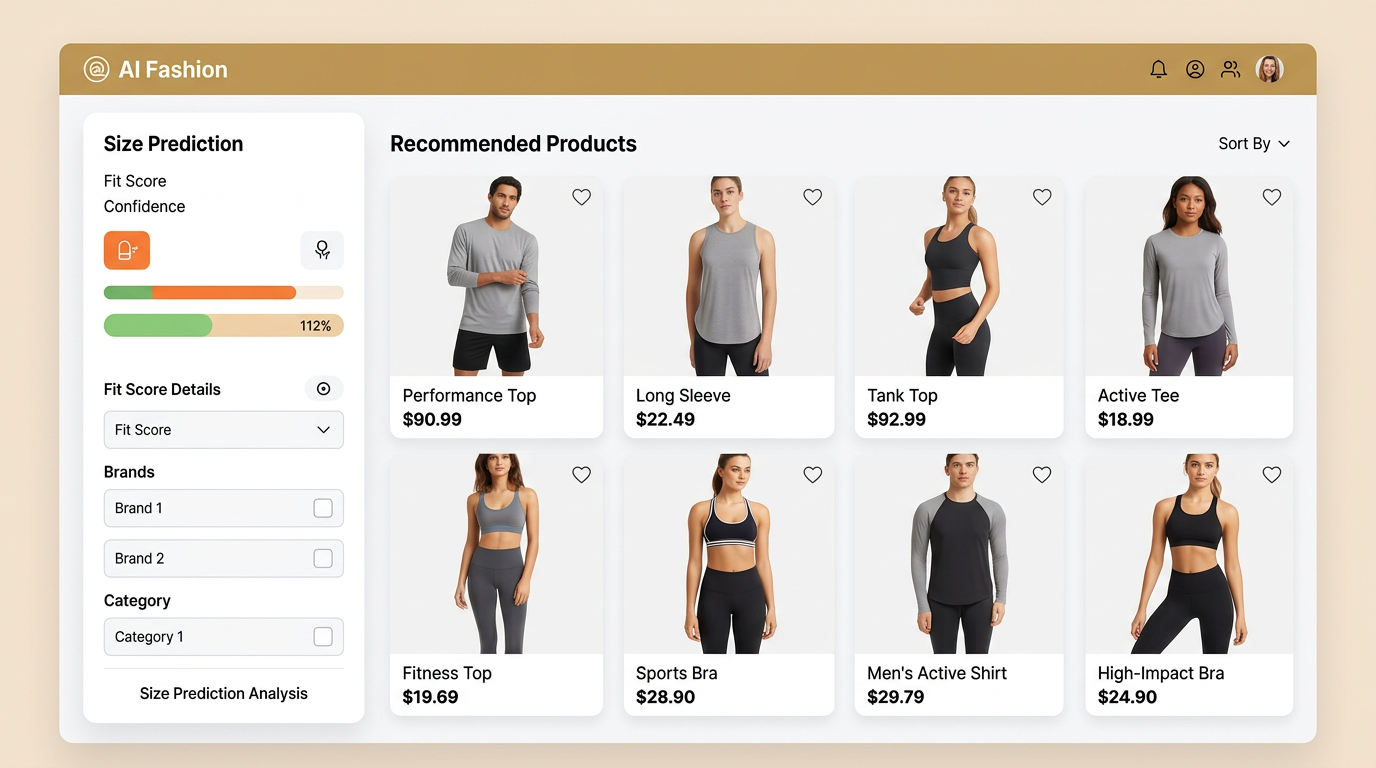
Source: Klodsy — AI shopping assistant for reducing fashion returns
| Capability | Function | Data Required From Brand |
|---|---|---|
| Style Profiling | Matches products to aesthetic preferences and occasion context | Style tags, occasion categories, aesthetic descriptors, trend alignment |
| Fit Prediction | Predicts size confidence based on brand-specific measurements | Garment measurements (not just label sizes), fit type, model reference sizing |
| Outfit Coordination | Suggests complementary items for complete looks | Cross-product pairing data, color coordination rules, style compatibility maps |
Structured Product Data for Fashion AI
Here is what a properly structured fashion product record looks like versus the minimum most brands currently provide:
❌ Typical Fashion Product Data
Name: Everyday Jogger Pant
Description: Comfortable joggers for everyday wear.
Sizes: XS, S, M, L, XL
Color: Black, Navy, Grey
Price: $68.00
✅ AI-Ready Fashion Product Data
{
  "name": "Everyday Performance Jogger Pant",
  "category": "Athleisure > Bottoms > Joggers",
  "fit_type": "regular",
  "fit_notes": "True to size. Tapered leg. Mid-rise.",
  "size_measurements": {
    "S": {"waist_in": 28, "inseam_in": 29, "hip_in": 37},
    "M": {"waist_in": 30, "inseam_in": 29.5, "hip_in": 39},
    "L": {"waist_in": 32, "inseam_in": 30, "hip_in": 41}
  },
  "model_reference": {"height": "5'10\"", "wearing": "M", "model_waist": 30},
  "fabric": {
    "composition": "87% Recycled Polyester, 13% Elastane",
    "weight_gsm": 280,
    "stretch": "4-way stretch",
    "moisture_wicking": true,
    "breathability": "high"
  },
  "style_tags": [ "athleisure", "casual", "streetwear", "minimalist"],
  "occasions": [ "gym", "casual_weekend", "errands", "travel"],
  "color_family": "neutral",
  "care": "Machine wash cold, tumble dry low",
  "sustainability": {"recycled_content_pct": 87, "certification": "bluesign"},
  "compatible_items": [ "SKU-HOODIE-001", "SKU-TEE-014", "SKU-JACKET-007"],
  "return_data": {"fit_satisfaction_pct": 91, "common_feedback": "runs slightly long in inseam"}
}
The Sizing Data Problem — and How to Fix It
Sizing is the single most important data problem in fashion AI. A "Medium" from one brand fits completely differently than a "Medium" from another. AI systems handle this by comparing garment measurements, not label sizes — but most brands do not provide garment measurements at all.
The data that dramatically reduces returns:
- Actual garment measurements per size — waist, hip, inseam, chest, sleeve length in inches/cm. Not just S/M/L labels.
- Fit type classification — slim, regular, relaxed, oversized. A structured attribute, not buried in description copy.
- Model reference sizing — "Model is 5'9", wears size M, chest 36", waist 28"." This gives AI a calibration point.
- Fit satisfaction data from returns — aggregate data showing what % of customers found the item true-to-size, runs small, or runs large. Companies like True Fit and Fitle use this data to predict fit with 91%+ accuracy.
- Cross-brand size mapping — if your Medium is equivalent to a specific brand's 8/10, include that mapping. AI agents use this for cross-brand recommendations.
Social Commerce and AI Discovery
Fashion discovery is increasingly happening on social platforms, not search engines. 43% of Gen Z starts product searches on TikTok. Livestream shopping converts at roughly 30% — ten times traditional ecommerce conversion rates. AI agents operating within social commerce environments need product data structured differently from traditional feeds.
Social commerce data requirements:
- Shorter, trend-relevant descriptions. TikTok Shop and Instagram Shopping favor concise, hashtag-rich copy that AI can parse quickly.
- Trend and aesthetic tags. Quiet luxury, minimalist, Y2K, cottagecore, old money — these are the filters Gen Z uses, and the tags AI agents match against.
- Creator-friendly product naming. Products named in ways creators naturally talk about them get more AI association with social content.
- Video-optimized imagery. Social AI uses visual search — provide images from multiple angles, on diverse body types, with clean backgrounds for visual matching.

Athleisure: Performance Data as Differentiator
Athleisure buyers are a distinct segment with specific data needs. They care about fabric performance (moisture-wicking, breathability, compression level), activity suitability (running, yoga, training, casual), and durability metrics. AI systems that can match athleisure products to specific activities need this data structured as attributes:
| Performance Attribute | What to Include | Example Values |
|---|---|---|
| Fabric Weight (GSM) | Grams per square meter — indicates warmth and structure | 180 GSM (lightweight), 280 GSM (midweight), 380 GSM (heavyweight) |
| Stretch Type | Direction and degree of stretch | 4-way stretch, 2-way stretch, mechanical stretch |
| Activity Suitability | Activities the garment is designed for | ["running", "yoga", "HIIT", "casual", "travel"] |
| Technical Features | Performance features as booleans | moisture_wicking: true, anti_odor: true, UPF_rating: 50 |
Action Plan for Fashion and Athleisure Brands
- Add garment measurements to every product. Actual measurements per size — not just S/M/L labels. This is the single highest-impact change for AI fit prediction.
- Implement fit type as a structured attribute. Slim, regular, relaxed, oversized — as a filterable field, not marketing copy.
- Add style, occasion, and aesthetic tags. Structured attributes for casual, formal, athletic, streetwear, and trend descriptors (quiet luxury, minimalist, etc.).
- Build cross-product pairing data. Document which items work together for outfit coordination. Link SKUs that complement each other.
- Optimize for visual search. Multiple-angle imagery on diverse body types with clean backgrounds. AI visual search matches images, not just text.
- Align feeds for social commerce. Create platform-specific feeds for TikTok Shop and Instagram Shopping with shorter descriptions and trend-relevant tags.
- Include return/fit satisfaction data. Aggregate feedback showing % true-to-size, runs small, runs large — this data is gold for fit prediction AI.
Frequently Asked Questions
Why is fashion the hardest category for AI product recommendations?
Fashion purchases depend on subjective preferences — style, aesthetics, occasion, social context — that are harder to quantify than product specifications. Add inconsistent sizing across brands and the visual nature of style matching, and you have a category that requires structured data most brands do not currently provide.
How much can AI actually reduce fashion returns?
Companies using AI fit prediction report 35–40% reductions in size-related returns. Fitle reports +4–6% conversion and –40% returns for ecommerce sites using their AI sizing tool. The key is providing actual garment measurements and fit satisfaction data, not just label sizes.
How does social commerce change AI discovery for fashion?
Social platforms like TikTok and Instagram are now primary discovery channels. AI agents within these platforms need shorter, trend-relevant descriptions, social-optimized imagery, and creator-friendly product naming. The data format that works for Google Shopping does not work for TikTok Shop.
What is the single most impactful data change for fashion AI?
Add actual garment measurements (waist, hip, inseam, chest in inches/cm) for every size variant of every product. This one change gives AI fit prediction systems the data they need to recommend the right size — which directly reduces the 52% of returns caused by fit issues.