
Optimizing Home Improvement Product Data for AI Discovery
Home improvement AI agents must understand project scope, material compatibility, and quantity calculations. Here is how DIY and decor brands should structure coverage rates, compatibility matrices, and project bundles for AI-mediated project-based shopping.
Home improvement is one of the most complex categories for AI shopping agents to navigate — and one of the most rewarding to get right. Unlike a shopper searching for a specific product, a homeowner asking an AI agent for help with a bathroom renovation needs tile, grout, adhesive, waterproofing membrane, tools, fixtures, and trim — all compatible with each other, all in the correct quantities, and all appropriate for the skill level of the person doing the work.
This project-driven complexity is exactly where AI agents add the most value. But agents can only scope projects and recommend complete material lists if brands provide structured, machine-readable product data that goes far beyond basic catalog information. In January 2026, Home Depot launched Material List Builder AI — a tool that interprets project intent and generates grouped material lists in minutes. It demonstrates exactly how far ahead the industry leaders are moving.
Why Home Improvement Data Is Different
Home improvement purchases are project-driven, not item-driven. AI agents must understand project scope, material compatibility, coverage-based quantity calculations, skill level requirements, and installation sequences. Brands that structure this data gain a compounding advantage because agents can confidently recommend complete solutions rather than individual products.

Home Depot's Material List Builder AI generates grouped material lists from project descriptions — demonstrating the data depth needed for AI-powered project commerce. Source: Home Depot Corporate
How AI Agents Process Home Improvement Queries
When a customer asks "I want to refinish my hardwood floors — what do I need?", an effective AI agent needs to assess room size, current floor condition, desired finish, and skill level to recommend the right sander rental, sandpaper grits (60, 80, 120, 150), stain, polyurethane, applicators, tack cloth, painter's tape, and safety equipment (dust mask, knee pads, ear protection). This requires structured project-scoping data that most retailers do not provide.
Home Depot's Material List Builder AI demonstrates what this looks like at scale. Professionals can input project details through text descriptions, floor plans, or even photos — and the system generates an accurate, grouped list of materials with correct quantities. Before this tool, creating a comprehensive material list took hours of manual SKU searching and spreadsheet work.
| AI Capability | Function | Data Required |
|---|---|---|
| Project Scope Analyzer | Interprets project type, scale, and complexity | Project categories, typical material lists per project type, skill levels |
| Material Compatibility Checker | Ensures products work together | Compatibility matrices, surface-adhesive pairing, primer-paint pairing |
| Quantity Calculator | Estimates materials based on measurements | Coverage rates (sq ft/gallon), waste factors (10-15%), unit conversions |
| Skill Level Matcher | Adjusts recommendations for DIY vs. professional | Difficulty ratings, tool requirements, safety equipment needs |
| Sequence Planner | Orders tasks and materials logically | Installation steps, cure times, dependency sequences |
Structured Product Data for Home Improvement
The difference between basic catalog data and AI-ready project data is substantial. Here is what a structured product record looks like for a wood stain product optimized for AI discovery:
{
  "name": "Varathane Premium Wood Stain — Dark Walnut",
  "brand": "Varathane",
  "category": "Wood Stain",
  "subcategory": "Interior Oil-Based Stain",
  "coverage_rate": {
    "value": 275,
    "unit": "sq_ft_per_quart",
    "note": "Coverage varies with wood porosity and application method"
  },
  "available_sizes": [
    {"size": "8 oz", "coverage_sqft": 55, "price": 7.98},
    {"size": "1 qt", "coverage_sqft": 275, "price": 11.98},
    {"size": "1 gal", "coverage_sqft": 1100, "price": 32.98}
  ],
  "application": {
    "surfaces": [ "hardwood", "softwood", "plywood", "veneer"],
    "method": [ "brush", "cloth", "foam applicator"],
    "coats_recommended": 2,
    "dry_time_between_coats_hours": 2,
    "cure_time_hours": 72,
    "temperature_range_f": {"min": 50, "max": 90}
  },
  "compatibility": {
    "requires_before": [ "sanding (150-220 grit)", "tack cloth cleaning"],
    "topcoat_options": [ "Varathane Oil-Based Polyurethane", "Varathane Water-Based Polyurethane"],
    "not_compatible_with": [ "latex paint", "water-based stain over existing oil stain"]
  },
  "skill_level": "beginner",
  "tools_required": [ "stir stick", "brush or cloth", "sandpaper 150-220 grit", "tack cloth", "drop cloth"],
  "safety": {
    "ventilation_required": true,
    "ppe": [ "chemical-resistant gloves", "safety glasses"],
    "voc_content": "high",
    "flammable": true
  },
  "room_suitability": [ "living room", "bedroom", "hallway", "furniture"],
  "indoor_outdoor": "indoor"
}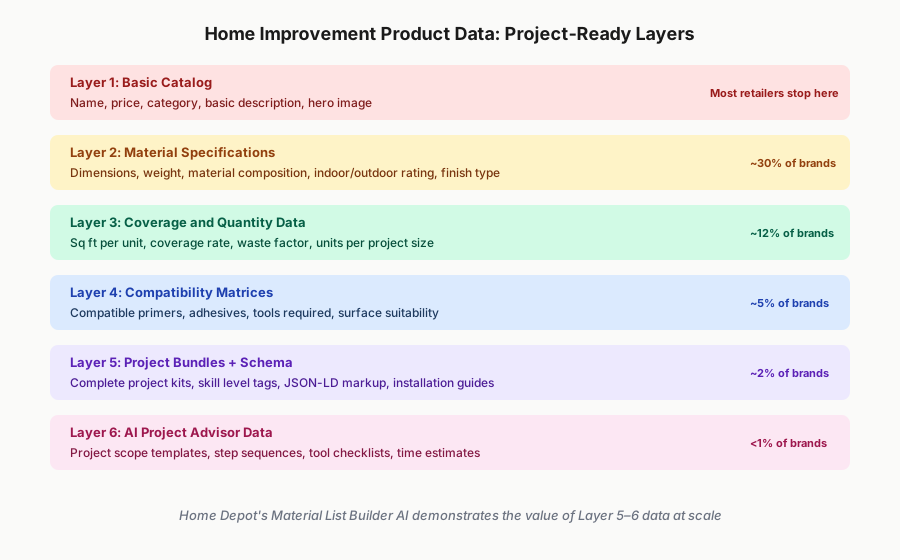
Home improvement product data layers: most retailers stop at Layer 1 while AI agents need Layer 3+ to provide project-scoping recommendations.
Coverage Rate and Quantity Data
Coverage data is the single most important attribute for home improvement AI. Without it, agents cannot calculate how much material a project requires — which is the primary reason customers seek AI help in this category.
| Product Type | Coverage Metric | Waste Factor | Unit |
|---|---|---|---|
| Interior Paint | 350-400 sq ft/gallon | 10% | Gallon |
| Tile | Per tile → sq ft | 10-15% (cuts) | Square foot |
| Tile Adhesive | 40-70 sq ft per bag | 5% | 25 lb bag |
| Grout | 25-40 sq ft per bag | 10% | 10 lb bag |
| Hardwood Flooring | Per case → sq ft | 10% (stagger cuts) | Case |
| Deck Stain | 150-300 sq ft/gallon | 15% | Gallon |
| Insulation (Batt) | Per roll → sq ft at R-value | 5% | Roll |
Material Compatibility Matrices
Compatibility data prevents AI agents from recommending products that do not work together — one of the most common and costly DIY mistakes. A structured compatibility matrix for a bathroom tile project might look like this:
{
  "project_type": "bathroom_floor_tile",
  "compatibility_matrix": {
    "porcelain_tile": {
      "adhesive": [ "modified thinset", "large-format thinset"],
      "not_compatible": [ "mastic adhesive (wet areas)", "unmodified thinset (porcelain)"],
      "grout": [ "unsanded grout (joints <1/8\")", "sanded grout (joints 1/8\"-1/2\")"],
      "underlayment": [ "cement backer board", "Ditra uncoupling membrane"],
      "waterproofing": [ "RedGard membrane", "Kerdi membrane"]
    },
    "natural_stone_tile": {
      "adhesive": [ "white thinset (prevent staining)"],
      "not_compatible": [ "gray thinset (may stain light stone)"],
      "grout": [ "unsanded grout only"],
      "sealer_required": true,
      "sealer_options": [ "impregnating sealer", "topical sealer"]
    }
  }
}
Project Bundle Data for AI Agents
The most AI-ready home improvement brands create structured project bundles — complete material lists for common projects that agents can recommend as turnkey solutions. This mirrors what Home Depot's Material List Builder does algorithmically, but structured as product data that any AI system can access.
{
  "project_bundle": {
    "name": "Bathroom Floor Tile Kit — 50 sq ft",
    "project_type": "bathroom_floor_tile",
    "skill_level": "intermediate",
    "estimated_time": "2-3 days",
    "items": [
      {"product": "Porcelain Floor Tile 12x24", "quantity": "55 sq ft", "note": "includes 10% waste"},
      {"product": "Modified Thinset Mortar", "quantity": "2 x 25lb bags"},
      {"product": "Sanded Grout", "quantity": "2 x 10lb bags"},
      {"product": "Cement Backer Board 1/4\"", "quantity": "4 sheets"},
      {"product": "Backer Board Screws", "quantity": "1 box (200ct)"},
      {"product": "RedGard Waterproofing Membrane", "quantity": "1 gallon"},
      {"product": "Tile Spacers 1/8\"", "quantity": "1 bag (200ct)"},
      {"product": "Grout Float", "quantity": "1"},
      {"product": "Notched Trowel 1/4x3/8\"", "quantity": "1"},
      {"product": "Tile Cutter or Wet Saw Rental", "quantity": "1 day"}
    ],
    "total_estimated_cost": "$450-650"
  }
}
Schema.org Markup for Home Improvement Products
JSON-LD structured data helps AI crawlers extract product specifications without parsing free-text descriptions. For home improvement products, additionalProperty fields are essential for capturing coverage rates, compatibility, and installation data:
<"code-attr">class="code-tag">script "code-attr">type="application/ld+json">
{
  "@context": "https://schema.org",
  "@type": "Product",
  "name": "Varathane Premium Wood Stain — Dark Walnut (1 qt)",
  "brand": {"@type": "Brand", "name": "Varathane"},
  "category": "Interior Wood Stain",
  "offers": {
    "@type": "Offer",
    "price": "11.98",
    "priceCurrency": "USD",
    "availability": "https://schema.org/InStock"
  },
  "additionalProperty": [
    {"@type": "PropertyValue", "name": "Coverage", "value": "275 sq ft per quart"},
    {"@type": "PropertyValue", "name": "Dry Time Between Coats", "value": "2 hours"},
    {"@type": "PropertyValue", "name": "Coats Recommended", "value": "2"},
    {"@type": "PropertyValue", "name": "Application Method", "value": "Brush, cloth, or foam applicator"},
    {"@type": "PropertyValue", "name": "Skill Level", "value": "Beginner"},
    {"@type": "PropertyValue", "name": "Indoor/Outdoor", "value": "Indoor only"},
    {"@type": "PropertyValue", "name": "Compatible Surfaces", "value": "Hardwood, softwood, plywood, veneer"},
    {"@type": "PropertyValue", "name": "Recommended Topcoat", "value": "Varathane Oil-Based or Water-Based Polyurethane"}
  ]
}
</"code-attr">class="code-tag">script>
The DIY Content Advantage
Home improvement brands that publish detailed how-to content, project guides, and installation tutorials create a significant AI discovery advantage. LLMs trained on this content associate those brands with expertise and recommend their products more frequently when customers describe DIY projects.
The key is structuring this content for AI extraction. Step-by-step guides with clear headings, material lists at the top, and time/cost estimates give AI agents the data they need to scope projects and recommend your products as part of complete solutions. Brands like Home Depot, Lowe's, and Rust-Oleum have extensive tutorial libraries that function as training data for every major LLM.
Action Plan: Making Home Improvement Data AI-Ready
- Add coverage and quantity data to all materials products — sq ft per unit, recommended waste factor, and units-per-project guidance.
- Build product compatibility matrices documenting which products work together and which combinations to avoid.
- Create structured project bundles for the 10-20 most common projects in your category with complete material lists.
- Tag all products with skill level indicators — beginner, intermediate, professional — and required tools.
- Implement Schema.org Product markup with
additionalPropertyfor coverage rates, surfaces, and compatibility. - Publish detailed how-to content with structured material lists, time estimates, and step sequences that AI systems can parse.
Frequently Asked Questions
Why is home improvement particularly well-suited for AI shopping agents?
Home improvement purchases are project-driven — customers need help scoping work, selecting compatible materials, and calculating quantities. This is exactly the kind of complexity where AI agents add the most value, moving from product search to project advisory. Home Depot's Material List Builder AI, launched in January 2026, demonstrates how much demand exists for this capability.
What is the most important product data attribute for home improvement AI?
Coverage rates. Without knowing how much area a product covers (sq ft per gallon, tiles per sq ft, adhesive per bag), AI agents cannot calculate quantities for a project — which is the primary reason customers seek AI help in this category.
How should brands structure compatibility data for AI agents?
Create machine-readable compatibility matrices that explicitly list which products work together and which combinations to avoid. For example, a tile product page should specify compatible adhesive types, grout types, and underlayment — not just say "use appropriate adhesive." The more specific and structured this data is, the more confidently AI agents can recommend complete project solutions.
Do project bundles help with AI discovery?
Yes. Structured project bundles — complete material lists for common projects like "50 sq ft bathroom floor tile" — give AI agents turnkey solutions to recommend. This is exactly what Home Depot's Material List Builder generates algorithmically. Brands that provide pre-built project bundles as structured data make it easy for any AI system to recommend their products as part of a complete solution.
How does DIY content affect AI product recommendations?
Detailed how-to guides, project tutorials, and installation instructions function as training data for LLMs. When a customer asks an AI agent how to refinish a deck, the agent draws on published content to recommend products. Brands with comprehensive, well-structured tutorial libraries get recommended more frequently because the AI has more data linking their products to specific projects.