
Optimizing Pet Products and Specialty Pet Health Data for AI Discovery
Pet product recommendations require breed, age, weight, and health condition matching that generic search cannot handle. This guide covers nutritional data structuring, breed-specific product mapping, subscription modeling, guaranteed analysis formatting, and schema markup for pet food, supplements, and accessories.
Pet products represent one of the fastest-growing ecommerce verticals — the U.S. pet industry crossed $152 billion in 2024, with nearly all growth coming from online sales. Yet most pet ecommerce brands convert at just 1–2%. The gap between demand and results comes down to one thing: pet product recommendations are harder than almost any other retail vertical.
A 10-pound senior Chihuahua with grain allergies needs completely different food, supplements, and accessories than a 90-pound young Labrador. Cat owners shopping for a senior cat with kidney issues need low-phosphorus options filtered by brand, flavor, and price. Generic product search cannot handle this complexity — but AI systems can, if brands provide the structured data these systems require.
Why Pet Products Are Uniquely Complex for AI
Every pet product recommendation must account for species, breed, age, weight, activity level, allergies, and health conditions. A "best dog food" recommendation is meaningless without these parameters. This makes pet products one of the highest-value verticals for AI — and one where structured data quality determines whether a brand gets recommended.
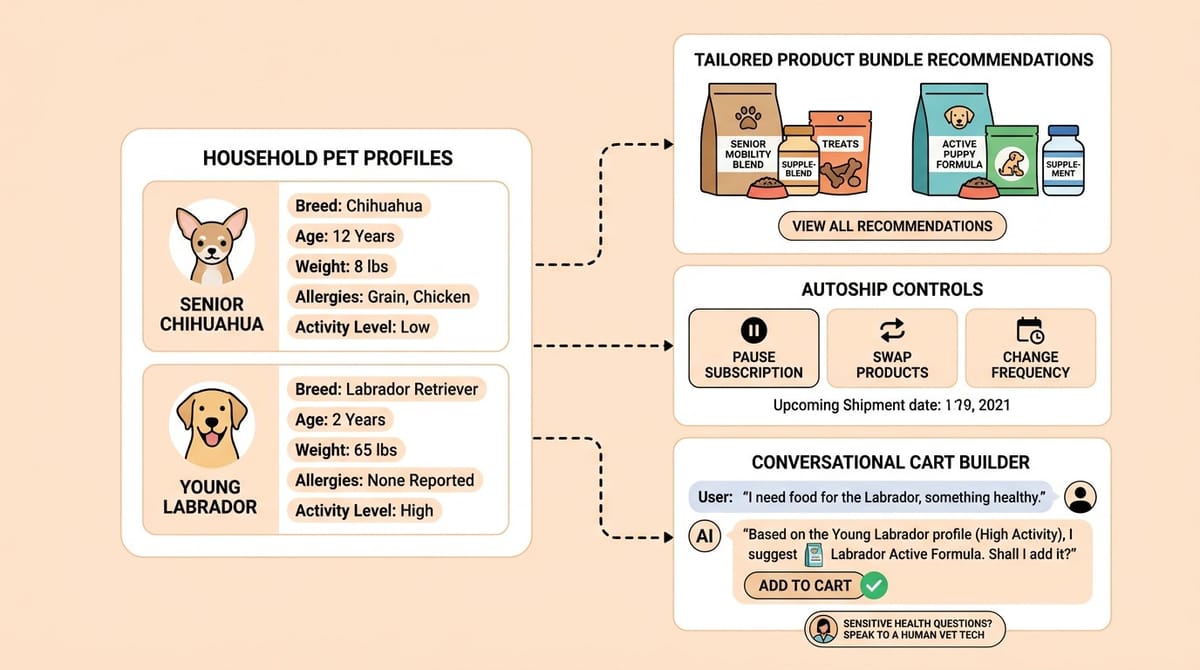
Source: Alhena AI — AI-powered pet product matching with household pet profiles and autoship
How AI Systems Handle Pet Product Queries
When a customer asks "what's the best food for my 7-year-old Golden Retriever with joint issues and a sensitive stomach," an effective AI system needs to evaluate breed-specific nutritional needs (large breed, joint-prone), age-related requirements (senior formula needed at age 7+ for Goldens), health condition targeting (glucosamine/chondroitin for joints, limited ingredient for sensitive stomach), weight-appropriate caloric content, and ingredient suitability.
The AI evaluation follows a specific data-dependent flow:
| Evaluation Step | Function | Data Required From Brand |
|---|---|---|
| Pet Profile Matching | Filters products by species, breed size, and life stage | Species, breed size categories (small/medium/large/giant), life stage ranges |
| Health Condition Targeting | Matches products to specific health needs | Joint support, digestive health, weight management, dental, skin/coat as structured tags |
| Nutritional Analysis | Evaluates guaranteed analysis and caloric content | Protein %, fat %, fiber %, moisture %, calories per cup/can |
| Ingredient Safety Check | Screens for allergens and sensitivities | Primary protein source, grain-free status, common allergen presence |
| Replenishment Calculation | Estimates consumption rate for auto-ship | Package size, feeding guidelines by weight, daily consumption rate |
Structured Product Data for Pet Food
Pet food has the most complex data requirements in the pet vertical. Here is what AI-ready pet food data looks like:
❌ Typical Pet Food Product Data
Name: Premium Adult Dog Food
Description: High-quality nutrition for your dog.
Size: 30 lb bag
Price: $54.99
✅ AI-Ready Pet Food Product Data
{
  "name": "Senior Large Breed Joint Support Formula — Salmon & Sweet Potato",
  "species": "dog",
  "breed_size": [ "large", "giant"],
  "life_stage": {
    "category": "senior",
    "age_range": "7+ years for large breeds"
  },
  "primary_protein": "Deboned Salmon",
  "protein_sources": [ "Deboned Salmon", "Salmon Meal", "Menhaden Fish Meal"],
  "grain_status": "grain_inclusive",
  "grains_used": [ "Brown Rice", "Oatmeal"],
  "guaranteed_analysis": {
    "crude_protein_min_pct": 25,
    "crude_fat_min_pct": 12,
    "crude_fiber_max_pct": 5,
    "moisture_max_pct": 10,
    "calcium_min_pct": 1.0,
    "phosphorus_min_pct": 0.8,
    "glucosamine_min_mg_kg": 700,
    "chondroitin_min_mg_kg": 300,
    "omega3_min_pct": 0.5,
    "omega6_min_pct": 2.5
  },
  "caloric_content": {
    "kcal_per_cup": 340,
    "kcal_per_kg": 3400
  },
  "feeding_guidelines": [
    {"weight_lbs": "50-75", "cups_per_day": "2.5-3.25"},
    {"weight_lbs": "75-100", "cups_per_day": "3.25-4.0"},
    {"weight_lbs": "100+", "cups_per_day": "4.0+"}
  ],
  "health_targets": [ "joint_support", "skin_coat", "digestive_health", "weight_management"],
  "aafco_statement": "Formulated to meet AAFCO nutrient profiles for maintenance of adult dogs",
  "certifications": [ "AAFCO", "Made in USA"],
  "allergen_free": [ "corn", "wheat", "soy", "artificial_colors", "artificial_preservatives"],
  "package_sizes": [
    {"weight_lbs": 15, "price_usd": 34.99, "estimated_supply_days": 15},
    {"weight_lbs": 30, "price_usd": 54.99, "estimated_supply_days": 30}
  ],
  "subscription": {
    "available": true,
    "discount_pct": 10,
    "frequencies": [ "2_weeks", "4_weeks", "6_weeks", "8_weeks"]
  }
}
Beyond Food: Supplements, Accessories, and Health Products
Pet supplements and health products require data structures similar to human health supplements — with additional species and breed-specific parameters:
| Product Category | Key Structured Data | Example |
|---|---|---|
| Joint Supplements | Active ingredients with amounts, weight-based dosing, chewable/tablet/liquid form | Glucosamine 500mg + MSM 400mg, for dogs 50+ lbs, soft chew |
| Dental Chews | Size/weight range, VOHC accepted, chew duration, caloric content | For dogs 25-50 lbs, VOHC seal, avg. 8 min chew time, 68 kcal |
| Flea/Tick Prevention | Weight range, duration, active ingredients, application method, species restrictions | Dogs 21-55 lbs, 30-day protection, topical, NOT for cats |
| Harnesses & Leashes | Size chart with girth measurements, weight rating, material, hardware type | M: girth 22-28", max pull 65 lbs, ripstop nylon, aluminum hardware |
| Beds & Crates | Internal dimensions, weight rating, breed size suitability, washable components | Interior: 36x24x4", for dogs up to 70 lbs, large breeds, machine-wash cover |
Breed-Specific Data: The Competitive Advantage
The pet brands that will win AI discovery are those that structure data around breed-specific needs. Different breeds have documented predispositions:
- Golden Retrievers: Prone to hip dysplasia and skin allergies. Products with joint support ingredients and limited-ingredient formulations should tag these as breed-relevant.
- French Bulldogs: Brachycephalic breed with respiratory and digestive sensitivities. Products should note suitability for flat-faced breeds, easy-to-chew formats.
- Siamese Cats: Higher protein requirements, prone to dental issues and respiratory infections. Food data should include protein density and dental health features.
- German Shepherds: Prone to digestive issues (EPI, IBD) and joint problems. Easily digestible formulations with probiotics and joint support should be tagged.
Include a breed_recommendations array in your product data linking specific breeds to products formulated for their needs. This is the data that lets AI answer "what food is best for my French Bulldog" with a specific, breed-appropriate recommendation.

Subscription and Replenishment: The Retention Advantage
Pet food and supplies have highly predictable consumption patterns, making this category ideal for AI-managed replenishment. A 30 lb bag of food for a 75 lb dog fed 3.25 cups/day at 340 kcal/cup lasts approximately 30 days. AI systems that can calculate this automatically become retention tools, not just discovery channels.
Structured subscription data should include:
- Calculated supply duration by pet weight. Not just package size, but estimated days of supply for different weight ranges.
- Subscription frequency options. 2-week, 4-week, 6-week, 8-week intervals with the ability for AI agents to recommend the optimal frequency.
- Bundle compatibility. Which products are commonly purchased together? Food + dental chews + joint supplement bundles let AI build complete care packages.
- Life stage transition alerts. When a puppy reaches adult age for their breed, product recommendations should automatically shift. Structure transition age data by breed size.
Schema Markup for Pet Products
{
  "@context": "https://schema.org",
  "@type": "Product",
  "name": "Senior Large Breed Joint Support Formula — Salmon & Sweet Potato",
  "brand": {"@type": "Brand", "name": "ExamplePet"},
  "description": "AAFCO-compliant senior dog food with 700mg/kg glucosamine for joint support. Salmon-based, grain-inclusive. For large and giant breeds 7+ years.",
  "additionalProperty": [
    {"@type": "PropertyValue", "name": "Species", "value": "Dog"},
    {"@type": "PropertyValue", "name": "Life Stage", "value": "Senior (7+ years large breeds)"},
    {"@type": "PropertyValue", "name": "Breed Size", "value": "Large, Giant"},
    {"@type": "PropertyValue", "name": "Health Target", "value": "Joint Support, Skin & Coat"},
    {"@type": "PropertyValue", "name": "Primary Protein", "value": "Deboned Salmon"},
    {"@type": "PropertyValue", "name": "Calories", "value": "340 kcal/cup"}
  ]
}
Action Plan for Pet Brands
- Structure every product by species, breed size, and life stage. These are the primary filters AI uses — they must be machine-readable attributes, not marketing copy.
- Add health condition targeting as structured tags. Joint support, digestive health, weight management, skin/coat, dental — mapped to products with specific ingredient evidence.
- Provide complete nutritional analysis in machine-readable format. Guaranteed analysis percentages, caloric content per cup/can, and ingredient lists — not just PDF labels.
- Include feeding guidelines by weight range. Cups per day for each weight bracket. This is the data AI needs for replenishment calculations.
- Build breed-specific product maps. Link products to breeds with documented predispositions. This lets AI answer breed-specific queries.
- Enable subscription data with consumption calculations. Supply duration, frequency options, bundle compatibility, and life stage transition timing.
- Implement Product schema with pet-specific additionalProperty fields. Species, life stage, breed size, health targets, and primary protein on every product page.
Frequently Asked Questions
Why are pet products a strong vertical for AI-mediated discovery?
High emotional investment, complex matching requirements (species, breed, age, weight, health conditions), predictable replenishment cycles, and willingness to pay premium prices. Pet owners who find an AI system that understands their pet's specific needs become loyal, high-LTV customers.
What data matters most for pet food AI discovery?
Species, breed size, life stage, primary protein source, health condition targeting, guaranteed analysis (protein/fat/fiber percentages), caloric content per cup, and AAFCO compliance statement. Without these as structured attributes, AI cannot make breed-appropriate recommendations.
How can pet brands use breed-specific data for competitive advantage?
Map your products to breeds with documented health predispositions. A joint support formula should explicitly tag Golden Retrievers, German Shepherds, and Labradors. A limited-ingredient food should tag breeds prone to food allergies. This structured breed mapping is what lets AI answer "what food is best for my Golden Retriever" with your product.
How does subscription data work with AI pet product discovery?
AI agents that know a 30 lb bag feeds a 75 lb dog for approximately 30 days can proactively suggest reorders at the right time. Include package size, feeding guidelines by weight, calculated supply duration, subscription discount, and frequency options. This turns AI from a one-time discovery tool into an ongoing retention channel.
What role does AAFCO play in pet food AI recommendations?
AAFCO (Association of American Feed Control Officials) compliance is the baseline quality signal for pet food. AI systems treat the AAFCO statement as a trust indicator similar to NSF or USP certification in human supplements. Include your AAFCO statement and whether the product meets maintenance, all life stages, or growth/reproduction profiles.