
Optimizing Sustainable and Eco-Friendly Product Data for AI Discovery
AI agents need verifiable sustainability data, not marketing language. Here is how eco-friendly brands should structure certifications, impact metrics, and supply chain transparency for AI-mediated product discovery — and why verified proof points drive 15.4% higher AI recommendations.
Sustainable and eco-friendly products face a unique challenge in AI-mediated commerce: the gap between marketing language and verifiable claims. Terms like "eco-friendly," "green," and "sustainable" have no standardized definitions — the FTC's Green Guides explicitly warn against using them without qualification. AI shopping agents operating in this space must distinguish between genuine certifications and unsubstantiated marketing, and they can only do this if brands provide the right structured data.
For brands genuinely committed to sustainability, this is a significant opportunity. Research from Provenance shows that verified product proof points drive 15.4% higher AI recommendations compared to unverified claims. AI agents that can verify environmental claims through structured certification data will increasingly favor brands with real credentials over those relying on vague green marketing.
Why Sustainable Products Are Different for AI Agents
Sustainability claims are often subjective and unregulated. AI agents need verifiable, structured certification data to distinguish genuine eco-credentials from greenwashing — making data quality a competitive advantage for authentic sustainable brands. The more specific and verifiable your claims, the more confidently AI systems recommend your products.
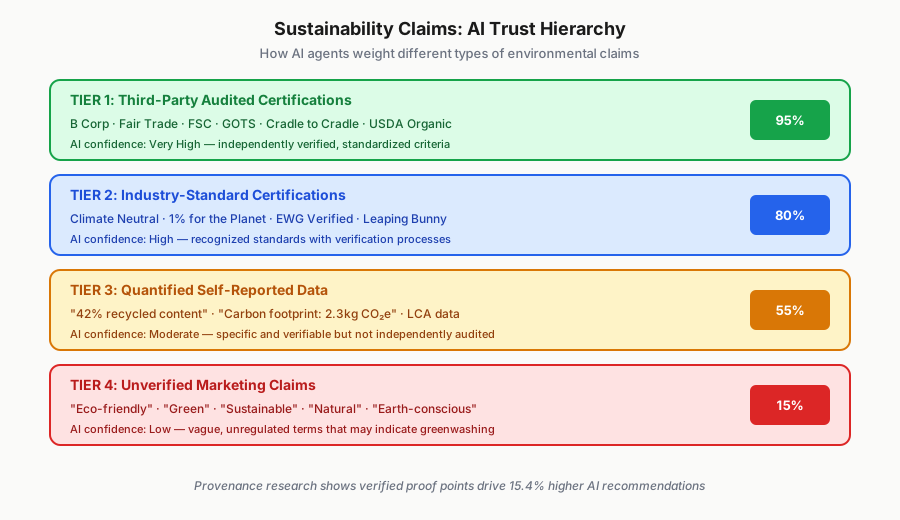
AI trust hierarchy for sustainability claims — third-party audited certifications like B Corp and Fair Trade receive the highest confidence scores, while vague terms like "eco-friendly" are weighted as low-confidence signals.
The Greenwashing Filter Problem
When a customer asks an AI agent for "sustainable running shoes," the agent faces a classification challenge. Does "sustainable" mean recycled materials? Carbon-neutral manufacturing? Fair labor practices? Recyclable packaging? Vegan materials? All of the above? Without structured sustainability data, AI agents either recommend everything that uses the word "sustainable" (rendering the filter useless) or apply conservative heuristics that exclude legitimate brands.
This filtering challenge is growing more acute as regulators crack down on greenwashing. The EU's Green Claims Directive, effective 2026, requires environmental claims to be substantiated by recognized scientific evidence and verified by accredited third parties. AI systems are already building these regulatory requirements into their recommendation logic — brands that cannot demonstrate compliance will lose visibility.
Structured Sustainability Data
Here is what a sustainability-optimized product data structure looks like for a certified eco-friendly product:
{
  "name": "EcoTrail Recycled Hiking Boot",
  "brand": "EcoTrail",
  "category": "Footwear > Hiking Boots",
  "sustainability": {
    "certifications": [
      {
        "name": "B Corp Certified",
        "certifier": "B Lab",
        "certification_id": "BCorp-2024-38291",
        "valid_through": "2027-06",
        "verification_url": "https://bcorporation.net/directory/ecotrail"
      },
      {
        "name": "Climate Neutral Certified",
        "certifier": "Climate Neutral",
        "year": 2025,
        "scope": "Full product lifecycle"
      }
    ],
    "material_composition": [
      {"material": "Recycled ocean plastic", "percentage": 45, "source": "Collected from coastal cleanup programs"},
      {"material": "Recycled rubber", "percentage": 30, "source": "Reclaimed tire rubber"},
      {"material": "Organic cotton", "percentage": 15, "certification": "GOTS"},
      {"material": "Bio-based adhesive", "percentage": 10}
    ],
    "carbon_footprint": {
      "value": 8.2,
      "unit": "kg_CO2e",
      "scope": "Cradle-to-gate",
      "methodology": "ISO 14067"
    },
    "packaging": {
      "material": "100% post-consumer recycled cardboard",
      "recyclable": true,
      "plastic_free": true,
      "compostable_elements": [ "tissue paper", "hang tags"]
    },
    "end_of_life": {
      "recyclable": true,
      "take_back_program": true,
      "take_back_url": "https://ecotrail.com/recycle",
      "biodegradation_timeline": "Sole: 3-5 years; Upper: 1-2 years"
    },
    "supply_chain": {
      "manufacturing_country": "Portugal",
      "labor_certification": "SA8000",
      "factory_audit": "Annual third-party audit",
      "traceability": "Full supply chain mapped"
    }
  }
}
Certification Trust Hierarchy for AI Systems
Not all sustainability claims carry equal weight with AI systems. The trust hierarchy below reflects how AI agents classify and weight different types of environmental claims when generating product recommendations:
| Trust Tier | Claim Type | Examples | AI Confidence |
|---|---|---|---|
| Tier 1 | Third-party audited certifications | B Corp, Fair Trade, FSC, GOTS, Cradle to Cradle, USDA Organic | Very High |
| Tier 2 | Industry-standard certifications | Climate Neutral, 1% for the Planet, EWG Verified, Leaping Bunny | High |
| Tier 3 | Quantified self-reported data | "42% recycled content," "Carbon footprint: 2.3kg CO₂e," published LCA | Moderate |
| Tier 4 | Unverified marketing claims | "Eco-friendly," "Green," "Sustainable," "Natural," "Earth-conscious" | Low |
Provenance's research demonstrates that verified sustainability proof points — structured, third-party validated data — drive measurably higher AI recommendation rates. Source: Provenance.org
Schema.org Markup for Sustainability Claims
Structured data is essential for communicating sustainability credentials to AI crawlers. Use additionalProperty fields to surface certifications, material composition, and environmental metrics:
<"code-attr">class="code-tag">script "code-attr">type="application/ld+json">
{
  "@context": "https://schema.org",
  "@type": "Product",
  "name": "EcoTrail Recycled Hiking Boot",
  "brand": {"@type": "Brand", "name": "EcoTrail"},
  "category": "Footwear > Hiking Boots",
  "offers": {
    "@type": "Offer",
    "price": "189.00",
    "priceCurrency": "USD",
    "availability": "https://schema.org/InStock"
  },
  "additionalProperty": [
    {"@type": "PropertyValue", "name": "Certification", "value": "B Corp Certified (BCorp-2024-38291)"},
    {"@type": "PropertyValue", "name": "Certification", "value": "Climate Neutral Certified 2025"},
    {"@type": "PropertyValue", "name": "Recycled Content", "value": "45% recycled ocean plastic, 30% reclaimed rubber"},
    {"@type": "PropertyValue", "name": "Carbon Footprint", "value": "8.2 kg CO2e (cradle-to-gate, ISO 14067)"},
    {"@type": "PropertyValue", "name": "Packaging", "value": "100% post-consumer recycled, plastic-free"},
    {"@type": "PropertyValue", "name": "Manufacturing", "value": "Portugal, SA8000 certified factory"},
    {"@type": "PropertyValue", "name": "Take-Back Program", "value": "Available — return worn boots for recycling"},
    {"@type": "PropertyValue", "name": "Vegan", "value": "Yes — no animal-derived materials"}
  ]
}
</"code-attr">class="code-tag">script>
Product-Level Impact Data
Forward-thinking sustainable brands are publishing product-level impact data — carbon footprint per item, water usage, waste diverted — in structured format. This data gives AI agents concrete, comparable metrics to use when recommending products rather than relying on subjective claims.
Allbirds, for example, publishes a carbon footprint number on every product page (e.g., 7.6 kg CO₂e for the Tree Runner). This single metric gives AI agents a quantifiable comparison point: when a customer asks for "low-carbon running shoes," the agent can rank options by actual emissions data rather than interpreting vague marketing language.
The EU Green Claims Directive Impact
The EU's Green Claims Directive, taking effect in 2026, requires all environmental claims to be substantiated by recognized scientific evidence and verified by accredited third-party bodies before use in marketing. This regulation is already influencing how AI systems evaluate sustainability claims — agents trained on post-Directive data increasingly penalize vague environmental language and reward verified, structured claims.
For brands selling into the EU or global markets, this means structured sustainability data is not just an AI optimization strategy — it is a compliance requirement that also happens to improve AI visibility.
Action Plan: Making Sustainability Data AI-Ready
- Structure all certifications as machine-readable data — include certifier name, certification ID, validity period, and verification URL. Not just logos on product pages.
- Quantify sustainability claims. Replace "eco-friendly" with specific metrics: "45% recycled ocean plastic," "carbon footprint: 8.2 kg CO₂e," "100% post-consumer recycled packaging."
- Publish product-level impact data. Carbon footprint, water usage, and waste metrics in structured format give AI agents comparable data points.
- Document end-of-life options. Recyclability, compostability, take-back programs, and biodegradation timelines help AI agents recommend products for environmentally conscious shoppers.
- Implement Schema.org markup with additionalProperty for certifications, material composition, and environmental metrics.
- Prepare for EU Green Claims Directive compliance. Structure your verification data now — it will simultaneously satisfy regulators and AI recommendation systems.
Frequently Asked Questions
Why do sustainable brands have a data advantage in AI discovery?
Brands with genuine, verifiable sustainability credentials can provide structured certification and impact data that AI agents use to distinguish them from greenwashing competitors. Provenance research shows verified proof points drive 15.4% higher AI recommendations. Better data leads to more confident AI recommendations.
Which sustainability certifications matter most for AI agents?
Third-party audited certifications carry the most weight: B Corp, Fair Trade, FSC, GOTS, Cradle to Cradle, and USDA Organic. AI systems treat these as verified trust signals with the highest confidence scores, while unsubstantiated claims like "eco-friendly" receive minimal weighting.
How should brands handle the lack of standardized sustainability definitions?
Replace vague terms with specific, quantified claims. Instead of "sustainable packaging," use "100% post-consumer recycled cardboard, FSC-certified, printed with soy-based inks." Specificity gives AI agents actionable data they can use for comparison and recommendation.
How does the EU Green Claims Directive affect AI visibility?
The 2026 directive requires environmental claims to be substantiated by scientific evidence and third-party verification. AI systems are already incorporating these standards into their recommendation logic — brands that cannot demonstrate compliance will lose visibility as agents increasingly filter for verified claims.