
Predictive Shopping and Adaptive Retail: How AI Is Rewriting the Purchase Journey in 2026
Ecommerce is shifting from reactive personalization to predictive commerce. AI systems now anticipate what customers want before they search. Here is how predictive merchandising, adaptive pricing, and real-time storefronts are reshaping retail in 2026.
Ecommerce personalization has been a priority for a decade. But in 2026, the industry is crossing a meaningful threshold: the shift from reactive personalization to predictive commerce. Instead of responding to what a shopper just did, AI systems are beginning to anticipate what they will want next — and adapting the shopping experience before the customer takes action.
This shift has practical implications for how brands merchandise products, set prices, and design customer journeys. Understanding the mechanics — and the limitations — of predictive shopping is becoming essential for ecommerce operators who want to stay competitive.
What Is Predictive Commerce?
Predictive commerce uses AI to anticipate customer intent based on behavioral signals, contextual data, and historical patterns. Rather than personalizing based on past actions alone, it adjusts product suggestions, layouts, and pricing based on what the customer is likely to want next.
The three-layer predictive commerce stack: intelligence, adaptive experience, and behavioral analytics working together to anticipate customer intent.

From Personalization to Prediction: What Actually Changed
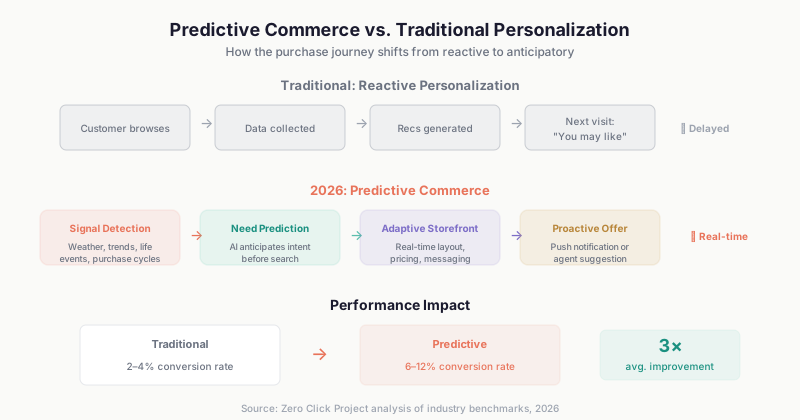
Traditional personalization relies on segmentation — grouping customers by demographics, purchase history, or browsing behavior. Predictive commerce goes further by modeling individual intent trajectories. It reads context, timing, and micro-behavioral signals to forecast purchasing decisions before they happen.
| Traditional Personalization | Predictive Commerce (2026) |
|---|---|
| Based on past actions | Anticipates future intentions |
| Static recommendations ("you bought X, try Y") | Dynamic, evolving experiences based on real-time context |
| Segment-driven ("women 25–34 who like fitness") | Individual context-driven ("this person is comparing running shoes right now") |
| Optimized for clicks | Optimized for timing, trust, and purchase readiness |
| Batch-processed overnight | Real-time, sub-second adaptation |
The practical difference: instead of asking "what should we recommend based on what this person browsed yesterday?" predictive systems ask "what moment is this customer in, and what are they ready for right now?"
The Predictive AI Stack for Retail
Modern predictive commerce operates through three interconnected layers:
| Layer | Function | Leading Platforms | Implementation Approach |
|---|---|---|---|
| Predictive Intelligence | Anticipates needs from behavioral data | Salesforce Einstein, Bloomreach, Google Vertex AI | ML models trained on purchase history, browsing patterns, and contextual signals |
| Adaptive Experience | Personalizes storefronts in real time | Dynamic Yield, Adobe Target, Insider | A/B testing + real-time content swapping based on predicted intent |
| Behavioral Analytics | Interprets engagement depth and patterns | Amplitude, Mixpanel, custom event pipelines | Event-based tracking with real-time aggregation and intent scoring |
Technical Implementation: Intent Scoring
At the core of predictive commerce is an intent scoring model that evaluates purchase readiness in real time. Here is how the signal pipeline works:
# Simplified intent scoring pipeline

def calculate_intent_score(session_data: dict) -> float:
    """Score purchase intent from 0.0 to 1.0"""
    weights = {
        "product_page_views": 0.15,
        "time_on_product_page": 0.10,
        "comparison_behavior": 0.20,  # Viewing 3+ similar products
        "review_reading": 0.15,       # Reading reviews = high intent
        "price_check_frequency": 0.15, # Checking price multiple times
        "cart_proximity": 0.10,        # Hovering over add-to-cart
        "return_visit": 0.15           # Coming back within 48 hours
    }

    score = sum(
        weights[signal] * normalize(session_data.get(signal, 0))
        for signal in weights
    )
    return min(score, 1.0)

# Trigger adaptive experience based on intent score
if intent_score > 0.7:
    show_urgency_signals()      # "Only 3 left in stock"
    offer_express_checkout()     # One-click purchase option
elif intent_score > 0.4:
    show_social_proof()          # Recent purchases, reviews
    suggest_comparison()         # Side-by-side with alternatives
else:
    show_educational_content()   # Buying guides, how-to content
    offer_email_capture()        # "Get notified when price drops"
These layers work together to create what some retailers call adaptive retail environments — storefronts that evolve with the shopper in real time, showing not just relevant products but relevant experiences.
Predictive Merchandising: Stocking for Tomorrow's Demand
One of the most practical applications of predictive AI is merchandising. Rather than relying on last month's sales reports to decide what to feature, predictive models analyze intent velocity — how quickly a trend or preference is forming — to adjust product placement in real time.
When a predictive system detects a spike in interest around a specific aesthetic, product category, or price range, it can automatically update homepage carousels, category page rankings, and email recommendations. By the time a trend reaches mainstream awareness, predictive commerce brands have already captured early demand.
Real-World Predictive Merchandising Examples
| Signal Detected | Predictive Action | Business Impact |
|---|---|---|
| 3x increase in searches for "linen pants" in 48 hours | Auto-promote linen category to homepage, reorder category page by linen-first | Capture early seasonal demand before competitors react |
| High add-to-cart but low checkout for $200+ items | Trigger "Buy Now Pay Later" visibility, offer bundle discounts | Reduce price-hesitation abandonment by 15–25% |
| Returning customer who bought a tent last week | Surface sleeping bags, camp stoves — not tents again | Increase cross-sell revenue; reduce irrelevant recommendations |
| Weather API: heatwave forecast for customer's region | Promote fans, cooling towels, hydration products | Context-aware merchandising driven by external signals |
This approach requires clean, real-time inventory data. Predictive merchandising fails when AI recommends products that are out of stock or backordered. The intelligence layer and the operational layer must be tightly connected.
Adaptive Pricing: Beyond Dynamic Discounting
Dynamic pricing has been part of ecommerce for years. But in 2026, the approach is maturing. Instead of simply lowering prices to close sales, adaptive pricing systems balance value perception, profitability, and customer trust.
These systems use real-time market signals, competitor pricing APIs, inventory levels, and engagement depth to determine optimal pricing. When a customer shows sustained engagement and high brand affinity, the system may maintain premium pricing while offering added experience value — early access, exclusive content, or bundled offers.
Adaptive Pricing Strategy Matrix
| Customer Segment | Intent Signal | Pricing Strategy | Value Addition |
|---|---|---|---|
| High affinity, high intent | Repeat visitor, comparison complete | Maintain premium price | Early access, loyalty points, free express shipping |
| New visitor, high intent | Direct search, quick to PDP | Competitive price match | First-order discount, free returns guarantee |
| Price-sensitive, browsing | Multiple price checks, cart abandonment | Strategic discount | Bundle savings, "price drop alert" opt-in |
| Low intent, exploring | Category browsing, no PDP engagement | Standard pricing | Educational content, buying guides, email capture |
The key insight: adaptive pricing is moving from a race to the bottom toward a strategy that aligns value perception with customer readiness. This requires careful implementation and transparency to maintain customer trust.
Measuring Predictive Commerce Performance
Traditional ecommerce KPIs — conversion rate, average order value, revenue per visitor — remain important. But predictive commerce introduces additional metrics that measure the accuracy and impact of AI-driven anticipation:
| Metric | What It Measures | How to Calculate |
|---|---|---|
| Predictive Purchase Rate | Percentage of AI-forecasted buying decisions that actually occur | Predicted purchases / actual purchases within 7-day window |
| Adaptive CLV | Lifetime value growth attributable to adaptive journey personalization | CLV of adaptive cohort vs. control group over 90 days |
| Experience Velocity | Speed of UX adaptation during a shopping session | Average time between intent signal and experience change |
| Recommendation Accuracy | How often AI-surfaced products match actual purchase intent | Products purchased / products recommended in session |
| Intent Score Calibration | How well the intent model predicts actual conversion | Correlation between predicted intent scores and actual outcomes |
The Human-AI Balance
Predictive commerce works best when data predicts but humans decide why it matters. AI runs the analytics, but humans define creative direction, brand voice, and ethical boundaries. Retailers in 2026 are learning to act as experience curators — setting the parameters within which AI operates rather than ceding full control.
This balance matters especially for pricing and recommendation ethics. Prediction without transparency risks feeling manipulative. Brands that disclose when AI influences recommendations and allow customers to opt into deeper personalization build stronger long-term trust.
Getting Started: Practical Steps
- Start with prediction-ready data. Clean, real-time product and inventory data is the foundation. Ensure your product catalog includes complete attributes, accurate pricing, and real-time inventory counts.
- Implement event-based tracking. Move from page-view analytics to event-level tracking: product views, comparison events, review reads, price checks, hover events. Tools like Amplitude or Segment provide the infrastructure.
- Test adaptive merchandising on one category. Pick a high-traffic category and run a pilot with predictive product placement. Measure conversion lift vs. static merchandising before rolling out site-wide.
- Build an intent scoring model. Start simple — use the weighted signal approach shown above. Calibrate against actual purchase data over 30 days, then iterate.
- Monitor for trust erosion. Track customer sentiment around pricing and recommendation changes. If customers feel manipulated, the system is calibrated wrong. Add transparency controls.
- Measure beyond conversion. Add predictive accuracy, adaptive CLV, and intent score calibration to your KPI dashboard alongside traditional metrics.
Frequently Asked Questions
What is the difference between personalization and predictive commerce?
Personalization reacts to what a customer already did — showing recommendations based on past purchases or browsing. Predictive commerce anticipates what they will want next, using behavioral patterns, context, and timing to adjust the shopping experience before the customer takes action. The key difference is temporal: reactive vs. anticipatory.
Is predictive pricing the same as dynamic pricing?
Dynamic pricing adjusts prices based on supply and demand — often in real time. Predictive pricing goes further by incorporating customer engagement signals, brand affinity, and value perception to determine optimal pricing that balances profitability with customer trust. It is about pricing to the customer's readiness and context, not just market conditions.
What data do I need for predictive merchandising?
At minimum: real-time inventory data, event-level browsing behavior (not just page views), search query patterns, and purchase history. More advanced implementations add external signals like weather data, competitor pricing APIs, social trend data, and calendar/seasonal context.
Does predictive commerce work for small brands?
Yes, but at a different scale. Smaller brands can start with predictive merchandising on their highest-traffic categories using tools like Bloomreach Discovery or Dynamic Yield. The key is having enough behavioral data to train meaningful models — typically 10,000+ monthly sessions in a given category.
How do I prevent predictive pricing from feeling manipulative?
Transparency is the key. Never show different prices for the same product to two customers viewing the page simultaneously. Instead, use adaptive pricing through value additions — loyalty rewards, bundle discounts, express shipping — that justify price differences. Allow customers to opt into personalized pricing programs and clearly communicate the benefits.