
Shopify’s Agentic-Commerce Advantage Is Distribution, Not Just AI
Shopify’s agentic-commerce advantage is not that it has a better chatbot. It is that a merchant can maintain one commerce operation—product data, cart, checkout, policies, and orders—while Shopify distributes it across a growing set of AI shopping surfaces. This guide explains how to use that advantage without confusing reach with readiness.
It is tempting to describe Shopify’s agentic-commerce strategy as an AI strategy: add a shopping assistant, connect to a few chat platforms, and wait for AI-led orders to arrive. That framing misses the more durable advantage.
Shopify’s leverage is distribution. The platform already sits behind a large base of merchant products, inventory records, checkout flows, payment relationships, fulfillment settings, and post-purchase operations. If those operational systems can be exposed to AI shopping surfaces through common interfaces, Shopify can give a merchant a route to new demand without requiring that merchant to build a separate integration for every assistant.
That is a powerful proposition, but it is not automatic success. Distribution only works when the merchant data moving through it is complete, current, and commercially usable. A clean connection to an AI surface cannot repair an ambiguous product title, stale inventory, weak policy information, or a confusing offer. Shopify can reduce integration work. It cannot make an unprepared catalog recommendation-ready.
The practical takeaway
Think of Shopify’s agentic-commerce advantage as a distribution layer, not a magic discovery switch. Its job is to make a merchant’s catalog, cart, checkout, and operations available to more AI shopping environments. The merchant’s job is to make those inputs accurate enough for an agent to recommend and transact with confidence.
What “distribution” means in agentic commerce
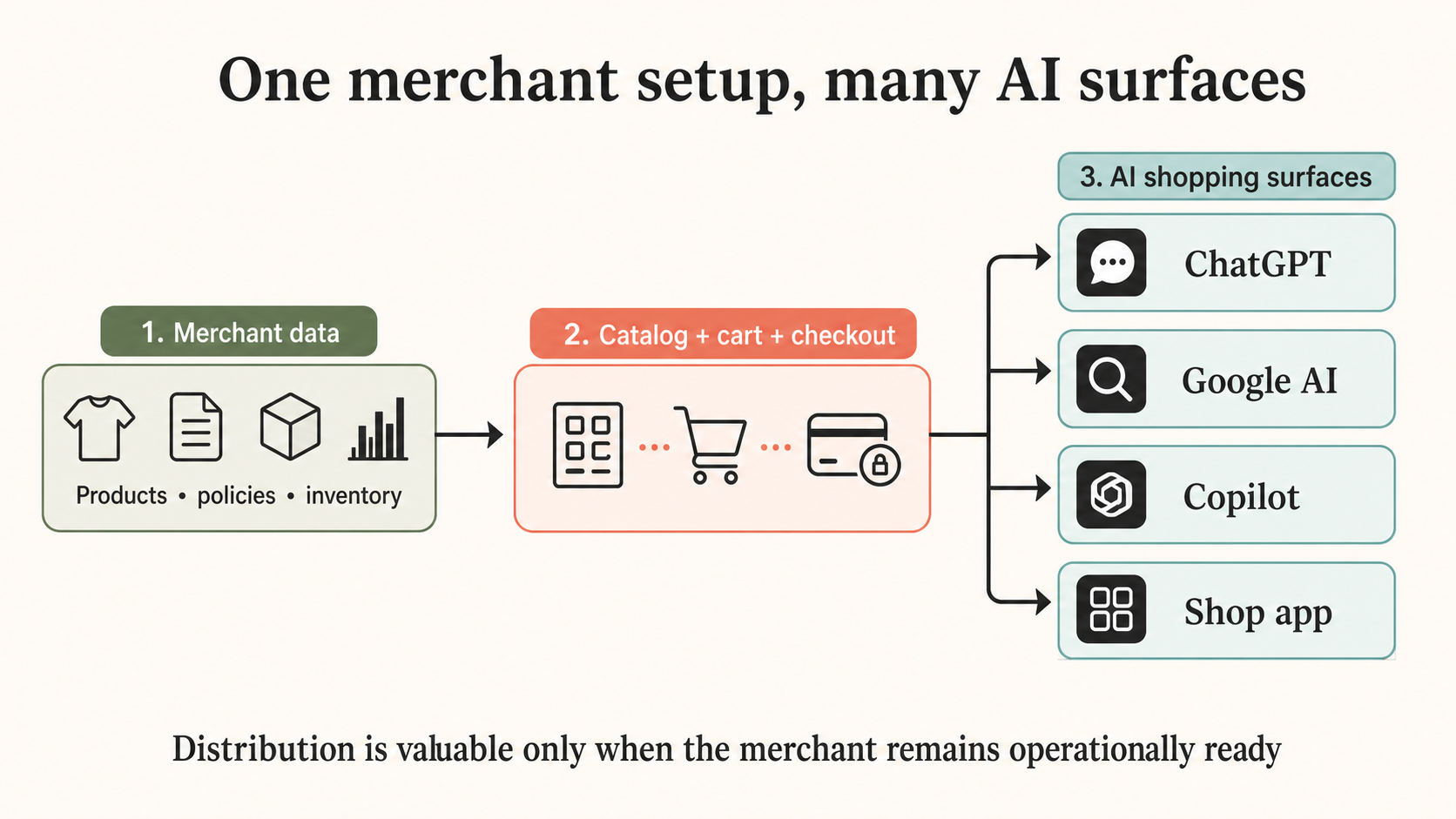
In ordinary ecommerce, a merchant often treats each channel as a distinct implementation: a storefront, a marketplace feed, a social shop, an affiliate destination, a mobile app. Each new surface can introduce another product feed, cart behavior, attribution model, and operational exception.
Agentic commerce increases that risk because AI surfaces do not only need a product link. They may need structured discovery data, real-time availability, a way to create a cart, a way to complete checkout, a clear record of the merchant and offer, and support for post-purchase questions. A merchant that rebuilds those capabilities separately for every assistant will move slowly and introduce inconsistencies.
Shopify’s current approach is to centralize more of those building blocks. Its Agentic Storefronts, Catalog API, UCP work, and agent-compatible cart and checkout documentation are designed to let the same merchant operation appear in surfaces such as ChatGPT, Google AI Mode and Gemini, Microsoft Copilot, and the Shop app. The exact availability and feature set differ by channel and merchant eligibility, so this should be treated as an operating model, not a blanket promise that every store is live everywhere.
The four layers behind Shopify’s advantage
| Layer | What Shopify provides | What the merchant must still own |
|---|---|---|
| Product discovery | Catalog infrastructure that can expose structured products to participating AI surfaces. | Accurate titles, attributes, images, variants, availability, and product facts. |
| Transaction | Cart and checkout capabilities designed to move an agent-supported shopper from selection to purchase. | Prices, shipping, taxes, eligibility, payment configuration, and clear policy terms. |
| Channel distribution | Central administration of participating agentic storefronts and integrations. | Channel choices, brand controls, monitoring, and commercial terms. |
| Operations | Orders flowing into the merchant’s commerce operation and post-purchase tooling. | Fulfillment accuracy, returns, support, inventory discipline, and customer experience. |
Each layer matters because agents collapse the old funnel. A human might forgive a bad product page and continue browsing. An agent faced with incomplete facts, uncertain availability, or unsupported checkout may simply select another merchant—or stop. The platform can make distribution broad, but every weak operational field becomes a weak point in the agent experience.
1. Catalog is the distribution asset—not a product feed afterthought
Shopify describes Catalog API as the discovery layer for agentic commerce: a way to make products from merchants structured and queryable across AI surfaces. That is an important shift in mindset. A catalog is no longer just an internal merchandising database or a feed that a marketing team sends to a channel. It is the representation of the merchant that an agent uses to retrieve, compare, and explain products.
For a DTC operator, this changes the priority of ordinary catalog hygiene. The fields that support an agent are not exotic: product title, variant, price, availability, product type, material, dimensions, compatibility, ingredients, care, delivery promise, return policy, and proof of quality. The difference is that these facts must agree with one another and remain current.
Start with the categories that require the most explanation. In apparel, that may be fit, fabric, warmth, care, and returns. In beauty, it may be ingredients, claims, allergens, skin concerns, and refill compatibility. In electronics, it may be standards, ports, ecosystem compatibility, warranty, and setup. An agent cannot reliably invent the distinction that the catalog fails to state.
2. UCP makes new surfaces less bespoke
Shopify and Google describe the Universal Commerce Protocol as an open standard for how AI agents transact with merchants. For a merchant, the value of a common protocol is not the acronym. It is the chance to avoid recreating discovery, cart, checkout, and post-purchase behaviors for every new AI interface.
That does not eliminate platform risk. Protocols still depend on implementation choices, partner support, payment authorization, policy handling, and the details of the surface that owns the shopper conversation. But a common approach can make a merchant’s underlying commerce capabilities more reusable. That is the distribution advantage: one operational core can meet a growing number of demand surfaces with less custom work.
Use this moment to ask a better question than “Which AI assistant should we optimize for?” Ask: “Which product, cart, checkout, and order capabilities are portable enough that we can participate wherever qualified demand emerges?” Shopify’s infrastructure may supply some of those rails, but readiness is still a property of the merchant operation.
3. Checkout is where distribution becomes commercial
Discovery without transaction is awareness. The strategic value rises when a shopper can move from recommendation to a valid order without losing inventory, price, policy, or identity context. Shopify’s agentic-commerce documentation covers carts and checkout through UCP, while its customer-facing guidance describes orders from agentic shopping experiences appearing in Shopify Admin.
For brands, that connection matters for three reasons. First, it can preserve operational continuity: orders, inventory, and fulfillment do not need to become a separate manual workflow just because discovery occurred in an AI interface. Second, it can make channel performance more observable. Third, it reduces the temptation to treat AI shopping as a pure referral channel when it may become a transaction channel.
Still, do not confuse a supported checkout path with universal autonomous buying. Channel availability, customer consent, payment methods, geography, merchant settings, and the agent’s own controls all matter. Build for a reliable handoff, then validate what is actually live for your store rather than relying on headline announcements.
4. Distribution is valuable because it preserves optionality
A merchant does not want to rebuild its commerce stack every time a new assistant becomes relevant. Nor does it want one AI interface to become the only way buyers can find or purchase its products. Shopify’s appeal is that it can reduce the cost of both problems: it helps centralize a merchant’s operational data while connecting that data to multiple surfaces.
This is why distribution may matter more than a proprietary AI feature. Features change quickly; distribution compounds when every merchant improvement—better attributes, more reliable inventory, stronger policies, cleaner checkout—can travel to more than one channel. The merchant gains the option to participate in a new surface without beginning from zero.
But optionality has a governance cost. Review where your products are permitted to appear, whether an agent surface can initiate direct checkout, which data is shared, how performance is reported, and whether the channel preserves the merchant of record. Shopify’s help documentation makes clear that availability and access settings can differ by agentic storefront. Treat those settings as commercial decisions, not background technical defaults.
A 30-day distribution-readiness plan
Week 1: Map the operational source of truth. Identify where titles, variants, prices, stock, shipping, returns, and support policies are maintained. Resolve conflicts before exposing the catalog more broadly.
Week 2: Fix the decision fields. Choose your 25 highest-value products and fill the facts an agent needs to compare them: use case, material or ingredients, size or compatibility, price, availability, delivery, returns, and meaningful differentiators.
Week 3: Review channel controls. In Shopify, inspect the agentic storefront and catalog settings available to your store. Document which surfaces are active, what they can access, whether direct checkout is supported, and who owns measurement.
Week 4: Test real customer tasks. Try representative prompts and journeys: “best gift under $100,” “compatible replacement,” “arrives by Friday,” or “safe for sensitive skin.” Record whether the product is retrievable, correctly described, available, and able to reach a valid checkout path.
What to measure
| Metric | Why it matters | First action |
|---|---|---|
| Catalog completeness | Agents can only compare facts that are present and structured. | Audit required and category-specific attributes on priority SKUs. |
| Availability accuracy | Wrong stock or delivery promises destroy recommendation confidence. | Compare surfaced availability with the actual checkout outcome. |
| Agent-surface visibility | Distribution does not guarantee that a product is retrieved or recommended. | Run recurring prompt tests by use case and product category. |
| Order quality | Revenue alone can hide cancellations, returns, or support burden. | Segment orders and service outcomes from agentic channels where data is available. |
| Channel dependence | A single winning surface can become a concentration risk. | Track discovery, conversion, and margin by surface rather than reporting “AI” as one channel. |
Where Shopify’s advantage ends
Shopify does not control the consumer’s preferred assistant, the ranking logic of every AI surface, or whether a product deserves a recommendation. It also cannot resolve a merchant’s unclear positioning, bad product facts, weak review profile, or fulfillment failures. Those are the brand’s responsibilities.
There is also a strategic tradeoff in frictionless distribution. The easier it becomes to make a product available everywhere, the easier it becomes for competitors to do the same. Distribution gets you into the consideration set. Differentiated product data, trust, price, availability, service, and brand preference determine whether you stay there.
The bottom line
Shopify’s agentic-commerce advantage is not that every merchant suddenly has an AI strategy. It is that Shopify can turn one merchant operation into a reusable distribution system across multiple AI shopping surfaces. Catalog, cart, checkout, and order operations are becoming the common infrastructure behind that reach.
Use the advantage properly: centralize the truth, make product data decision-ready, review channel controls deliberately, test real tasks, and measure channel quality—not just AI traffic. The platform can distribute your commerce capability. Only the merchant can make that capability worth recommending.
Frequently Asked Questions
Does Shopify automatically put every merchant into every AI shopping surface?
No. Shopify’s agentic storefront availability, eligibility, access settings, and checkout capabilities vary by channel and merchant. Review the controls available in your Shopify Admin and validate each surface instead of assuming universal distribution.
What is Shopify’s Catalog API advantage for merchants?
It can make a merchant’s product information structured and queryable across participating AI shopping surfaces. The benefit is reusable distribution, but the merchant still needs complete, accurate product and policy data.
Does UCP remove the need for a merchant’s own checkout?
No. UCP is intended to help agents and merchants coordinate commerce flows. Merchants still need valid pricing, inventory, policy, payment, and operational controls for a transaction to complete reliably.
What is the fastest first step for a Shopify brand?
Audit your highest-value products for decision-critical facts: price, stock, shipping, returns, variants, product attributes, compatibility, and clear use-case language. Distribution will expose those facts; it cannot supply them.
References & Further Reading
[1] Shopify: The agentic commerce platform connects merchants to AI conversations
[2] Shopify: Agentic commerce for every developer, Spring ’26 Edition
[3] Shopify Help Center: Agentic storefronts
[4] Shopify Help Center: Catalog and product discovery for agentic storefronts
[5] Shopify developer documentation: Carts and checkout for agents
Continue Exploring
Optimizing Shopify for Agentic Commerce: A Practical Guide
A technical guide to schema, metafields, feeds, and storefront readiness for Shopify merchants.
Amazon Is Building a Moat Around Agentic Shopping
How a major commerce platform is concentrating the control points around agentic shopping.
Retailer-Owned Agents May Become the Next Retail Media Gatekeeper
Why the retailer agent can become a new commercial decision surface.