
Amazon Is Building a Moat Around Agentic Shopping
Amazon’s agentic-commerce strategy is becoming easier to see. The company is connecting consumer context, AI discovery, external merchant feeds, checkout, advertising, and rules for automated access into one controlled shopping environment. For brands, that is a more consequential development than any single AI feature release.
Amazon is often discussed as though it has one response to agentic commerce: build a shopping assistant and defend the marketplace from everyone else. The reality is more interesting—and more strategically important for brands.
Amazon is assembling a set of connected control points. Its shopping assistant can use consumer context. Its Buy for Me capability can initiate purchases from participating external brand sites. Its Shop Direct program can ingest merchant product feeds into Amazon discovery while leaving the transaction with the merchant. Its advertising products are moving into the AI-shopping surface. And Amazon’s agent policy and litigation establish that access by third-party automation is not simply a given.
None of those elements alone proves a moat. Together, they create one: a system in which Amazon can decide how inventory enters, how it is ranked, what context informs recommendations, where checkout happens, and which automated actors may participate.
The research finding
Amazon is not only building an AI assistant. It is building a controlled agentic-shopping stack. The moat is the combination of control over consumer context, discovery, merchant participation, transaction rails, monetization, and authenticated access.
Why the word “moat” needs care
“Moat” is an interpretation, not a fact Amazon has stated. The company’s public releases describe product features and merchant programs; its seller-policy update describes requirements for automated software and AI agents. The analytical claim comes from reading those pieces together.
It would be inaccurate to say Amazon has closed itself to every outside agent, or that every external brand must sell through Amazon. Shop Direct, for example, is explicitly designed to let merchants submit product feeds that can surface in Amazon search and Alexa for Shopping while the merchant completes the sale on its own site. That is an opening.
But it is an opening on Amazon’s terms. The distinction matters. In an open agentic-commerce model, an independent agent might discover a product, compare offers, carry a shopper’s authorization, and complete a purchase through a merchant’s own stack. In Amazon’s emerging model, Amazon increasingly has a role in the discovery interface, product-data intake, consumer context, or transaction handoff—even when the merchant retains checkout.
The six control points taking shape
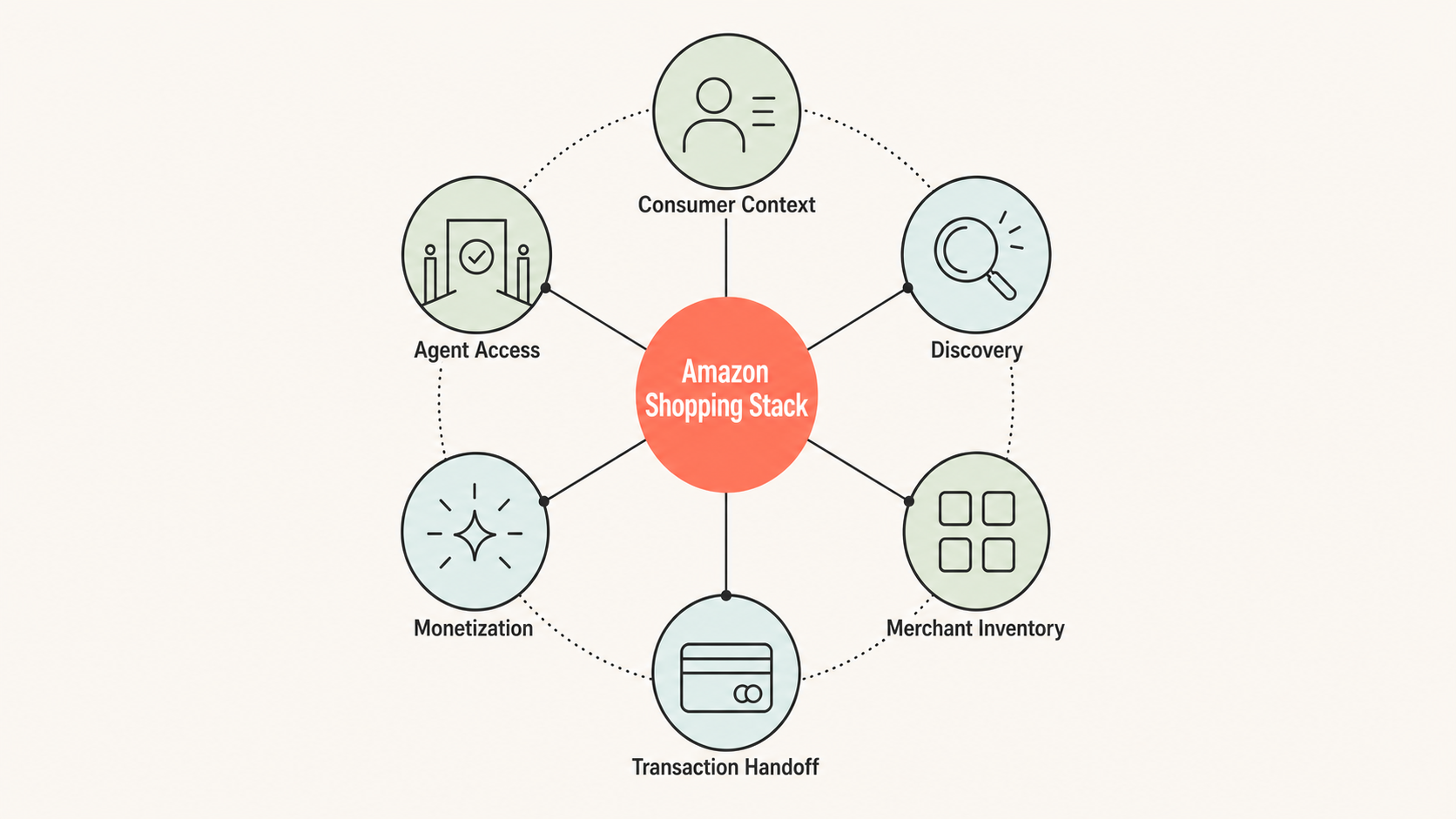
| Control point | What Amazon has announced or done | Why it matters to brands |
|---|---|---|
| Consumer context | Amazon says Alexa for Shopping combines shopping history with Alexa+ context and follows the customer across Amazon surfaces. | Recommendation quality can improve with first-party context that an external agent may not have. |
| Discovery | Rufus was renamed Alexa for Shopping in May 2026 and is available across the shopping app, Amazon.com, and Echo Show. | The assistant can become the first place a shopper narrows a set of products. |
| Merchant inventory | Shop Direct lets external merchants submit real-time product information for Amazon search and Alexa for Shopping. | More inventory can enter the agent’s consideration set without the merchant owning the discovery surface. |
| Transaction handoff | Buy for Me lets Amazon’s agent purchase select external-brand items using Amazon-held payment and shipping details. | Amazon can preserve convenience and customer context beyond its own catalog. |
| Monetization | Amazon said it introduced Sponsored Products and Brand Prompts in Rufus; Amazon Ads reported $17.2 billion of Q1 2026 revenue. | AI recommendations can become a new paid-and-earned visibility contest. |
| Agent access | Amazon’s March 2026 seller update introduced an Agent Policy and says Amazon may restrict automated-software or AI-agent access in some instances. | Independent agents need permission and technical compatibility, not just a browser. |
1. The assistant is becoming an ambient shopping layer
Amazon says its shopping assistant—originally Rufus, now Alexa for Shopping—can help customers research, compare, and buy products, and that more than 300 million customers used Rufus for those tasks in 2025. The company has also emphasized that the experience can use prior shopping behavior and carry context across surfaces.
This is not just a better search box. A conventional product search begins with a query and ends with a results page. An assistant can retain preferences, interpret vague intent, follow up on tradeoffs, explain a product, and return to a task later. Those are the mechanics that turn discovery into a relationship layer.
For a brand, the strategic question changes from “How do we rank for a keyword?” to “What does the assistant know, retrieve, and trust when it must choose among similar products?” Amazon has a structural advantage in answering that question for shoppers already inside its ecosystem: it has retail browsing behavior, order history, delivery expectations, review data, and a native place to transact.
2. Buy for Me extends Amazon’s convenience beyond Amazon’s catalog
When Amazon introduced Buy for Me in April 2025, it described a capability that could purchase select items from external brand sites when Amazon did not sell them directly. Amazon’s agent would use a customer’s Amazon payment and shipping details to complete the transaction. In later earnings commentary, Amazon said the capability could shop tens of millions of items from other stores.
The important point is not that Buy for Me makes every off-Amazon merchant an Amazon seller. The merchant may still be the seller of record, own fulfillment, and manage its own site. The point is that Amazon can remain the customer’s starting point—and potentially the assistant that carries the transaction forward—even when product availability lies elsewhere.
That creates a subtle competitive shift. The old marketplace boundary was inventory: if Amazon did not carry an item, the shopper had to leave. The agentic boundary is intent: if Amazon can understand the need and broker the handoff, it can stay in the journey for more categories and more merchants.
3. Shop Direct makes the gate wider, but not less valuable
In March 2026, Amazon announced Shop Direct, a program for merchants to submit product feeds with real-time information that can appear in Amazon search and Alexa for Shopping. Amazon distinguishes it from Buy for Me: with Shop Direct, the merchant completes the sale.
This is a meaningful opportunity for DTC brands. It can put a non-marketplace catalog in front of shoppers who begin with an Amazon shopping question, while preserving the merchant checkout and its direct customer relationship. But it also means that product information must be useful inside an Amazon-controlled recommendation environment. Clean titles, complete attributes, availability, delivery expectations, product imagery, return terms, and differentiated use-case language become inputs into a surface the merchant does not operate.
Shop Direct therefore has two effects at once. It broadens the merchandise available to Amazon’s assistant, making the assistant more useful. And it increases the strategic value of Amazon’s discovery layer because merchants have a new reason to participate in it.
4. Advertising will shape the economics of the answer
Amazon said in its first-quarter 2026 earnings materials that it had introduced Sponsored Products and Brand Prompts in Rufus. Separately, Amazon Ads reported $17.2 billion in first-quarter revenue. The numbers do not tell us how AI-shopping ad formats will perform or how they will be ranked. They do show that Amazon is bringing a mature advertising business into the assistant experience rather than treating AI discovery as a purely neutral utility.
This does not mean every recommendation is an ad, and brands should resist assuming that paid placement alone will determine relevance. The more useful conclusion is that agentic discovery is likely to inherit marketplace economics: organic eligibility, relevance, fulfillment confidence, price and availability, customer trust, and paid visibility may all collide in the same conversational interface.
For DTC teams, this is a warning against an overly simple “AI SEO” playbook. Structured data and useful product information are necessary. They may not be sufficient if the most important agent surfaces also become commercial media environments.
5. Permissioned access may be the real boundary
Amazon’s seller notice for Business Solutions Agreement changes effective March 4, 2026 says the company added an Agent Policy, with requirements for automated software or AI agents accessing Amazon Services, and that it may restrict access in certain cases. A federal court’s March 2026 preliminary-injunction order in Amazon’s dispute with Perplexity is another reminder that autonomous access can become a legal and technical question, not just a product capability.
The practical distinction is between an agent Amazon can identify, authenticate, govern, and potentially monetize—and an agent that arrives as an outside intermediary with its own interface and incentives. In the first model, Amazon keeps visibility into the shopping experience. In the second, Amazon risks becoming a supplier of inventory and logistics while another company owns the customer relationship and recommendation surface.
That is why the emerging debate is bigger than bot blocking. It is a contest over who gets to represent the shopper, who can access the merchant, and who owns the interface where commercial choice is made.
What this means for DTC brands
Brands should not treat Amazon’s strategy as a reason to abandon owned commerce. Nor should they assume that participation in Amazon-controlled agent surfaces is automatically a loss. The right response is to prepare for multiple paths to agentic discovery while keeping the customer, data, and measurement implications visible.
Audit product data as decision data. Feed quality is no longer a merchandising detail. Make product attributes, compatibility, availability, pricing, shipping, returns, warranty, and comparison points explicit and current wherever an agent might retrieve them.
Separate discovery participation from checkout dependence. Evaluate programs such as Shop Direct on the value of incremental discovery, the data returned, the customer relationship retained, and the operational cost—not on traffic alone.
Build an agent-surface measurement plan. Track referral quality, assisted conversions, brand mentions, product-feed errors, and shifts in marketplace versus direct demand. A shopper may encounter a brand in an agent before arriving through any traceable link.
Protect differentiated evidence. An assistant can only recommend what it can understand. Publish specific proof of product fit, quality, use cases, service standards, and customer outcomes instead of relying on generic brand language.
Keep optionality. Be ready for Amazon-controlled discovery, but do not make it the only path. Build structured catalog, policy, and trust data that can travel to other retailers, assistants, and merchant-owned experiences.
What would disprove this thesis?
The moat thesis should be tested, not accepted as an article of faith. It would weaken if Amazon enables independent, authenticated agents to access product information and transact on broadly equivalent terms; if merchants retain meaningful control of customer data and ranking transparency across Amazon’s assistant surfaces; or if shoppers consistently choose general-purpose assistants that route around Amazon’s discovery layer.
For now, the evidence points in the other direction. Amazon is widening access to product supply while tightening its role in the paths that matter most: understanding the shopper, presenting the options, carrying the transaction, and deciding how other agents enter.
The bottom line
Amazon’s agentic-commerce strategy is not a chatbot strategy. It is a control-point strategy.
The company is making its own assistant more capable, pulling more external inventory into its discovery environment, extending its convenience into off-Amazon purchases, introducing AI-native advertising formats, and formalizing the conditions under which outside automation can participate. That combination can make Amazon more useful to shoppers and more valuable to merchants. It can also make Amazon harder to bypass.
For DTC leaders, the immediate job is neither panic nor passive observation. It is to understand where a brand’s product data, customer relationship, checkout, and visibility are being intermediated—and to decide deliberately which of those control points are worth sharing.
Frequently Asked Questions
Is Amazon blocking all third-party AI shopping agents?
No. Amazon’s public seller-policy notice says it may restrict automated-software or AI-agent access in certain instances, not that all third-party agents are categorically prohibited. The more important issue is that access is increasingly permissioned and governed on Amazon’s terms.
Does Shop Direct mean a DTC brand must sell on Amazon?
No. Amazon describes Shop Direct as a way for merchants to submit product information for Amazon discovery while the merchant completes the sale. Brands should still assess the data, operational, and customer-relationship tradeoffs before participating.
What is the difference between Shop Direct and Buy for Me?
With Shop Direct, Amazon can surface a merchant’s products while the merchant handles the sale. With Buy for Me, Amazon’s agent can purchase select external-brand items using Amazon-held customer payment and shipping details.
What should brands prioritize first?
Start with accurate, machine-readable product and policy data. Then measure where AI shopping surfaces influence discovery and conversion, and preserve optionality across Amazon, other assistants, retailers, and owned channels.
References & Further Reading
[1] Amazon: Alexa for Shopping is an AI assistant that helps customers research, compare, and buy
[2] Amazon: Buy for Me helps customers purchase items from other brand websites
[3] Amazon: Shop Direct lets merchants surface products in Amazon search and Alexa for Shopping
[4] Amazon Q1 2026 earnings report
[5] Amazon Seller Central: Business Solutions Agreement updates effective March 4, 2026
[6] Amazon.com Services LLC v. Perplexity AI, Inc. preliminary-injunction order
Continue Exploring
How ChatGPT Shopping Research Is Changing Ecommerce Discovery
An evidence-led look at merchant visibility, product comparison, and the discovery-to-checkout path in ChatGPT shopping.
How to Get Agentic AI to Recommend Your Ecommerce Site
A practical guide to the product data, trust signals, and content foundations that make merchants easier for AI systems to evaluate.
Agentic Commerce Needs a Neutral Infrastructure Layer
Why commerce leaders should distinguish interoperability from the control of a single shopping interface.