
The API-First Shift: How Commerce Architecture is Evolving for AI Agents
API-first commerce isn't just a technical trend—it's an architectural necessity for a world where AI agents, not just humans, navigate the path from discovery to checkout.
What's Changing (And Why It Matters)
For the past three decades, retail's operating model has been remarkably consistent: build a digital storefront, drive customers to it, optimize their journey through your checkout. The customer visits your destination, makes a decision, completes a purchase. You control the experience because you control the place.
That model is beginning to shift. Not because it's breaking, but because a new layer is emerging alongside it. Understanding this shift - what it is, why it's happening, and what it means for your business - is increasingly important for anyone making decisions about retail infrastructure.
The change involves AI agents. Not as chatbots that answer questions on your website, but as autonomous systems that understand customer intent and can browse, compare, negotiate, and transact across multiple retailers on behalf of a person. An agent doesn't visit your storefront. Instead, it calls your APIs, reads your product data, checks your inventory in real time, and can complete a purchase without any human clicking through your checkout flow.
This is no longer theoretical. OpenAI and Stripe released the Agentic Commerce Protocol in September 2025. Shopify, Walmart, and Sam's Club are already live with it. Early data suggests that over 59% of CPG executives expect AI agents to influence customer relationships significantly within the next five years.
What's interesting about this isn't that it's happening - it's that many merchants weren't prepared for it when it arrived. Some brands discovered their products showing up in AI agent recommendations without having any idea how that happened or how to optimize for it.
This raises an important question: what does your business need to do differently when customers are being served by intelligent intermediaries instead of visiting you directly? The answer has a lot to do with something called API-first architecture.
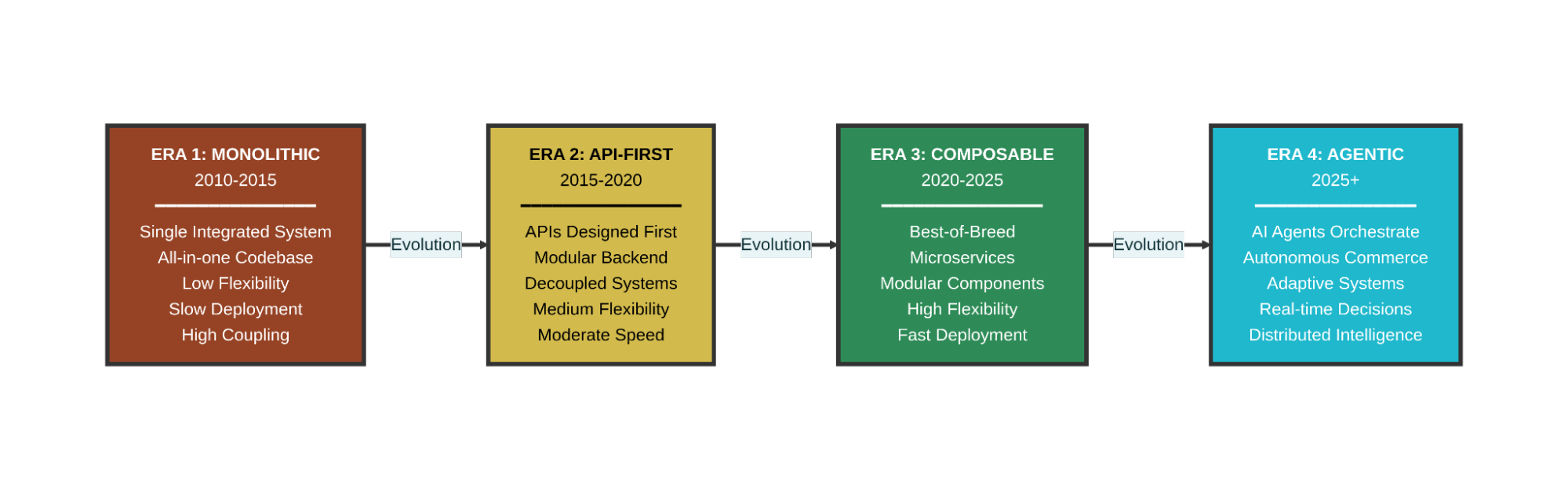
Four eras of ecommerce architectures - from monolithic to agentic
What API-First Actually Means
Most conversations about "API-first" get tangled in technical jargon. Let's untangle it by thinking about what it actually does.
Traditionally, when you build an e-commerce system, you start with the customer experience. You design your website, decide what your checkout looks like, build your mobile app. All of these interfaces are designed first. The backend systems (inventory, payments, recommendations) are built to support these specific interfaces.
API-first inverts that order. You start by designing the data contracts and communication protocols between systems. You define how your inventory system talks to your payment system, how your product catalog communicates with your fulfillment system, how external partners can access your data reliably. Only after these contracts are clear do you build the customer-facing applications on top.
Why does this matter? Because it makes your business flexible. In an API-first system, your payment system is independent. Your inventory service is separate. Your product catalog is a resource that can be consumed by any interface. You can add a new channel - like agent-based purchasing - without rebuilding everything.
The interesting thing is that companies that adopted API-first thinking in 2018-2020 were doing it for good reasons - flexibility, scalability, developer experience - but they often didn't anticipate that it would become critical for agent compatibility. They were just being thoughtful about architecture. Now, that thoughtfulness is directly valuable.
To see this in practice: Walgreens opened its photo-printing service through APIs to third-party apps. Customers could upload photos from their phones and social accounts without visiting Walgreens' website. The result was significant - six times more revenue per digital user compared to in-person users. That revenue didn't come from better marketing or UI design. It came from letting the infrastructure be accessible from places customers already were.
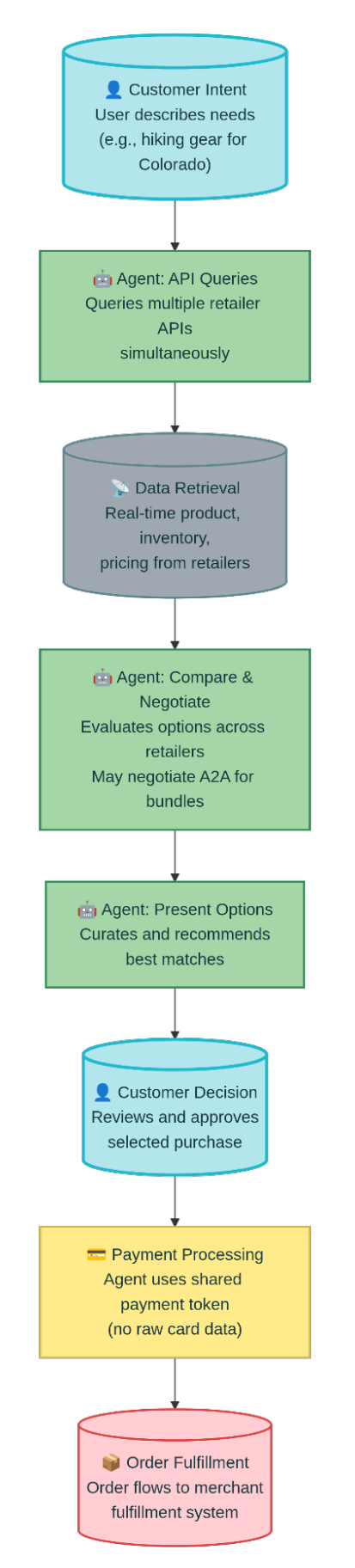
See an example on the right outlining a flow of operations in a commerce architecture with autonomous agents involved.
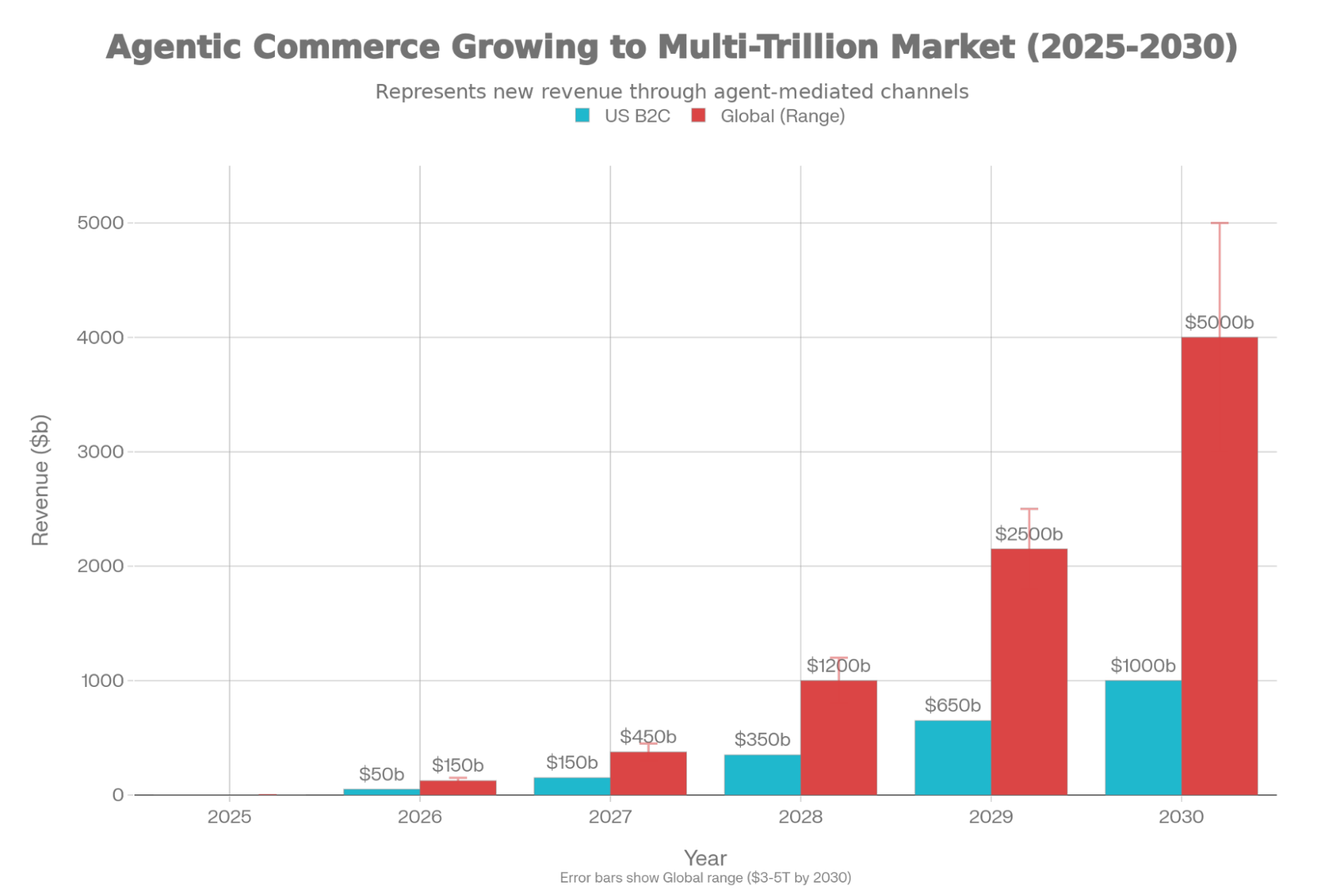
Agentic commerce growth forecast for US B2C and Global for 2025-2030 (by ZeroClick Project)
A Practical Scenario: How Agent-Based Shopping Actually Works
Imagine someone planning a hiking trip. They open ChatGPT and describe what they need: "I'm going hiking in Colorado in November. I get cold easily and have never done high-altitude hiking before. Show me complete outfits that will work for my body type and my budget."
The agent then queries the product APIs of several outdoor retailers simultaneously. Not by scraping their websites - by calling structured endpoints that return real-time data. For each product, it gets information like: specifications, current pricing, real-time inventory status, shipping timelines to the user's location, and relevant reviews.
The agent compares options across retailers. It might find that one brand has a parka with slightly better insulation than another, but costs $120 more. For a first-time cold-weather hiker, that extra performance might not be worth the cost. The agent could use a merchant-to-merchant negotiation protocol to ask: "Could you bundle this parka with a quality base layer to match the competitive value?" Retailer A and Retailer B's systems negotiate this directly, agent-to-agent.
The user reviews the options and says: "I'll buy this one." The agent completes the transaction in ChatGPT without the user ever leaving the interface. It uses a shared payment token - a temporary credential scoped only to this transaction that the payment processor issued. The purchase flows into the merchant's order system exactly as if the customer had bought from their website.
For this scenario to work, three things had to be true on the merchant side:
- Machine-readable product data: Information about the product couldn't be buried in marketing copy. It had to be structured data - materials, dimensions, care instructions, certifications.
- Real-time APIs for inventory and pricing: The agent needed to query current inventory and pricing at agent speed (milliseconds, not seconds).
- Agent-compatible checkout: The payment system needed to support agent-initiated transactions using shared tokens.
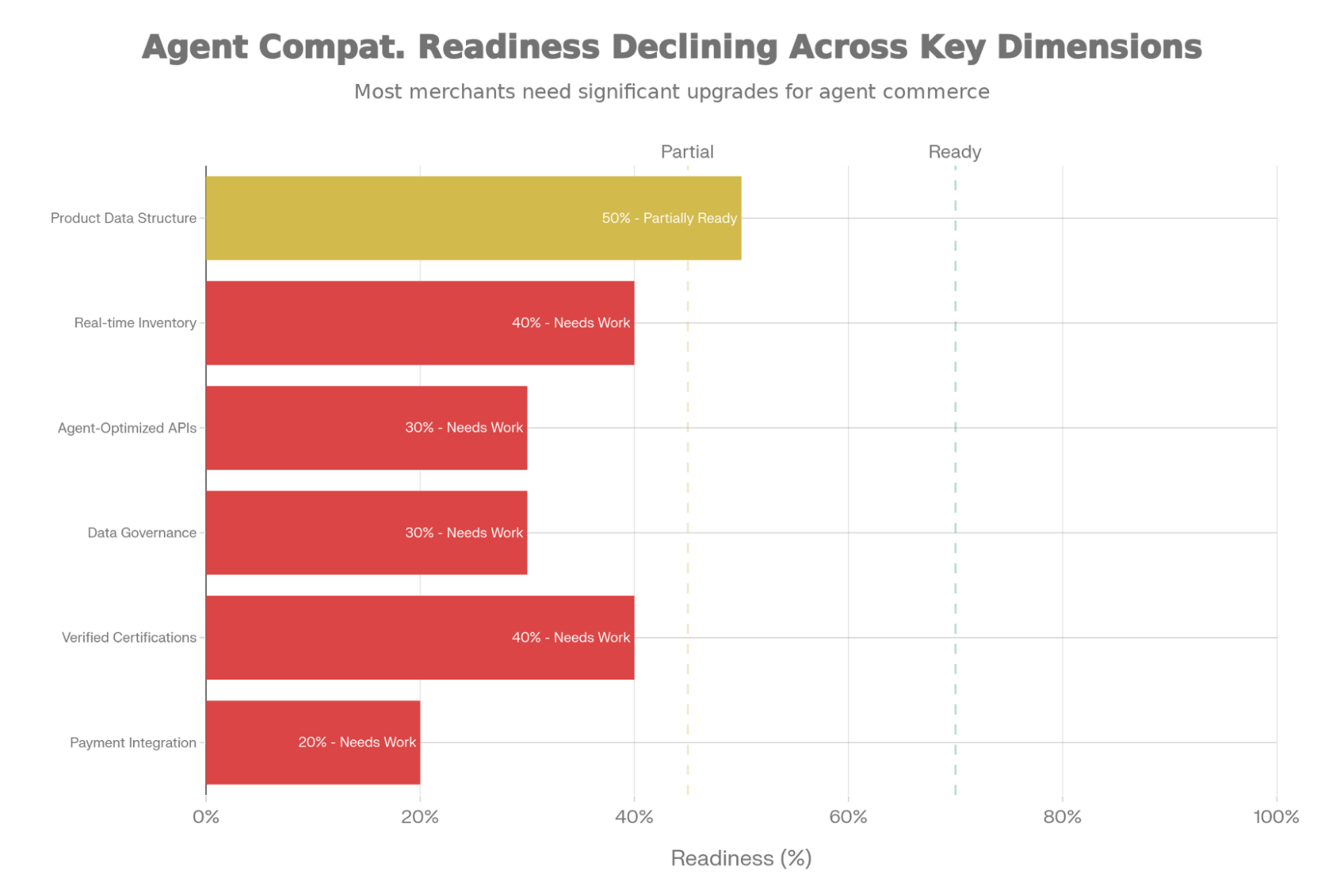
Agent compatibility readiness across key dimensions as of Q1 2026 (by ZeroClick Project)
How This Could Develop: Different Possible Futures
Path 1: Agent-Driven Specification Optimization (70% probability)
Agents become very efficient at comparing products based on measurable attributes. Specifications, price, delivery time, verified reviews - these are all things agents can evaluate objectively. Brands increasingly optimize their offerings and data presentation around what agents can reliably measure.
Path 2: Specialized Agent Ecosystems (55% probability)
Agents might become more specialized. Some agents optimize for lowest price. Others prioritize sustainability. Others support small businesses or locally-made goods. The agent ecosystem could become as diverse as today's media landscape.
Path 3: Human-Agent Hybrid Interaction (60% probability)
Agent-driven commerce develops alongside - not instead of - traditional shopping. High-consideration purchases, relationship-driven sales, and premium categories might resist pure agent mediation or combine it with human interaction.
What Merchants Can Do in the Next 6-12 Months
If you're making decisions about your retail infrastructure, here's what actually matters in the near term.
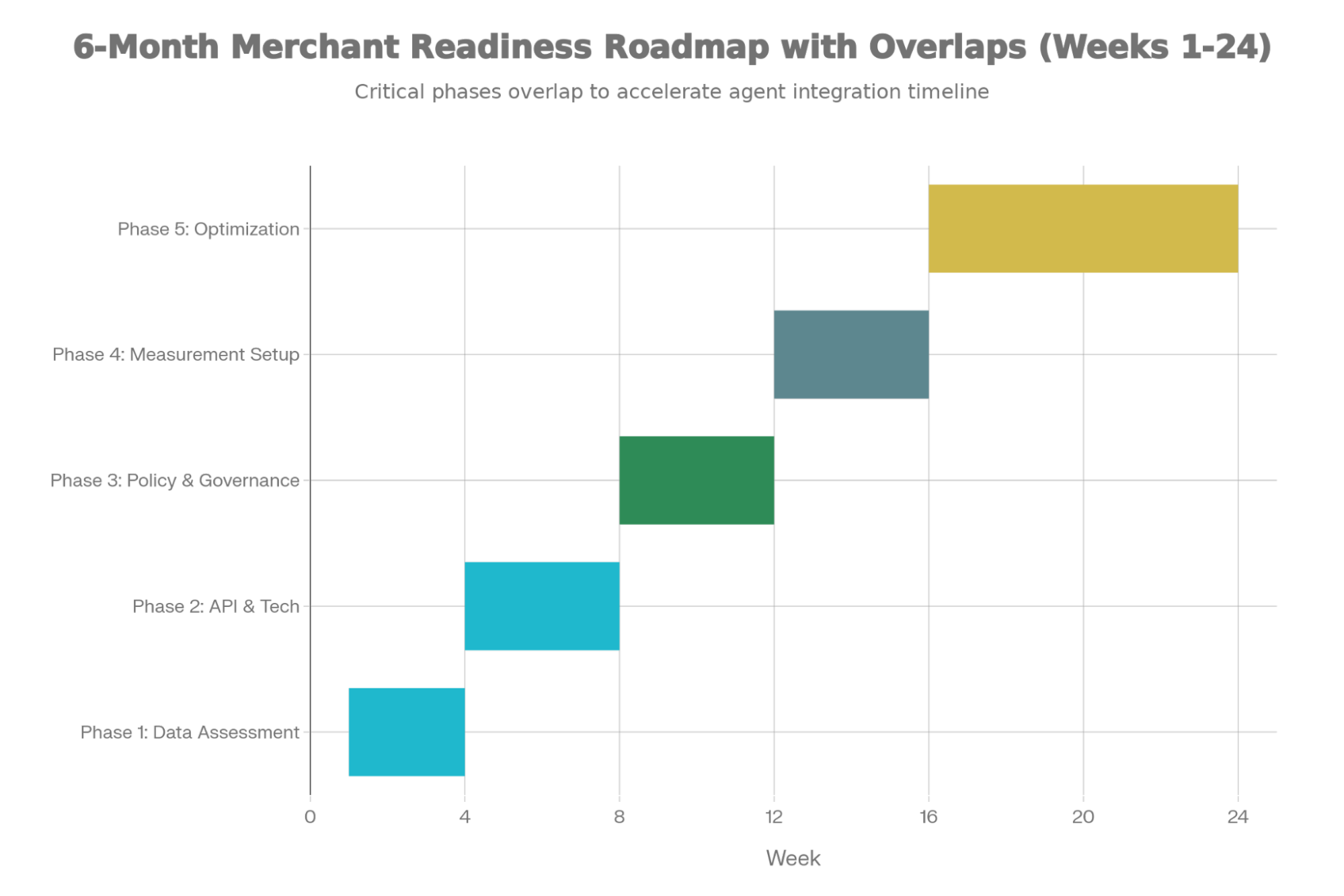
6-month merchant readiness roadmap outline for 2026
1. Understand Your Data Landscape
Start with an honest assessment. Is your product information structured? Standards-compliant? Real-time? The goal is ensuring underlying data is clean and structured. Think of it like preparing financial records for an audit.
2. Evaluate Your Current APIs
Are your APIs designed for agent use? Real-time inventory queries require different design than traditional e-commerce APIs. You need high-throughput, structured data formats, and secure authentication for external agents.
3. Clarify Your Policies Around Agent-Driven Purchases
Work through business logic: How do you handle returns for agent purchases? What defines 'clear authorization'? How do you manage dispute risk with payment processors?
4. Think About Your Data Governance
Establish a single source of truth for product data. That data should feed all your channels: e-commerce site, mobile app, agent APIs, and third-party platforms. Accuracy is organizational, not just technical.
5. Set Up Measurement
Track how often your products appear in agent recommendations, what position they hold, and what percentage of revenue originates from agents vs. direct visits.
The Bottom Line
API-first commerce isn't a trend. It's an architectural approach that's becoming essential for competing in a world where customers are being served by intelligent intermediaries, not just visiting your storefront directly.
Frequently Asked Questions
What is the fundamental difference between traditional and API-first architecture?
Traditional architecture is built around specific user interfaces (like a website), where backend systems support the UI. API-first architecture inverts this, designing data contracts and communication protocols first, allowing any interface—including AI agents—to consume the same core services independently.
Why are AI agents shifting the value of API-first systems?
AI agents don't 'browse' websites; they consume data through APIs. Systems that were already API-first are natively compatible with agents, while monolithic systems require expensive retrofitting to expose the structured data and transactional capabilities agents need.
How do AI agents 'read' and 'compare' products across different retailers?
Agents call structured endpoints that return machine-readable data (JSON). They compare quantifiable attributes like materials, dimensions, certifications, and real-time price/inventory, weighting verified data much higher than marketing narrative.
What is the Agentic Commerce Protocol (ACP), and why does it matter?
ACP is an open standard (developed by OpenAI and Stripe) that defines how agents should handle checkout and payments. It provides a common language for programmatic transactions, ensuring security and interoperability across different merchants.
How can a brand prepare its product data for AI agent discovery?
Start by standardizing specifications (dimensions, materials, etc.) into machine-readable formats. Ensure all claims (like sustainability) are linked to third-party certifications that agents can verify, and maintain a single source of truth for inventory and pricing.
What are the key technical requirements for an 'agent-ready' checkout?
Technical requirements include support for scoped, temporary payment tokens (rather than raw card data), real-time inventory validation at the millisecond level, and asynchronous order processing that doesn't rely on human 'clicks'.
How should merchants handle disputes or returns for agent-initiated purchases?
Merchants should update their terms of service to define 'agent authorization' clearly. Return policies may need to be more flexible for agent-driven errors, and integration with payment processors should include agent-specific metadata to simplify dispute resolution.
What metrics should businesses use to track their performance in the agentic economy?
Key metrics include 'Agent Share of Voice' (how often you appear in recommendations), 'Recommendation Rank', and 'Agent Conversion Rate'. Comparing the AOV and return rates of agent-originated orders vs. direct traffic is also critical.