
eTail West 2026 Felt Different: Retail AI Finally Has a Job Description
eTail West 2026 showed that retail AI has moved past demo culture. The real conversation is now about which workflows brands trust agents to run, how they measure them, and where human control still matters.
By the time the last conversations drifted out from the pool deck in Palm Springs, eTail West 2026 had made one thing obvious: retail AI is no longer being discussed as a novelty layer on top of ecommerce. It is starting to look more like an operating model.
That was the real shift in the room. A year ago, most event-stage AI talk still carried the energy of experimentation. This year, the tone was more disciplined and a little more anxious. Operators were no longer asking whether AI belonged in the stack. They were asking which decisions they were prepared to hand over, what the guardrails should be, and how finance would judge the result.

The broader coverage around eTail West 2026 framed the event as a turning point from AI experimentation to operational deployment.
The short version
eTail West 2026 was not a conference about abstract AI promise. It was a conference about delegated work: autonomous lifecycle messaging, AI-supported merchandising and media allocation, clearer decision support for shoppers, and the first serious signs that first-party data quality is becoming the control surface for agentic commerce.
The center of gravity moved from personalization to delegation
The clearest signal came from the shape of the programming itself. Sessions built around agentic commerce, autonomous consumer relationships, AI merchandising, and operator workflows pushed the discussion beyond the familiar language of personalization. Retail leaders were talking less about tailoring a message and more about assigning a system to manage a slice of work.
That is a much bigger conceptual jump. Personalization still assumes the human team is driving and software is helping. Delegation assumes the software can take action inside defined boundaries while humans supervise, escalate, and decide where not to automate.
In practice, the use cases discussed around the event clustered into three buckets:
- Lifecycle marketing: AI systems deciding which message to send, when to send it, and which segment should receive it, with marketers setting objectives instead of drafting every branch by hand.
- Merchandising and performance media: tools continuously reallocating spend, testing creative, and tuning offers in response to shifting intent signals.
- Operations and post-purchase: agents reducing the lag between signal and action across inventory communication, support routing, and customer follow-up.
That mix matters because it reflects a more mature posture. The strongest stories at eTail were not about replacing teams. They were about compressing decision cycles inside areas where operators already understand the objective and can define the failure modes.
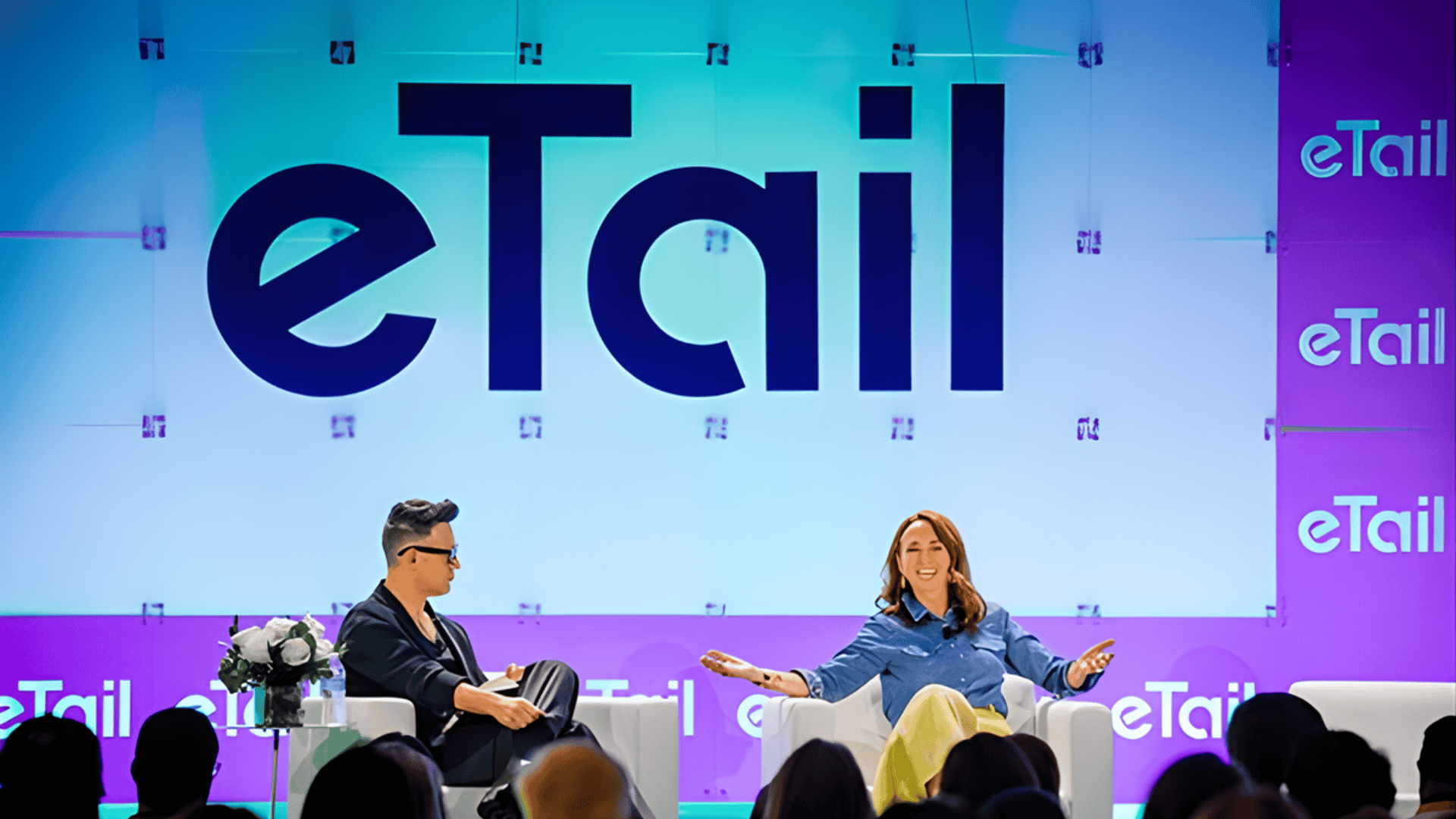
Future Commerce's event recap captured the new mood well: less theory, more proof, and a growing belief that AI has started doing real operational work.
Trust replaced novelty as the hard problem
If there was a single word that kept surfacing beneath the enthusiasm, it was trust.
That was especially visible in high-consideration categories. Furniture.com's AI-powered discovery experience became a useful example of where the conversation is headed. In categories where shoppers need help comparing trade-offs, understanding fit, and justifying a major purchase, an AI layer only helps if it makes the buying process more legible. If it cannot explain why a recommendation surfaced, the system scales confusion instead of confidence.
This is an important lesson for anyone thinking about agentic commerce. The problem is not simply whether an agent can take an action. The problem is whether the brand has built a shopping environment where the action feels accountable. Explainability, visible fallback paths, and clean product context are not secondary details. They are part of the product.

Furniture.com's launch around the event illustrated the trust problem clearly: conversational discovery only works when comparison, context, and checkout are still understandable to the shopper.
That point also helps explain why so many conversations at eTail came back to first-party data and owned channels. Brands cannot responsibly automate a relationship they do not understand. The better the underlying customer context, the easier it becomes to let systems act with confidence instead of guesswork.
Macro pressure turned AI into a margin conversation
Another reason the event felt more grounded is that the macro backdrop gave retailers very little patience for vague transformation language. Between acquisition volatility, margin pressure, organizational fatigue, and a broader sense that retail teams have already endured several years of nonstop tool churn, AI had to be framed as an operating lever rather than a futuristic aspiration.
That is why conversations about search volatility, direct audience ownership, and lifecycle efficiency felt so central. Vendors were increasingly pitching AI in the language of cost control, conversion quality, and resilience. The subtext was hard to miss: brands that depend on rented reach and fragmented data are going to struggle if autonomous systems become a more important layer in discovery and purchase flow.
Even the sessions around social commerce and community pointed in the same direction. TikTok Shop, live commerce, and creator-led demand were not being treated as side projects. They were being treated as environments where brand signal, audience trust, and operational readiness either reinforce each other or break down quickly.
What eTail West 2026 means for agentic commerce
For people tracking zero-click and agent-driven retail, eTail West 2026 offered a more pragmatic read on where the market is actually moving.
- Retail teams are ready to automate narrow workflows before they automate full journeys. The near-term wins are in bounded systems with clear success metrics.
- Trust is becoming the gating variable. Brands will not earn the right to let agents act unless recommendations, prices, policies, and fallback logic are transparent.
- First-party data is turning into agent infrastructure. Clean consented data is what lets brands move from generic AI usage to confident AI action.
- Measurement is shifting upward. The language around clicks and engagement is giving way to conversations about margin, customer lifetime value, and decision speed.
That last point may be the most important. Once AI moves from assistant to operator, the standard dashboard stops being enough. Brands need instrumentation that can evaluate whether automated decisions improve the economics of the business, not just the activity level of the campaign.
What retail teams should do next
If your team is using eTail West 2026 as a signal for what to do over the next two quarters, the strongest next steps are not exotic.
- Choose one workflow to delegate. Pick a narrow operating loop in lifecycle, merchandising, or support and make the success metric explicit.
- Audit the trust layer. Review whether your product data, pricing logic, policies, and recommendation context are understandable enough for both humans and agents.
- Tighten first-party data foundations. Improve consent, identity quality, and event cleanliness before you scale more autonomous systems.
- Rework measurement around business outcomes. Tie AI programs to lifetime value, conversion quality, margin protection, or labor compression rather than isolated engagement metrics.
- Prepare the site for machine-mediated discovery. Our guides on AI-powered buying readiness and earning recommendations from agentic AI are a practical place to start.
That is what made eTail West 2026 feel significant. The event did not prove that retailers have solved agentic commerce. It proved that serious operators have stopped treating it as a thought experiment. The new question is not whether agents will influence commerce. It is which brands are building the data, trust, and operating discipline required to let them act.
Frequently Asked Questions
What was the biggest AI theme at eTail West 2026?
The biggest theme was delegation. Retail teams were less focused on generic personalization and more focused on letting AI manage bounded workflows in lifecycle marketing, merchandising, and operations.
Why does eTail West 2026 matter for agentic commerce?
It showed that mainstream retail operators are starting to think about AI as a decision-making layer inside commerce, not just a content or analytics assistant. That is a meaningful step toward real agentic commerce.
What did the event signal about trust in retail AI?
Trust emerged as the hard constraint. Explainable recommendations, transparent policies, and visible fallback paths are becoming prerequisites for letting AI guide or automate more of the purchase journey.
What should brands do after eTail West 2026?
Start with one measurable workflow, improve first-party data quality, and make sure your site, product information, and policies are understandable enough for both shoppers and AI systems.
References & Further Reading
[1] What Changed in Retail Between eTail Palm Springs 2025 and 2026 - ClickZ
[2] Consolidation Is Power: Insights from eTail Palm Springs - Future Commerce
[3] Furniture.com streamlines consumer experience in latest evolution - Furniture Today
[4] Furniture.com launches AI-powered discovery platform - Digital Commerce 360
[5] eTail West 2026 event page - Pushly
[6] eTail Palm Springs 2026: Scaling Retail Innovation - RETHINK Retail
Continue Exploring
Event Page
Browse the event profile for dates, topics, and speaker context.
Prepare Your Retail Site for AI-Powered Buying
A practical checklist for making PDPs, policies, and checkout flows easier for AI systems to interpret.
How to Get Agentic AI to Recommend Your Ecommerce Site
A deeper look at the content, trust signals, and data structure AI systems use when recommending brands.