
The Protocol Hype Gap: How to Evaluate Agentic-Commerce Standards
Agentic-commerce protocols are real infrastructure efforts, but the market is moving faster than the operational evidence. This guide gives commerce and technology teams a practical way to distinguish a specification, an integration, and a merchant-ready capability before committing budget or making customer-facing promises.
Agentic commerce has acquired an unusually dense vocabulary unusually quickly: UCP, ACP, MCP, A2A, payment tokens, agent authorization, catalog APIs, direct buying, in-context checkout. Most of these terms describe real technical work. The problem is not that the protocols are imaginary. The problem is that an announcement, a public specification, a partner logo, and a merchant-ready production path are often discussed as if they mean the same thing.
They do not.
A protocol can be well designed and still lack production integrations. A platform can announce an integration that only a subset of merchants can access. A merchant can technically connect but still fail the operational test because inventory, return policies, authorization, support, or reconciliation are not ready. The gap between those stages is where most “we’re ready for agentic commerce” claims become unreliable.
The rule of thumb
Do not ask whether a protocol exists. Ask which capability is specified, which partner has implemented it, which merchants can enable it, what a buyer can do today, and who resolves the exceptions when the agent gets it wrong.
The three maturity states to separate
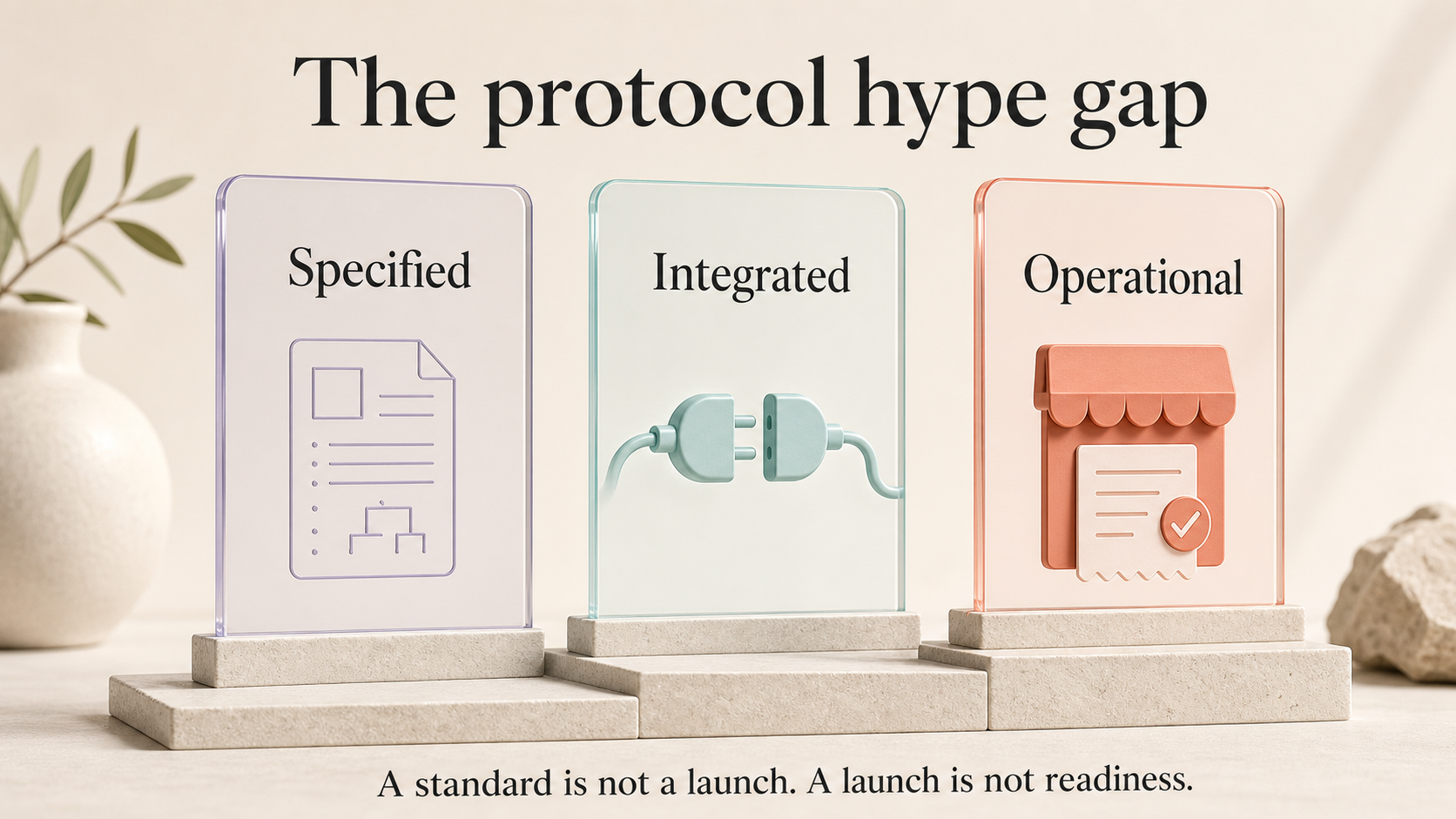
The visual above is not a scorecard. It is a discipline for avoiding category errors.
| Maturity state | What it means | What it does not prove |
|---|---|---|
| Specified | The technical model, messages, capabilities, or interfaces are documented. | That a consumer can use it, that a platform has deployed it, or that merchants are eligible. |
| Integrated | At least one platform and commerce system have connected a defined capability. | That the flow is broadly available, commercially complete, or reliable across merchants. |
| Operational | Eligible merchants can run a real buyer journey with support, monitoring, and exception handling. | That the protocol is universal, mature in every market, or the best route for every merchant. |
This distinction is particularly useful for UCP and ACP. UCP has a public specification and documented building blocks for commerce interoperability. ACP has Stripe documentation for in-context selling on AI agents, but Stripe labels its agentic-commerce offering private preview. Google’s UCP materials describe direct buying in AI Mode and Gemini, but also tell merchants to join a waitlist. These are not shortcomings; they are accurate signs of different maturity states. The mistake is presenting one stage as another.
The fake-urgency test: when a standard becomes a sales deadline
The protocol hype gap is often monetized as fake urgency. An agency takes a legitimate early signal—a public specification, an ecosystem announcement, a partner logo, or a limited preview—and recasts it as a deadline: implement immediately or become invisible to every AI shopper. That conclusion does not follow from the evidence.
A standard can matter strategically long before it creates a near-term implementation obligation. The right response is to monitor it, map it to your buyer journeys, and close foundational data and operational gaps that will be useful across channels. The wrong response is to buy a rushed "UCP package" when the seller cannot identify the eligible surface, the capability being enabled, the merchant prerequisites, the buyer approval path, or the live test that proves it works.
Use five questions to puncture fake urgency: Which protocol version and capability are in scope? Which named platform is live for our merchant profile? What buyer journey works today? What is the rollback or support path? What independent evidence shows a completed merchant flow? If those answers are vague, the mandate is marketing—not a launch plan.
There is one constructive form of urgency: fix the reusable foundations. Accurate catalog data, clear policies, authorization rules, order operations, and support workflows are valuable whether a specific protocol matures this quarter or next year. Treat them as no-regret readiness work, not proof that a vendor’s implementation claim is production-ready.
Step 1: Start with the buyer journey, not the protocol name
Before reviewing a standard, write down the exact journey you want to support. “Agentic commerce” is too broad to evaluate. A useful journey has an actor, a task, an authorization model, an offer, a transaction, and an exception path.
- Discovery only: an agent retrieves and compares products, then sends the shopper to a merchant site.
- Cart creation: an agent builds or updates a cart but the customer completes payment on the merchant storefront.
- In-context checkout: a buyer completes payment without leaving the AI surface, subject to merchant and payment-provider support.
- Delegated buying: an agent acts within pre-approved constraints such as price, merchant, category, or required buyer confirmation.
- Post-purchase support: order status, returns, substitutions, receipts, and service tasks survive the handoff.
Each journey needs different capabilities. A protocol that supports catalog discovery is not automatically a solution for payment authorization. A secure payment token is not a substitute for accurate product data. A checkout API does not tell a merchant how to handle returns created by an agent. When a vendor says it “supports UCP” or “is ACP-ready,” ask which journey is actually in scope.
Step 2: Check the specification for the capability you need
A serious protocol assessment begins with source material, not a partner announcement. Read the official specification, developer documentation, version notes, and capability definitions. Look for the pieces that correspond to your buyer journey: discovery, cart, checkout, order, authentication, payment, cancellation, return, and post-purchase state.
UCP’s public documentation describes a common language and functional primitives for commerce entities, while its specifications and developer materials break capabilities into defined services and bindings. Shopify’s UCP-compatible documentation, for example, distinguishes Catalog, Cart, and Checkout MCP capabilities. Its Checkout MCP documentation also says requests require authentication or a signed request and describes a handoff to the merchant storefront when buyer review is needed.
That level of specificity is useful because it tells you what to test. It also tells you what not to assume. If a capability is described as a handoff, do not market it internally as unattended checkout. If authentication is required, identify who issues it, how it expires, and what happens when it fails. If the specification has multiple transports or optional extensions, verify what each partner actually supports.
Step 3: Treat partner lists as discovery leads, not deployment proof
Partner ecosystems are valuable. They show that a standard has attracted interest across commerce platforms, retailers, payment providers, and AI interfaces. But a logo can mean many things: co-development, a signed memorandum, a limited pilot, an announced roadmap, a completed integration, or production use for a specific capability. These are materially different claims.
Use a simple evidence hierarchy:
- Marketing announcement: the company says it intends to participate.
- Public documentation: a developer or merchant guide explains a named capability, restrictions, and setup.
- Availability criteria: the company states which merchants, countries, plans, products, or payment methods are eligible.
- Live test: a merchant can execute an end-to-end test with a real product and a real buyer approval path.
- Operational evidence: the merchant can monitor orders, reconcile payments, handle changes, and support customers at a known service level.
Do not skip from step one to step five. An early announcement can be strategically important while still being operationally irrelevant to your business this quarter. Honest maturity labeling protects both engineering teams and commercial teams from building a roadmap around a capability they cannot yet enable.
Step 4: Run the merchant-readiness audit
Protocols reduce integration friction; they do not remove merchant obligations. Before enabling any agentic-commerce path, audit the operating conditions below. The answer should be evidence, not optimism.
| Readiness area | Questions to answer | Evidence to collect |
|---|---|---|
| Catalog truth | Are product attributes, variants, price, inventory, and availability current and machine-readable? | Sample API or feed responses for priority SKUs; a process for correcting errors. |
| Offer and policy | Can an agent explain shipping, taxes, returns, warranty, exclusions, and delivery timing? | Linked policies, structured fields, and test prompts with correct answers. |
| Authorization | Who approves the purchase? What limits, review steps, and merchant restrictions apply? | Documented approval rules, token scope, expiry, and failure behavior. |
| Checkout and payment | Can the buyer complete the intended payment path in the eligible market? | Successful sandbox or live test, including errors and fallback. |
| Order operations | Does the order enter the normal OMS, inventory, fulfillment, and support workflow? | Order records, fulfilment events, cancellation handling, and reconciliation reports. |
| Customer care | Who owns a wrong item, duplicate order, return, or unauthorized action? | Named owner, escalation path, customer copy, and support training. |
Step 5: Score claims on a capability matrix
Build a small capability matrix for every vendor or platform you are evaluating. Give each row one of four statuses: not documented, documented, pilot or limited availability, or live for our merchant profile. This avoids the false comfort of a single “protocol-ready” label.
| Capability | Evidence needed before calling it live |
|---|---|
| Product discovery | Real products surface correctly for representative tasks, with accurate price and availability. |
| Cart creation | A test cart preserves variants, quantity, price, delivery, and applicable offers. |
| Checkout | A buyer can complete the permitted payment and approval path in an eligible market. |
| Order lifecycle | The merchant sees the order, can fulfill it, and can communicate status and changes. |
| Returns and cancellations | The handling path works without forcing the customer into a dead-end between agent and merchant. |
| Measurement | The merchant can identify the surface, order, refunds, and support cost well enough to assess quality. |
The matrix often reveals the actual gap. A company may be ready for discovery and cart creation, cautious for checkout, and unprepared for returns. That is not failure. It is a responsible basis for sequencing a launch.
Step 6: Choose a launch scope that matches your evidence
The safest early deployment is usually narrower than the most exciting announcement. Start with a category that has stable inventory, clear product attributes, simple delivery rules, low fraud exposure, and low return complexity. Keep a buyer-review step for purchases that need it. Avoid using a protocol pilot as the first place to test a new pricing system, ambiguous product data, international tax edge cases, or a high-touch service promise.
Define the fallback before launch. If an agent cannot verify stock, it should not improvise. If authorization fails, the buyer should have a clear review path. If the merchant cannot support a post-purchase change through the agent surface, the customer should be handed to a known channel with full order context. An elegant protocol flow is not a replacement for operational recovery.
What to say internally—and what not to say
Use precise language. It builds credibility and makes teams more likely to surface risks early.
- Say: “We have reviewed the UCP checkout capability and are testing it for a defined buyer-review journey.”
- Do not say: “We are UCP-ready,” unless you can name the eligible merchant profile, surfaces, capabilities, markets, and operational controls.
- Say: “Our payment partner’s agentic-commerce offering is private preview; we are assessing fit and availability.”
- Do not say: “Agents can now buy from us everywhere.”
- Say: “Our catalog is structured enough for a discovery pilot, but returns and post-purchase support remain outside scope.”
- Do not say: “The protocol handles the customer experience.”
The bottom line
The protocol hype gap is not a reason to ignore UCP, ACP, or other standards. It is a reason to evaluate them with more discipline. Standards are how fragmented systems become interoperable. They deserve attention precisely because they can lower the cost of future distribution and transaction support.
But a protocol is a capability framework, not a finished merchant operation. Separate what is specified from what is integrated, and what is integrated from what you can operate for real customers. The teams that make those distinctions now will move faster later—because they will know exactly what has to be true before an agent is allowed to buy.
Frequently Asked Questions
Does a public protocol specification mean merchants can use it today?
No. A public specification proves that interfaces and capabilities have been defined. Merchant use still depends on platform implementation, eligibility, country and payment support, merchant configuration, and operational readiness.
What is the fastest way to test whether a protocol claim is real for our business?
Choose one representative buyer journey and request the setup documentation, eligibility rules, test credentials, expected order records, and support path. If you cannot execute and observe the flow end to end, classify it as documented or pilot—not operational.
Is UCP the same as ACP?
No. They are distinct agentic-commerce efforts with different ecosystems and technical approaches. Assess each by the buyer journey, integrations, availability, and controls relevant to your merchant operation rather than treating either acronym as a universal compatibility label.
What should merchants prepare before enabling agentic checkout?
Start with accurate catalog data, clear delivery and return policies, a defined authorization model, an eligible payment and checkout path, order reconciliation, and a support plan for errors, cancellations, and returns.
References & Further Reading
[1] What Is the Universal Commerce Protocol (UCP)? An Open Standard for Agentic Shopping
[2] What Is the Agentic Commerce Protocol (ACP)? A Guide for Brands, Retailers, and Marketers
[3] The UCP Readiness Audit: A Technical Checklist for Making Your Storefront AI-Agent Compatible
[4] Reference Architecture for a UCP-Ready E-commerce Stack
[5] Why Agentic Commerce Needs a Neutral Infrastructure Layer
Continue Exploring
Shopify’s Agentic-Commerce Advantage Is Distribution, Not Just AI
How one merchant operation can reach multiple AI shopping surfaces—and the readiness work that remains.
The UCP Readiness Audit
A technical checklist for evaluating storefront compatibility with AI-agent commerce flows.
Amazon Is Building a Moat Around Agentic Shopping
A research briefing on the platform control points around discovery, checkout, and agent access.